Experienced leaders and younger cohorts bring complementary skillsets to bear on solving the climate crisis – a reality highlighted in the world's most youthful continent, Africa
Africa sits at the centre of a difficult climate paradox. It contributes less than 4% of global greenhouse-gas emissions, yet remains among the regions most exposed to climate impacts. In 2025, weather and climate-related events affected at least 13 million people across the continent and caused more than 3,000 reported deaths.
With nearly 60% of its population under the age of 25, Africa is also the world’s youngest continent. This raises a leadership question with respect to the climate crisis that deserves more attention: What becomes possible when generations lead together? Climate commitments taken today will shape economies, communities and ecosystems for decades. Yet leadership usually works on much shorter timelines. Senior leaders still hold most formal authority, while younger people are often engaged through consultations, youth forums or separate advisory spaces. These mechanisms can create great value, but representation alone is not intergenerational leadership.
Intergenerational leadership is not based on the assumption that younger people are inherently more visionary, or that older people are inherently resistant to change. It starts from a simpler premise: Different generations hold different forms of knowledge, experience and responsibility, and climate institutions are stronger when those perspectives are brought into decision-making together.
In practice, intergenerational leadership means moving beyond consultation towards joint ownership where younger and more experienced leaders help to set priorities, work together in technical and policy processes, share responsibility for implementation, and are accountable for the decisions they shape together.
No one is suggesting that young people should replace experienced leaders. It is that no generation has all the knowledge, capabilities or reach needed to navigate a challenge as complex and long-term as climate change.
Climate decisions look different across generations
The World Economic Forum’s Youth Pulse 2026: Insights From the Next Generation for a Changing World gives a useful picture of what younger people are seeing. Drawing on nearly 4,600 young people from 489 locations worldwide, the report shows respondents navigating climate risk alongside rising living costs, AI, changing labour markets and declining trust in institutions. Their perspectives, the report argues, provide a practical compass for leaders trying to understand a rapidly changing world. It also makes an important point that strategic foresight is inherently intergenerational. Understanding what lies ahead requires bringing together different experiences, time horizons and ways of interpreting change.
Experienced leaders bring institutional memory, technical knowledge, political judgement, networks and the authority to move decisions through governments, companies and other institutions. Younger leaders may be closer to emerging technologies, changing social expectations, community-level climate impacts and new forms of organizing. They also have a longer stake in whether decisions made today still work 20 or 30 years from now. Therefore, both generations have complementarities in knowledge, mindset, skills and experience for designing and delivering impact for the people and the planet. Neither set of strengths is enough on its own.
A young professional entering public service today may still be working when a 2050 climate target comes due. An experienced official may carry lessons from earlier droughts, failed projects or difficult negotiations that are not written in a strategy document. Intergenerational leadership brings those forms of knowledge into the same process. Bringing those perspectives together can broaden the range of signals leaders consider when thinking about possible futures.
From a seat at the table to shared leadership
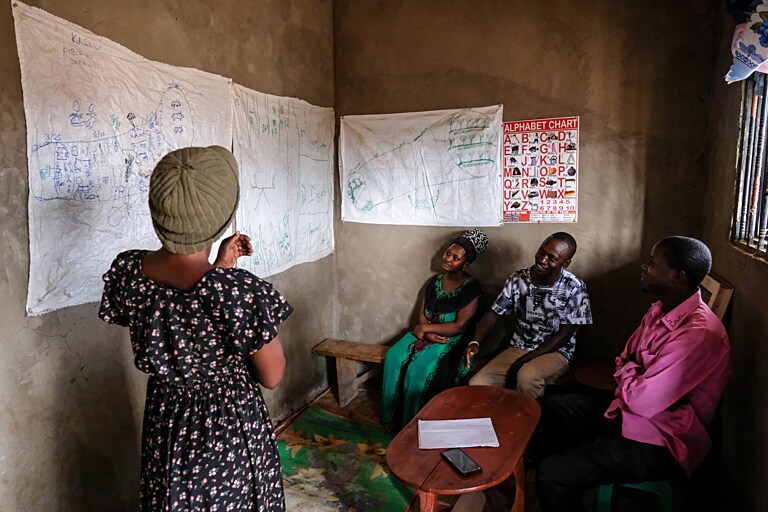
Emerging practice in Africa shows what this can mean. In Cameroon, the 2026 SOIF review From Promise to Practice highlights the Mbessa Indigenous Commission for Future Generations and Sustainability, which deliberately brings young people, adults and elders into the same collective body alongside community leaders and people with different expertise. Rather than creating a separate space for younger voices, it places generations within the same institution for thinking about long-term community development, food futures and environmental protection.
Kenya illustrates a complementary approach. Through the Kenya Senate Futures Caucus and participatory foresight work in Turkana, Marsabit and Nakuru, communities, public officials and other actors are using scenarios, futures dialogues and locally grounded knowledge to examine pastoral livelihoods, food systems and climate vulnerability.
Together, these examples point to an important distinction. Intergenerational leadership only begins with representation. It combines different generations and forms of knowledge with a longer view of the choices being made. Participation without that longer horizon can remain focused on immediate concerns; foresight without participation can become detached from lived realities. Effective leadership needs both.
A critical action juncture
The case for intergenerational leadership is especially timely as climate diplomacy shifts from commitments to implementation. COP31 in Antalya, from 9-20 November, is being framed as an “Implementation COP” and a “COP of the Future”, with greater focus on turning climate plans into tangible action.
For Africa, implementation is not only about finance and projects. It is also about leadership: deciding what to prioritize, where to invest and how today’s choices will hold up over decades. As COP31 moves the conversation towards delivery, governments, climate institutions and businesses should move beyond symbolic youth participation and build intergenerational leadership into the way decisions are made, implemented and reviewed.
The test should not simply be how many young people are in the room, but whether generations are genuinely shaping priorities, solutions and accountability together. Climate action is intergenerational by consequence. Leadership on that front should now become intergenerational by design and delivery.