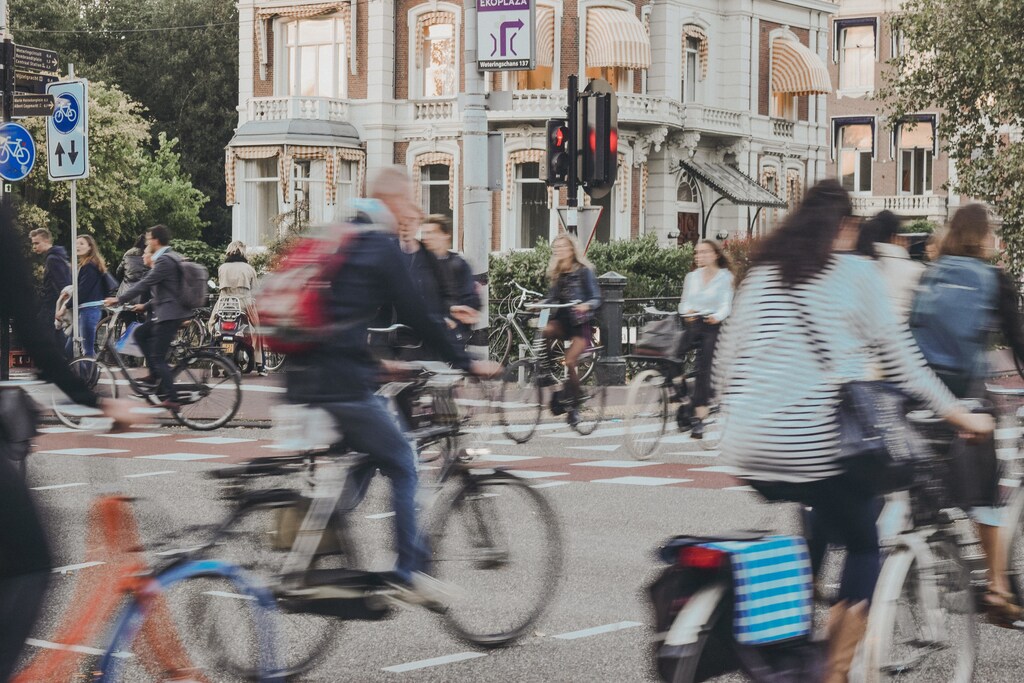
Digital insurance company Luko analyzed 90 cities across the globe to determine the most bicycle-friendly cities in its Global Bicycle Cities Index 2022.
The analysis was based on six indicators: the weather, bicycle usage, crime & safety, infrastructure, bike sharing opportunities and awareness events.
No American cities made it onto the top 10 roundup - San Francisco was the highest-ranked US city, ranking 39th.
The Dutch city of Utrecht has been named as the world’s most bicycle friendly city.
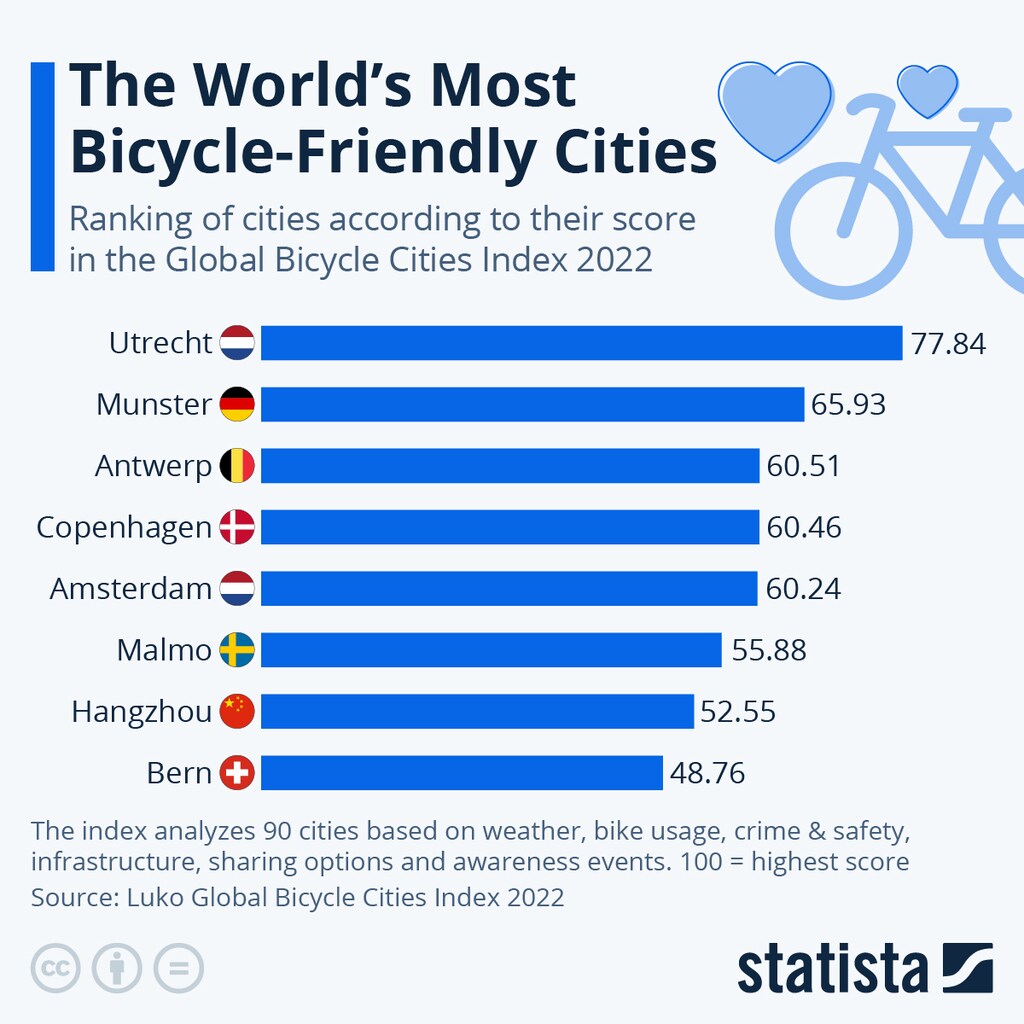
The Dutch city of Utrecht has been named as the world’s most bicycle friendly city by the Global Bicycle Cities Index 2022. The study, conducted by digital insurance company Luko, analyzed 90 cities across the globe, based on indicators grouped under six categories: the weather, bicycle usage, crime & safety, infrastructure, bike sharing opportunities and awareness events such as ‘No Car Day’. The final results are presented on a scale from 0 to 100, where the higher the score, the better the city. Utrecht is joined by eight other European cities in the top 10, with Hangzhou (China) the only non-European city in the top tier of the ranking.
As our chart shows, no American cities have made it onto the top 10 roundup, with San Francisco the highest-ranked U.S. city coming in at 39th place. Portland and Seattle are also among the top 50, in 41st and 50th respectively. U.S. metropolises aren’t known for being as bike-friendly as many of their European counterparts, where cycling for everyday transportation is more deeply ingrained in the culture.
How is the World Economic Forum promoting safer, cleaner and more inclusive transportation systems?
The World Economic Forum’s Platform for Shaping the Future of Mobility works across four industries: aerospace and drones; automotive and new mobility; aviation travel and tourism; and supply chain and transport. It aims to ensure that the future of mobility is safe, clean, and inclusive.
Through the Clean Skies for Tomorrow Coalition, more than 100 companies are working together to power global aviation with 10% sustainable aviation fuel by 2030.
In collaboration with UNICEF, the Forum developed a charter with leading shipping, airlines and logistics to support COVAX in delivering more than 1 billion COVID-19 vaccines to vulnerable communities worldwide.
The Road Freight Zero Project and P4G-Getting to Zero Coalition have led to outcomes demonstrating the rationale, costs and opportunities for accelerating the transition to zero emission freight.
The Medicine from the Sky initiative is using drones to deliver vaccines and medicine to remote areas in India, completing over 300 successful trials.
The Forum’s Target True Zero initiative is working to accelerate the deployment and scaling of zero emission aviation, leveraging electric and hydrogen flight technologies.
In collaboration with the City of Los Angeles, Federal Aviation Administration, and NASA, the Forum developed the Principles of the Urban Sky to help adopt Urban Air Mobility in cities worldwide.
The Forum led the development of the Space Sustainability Rating to incentivize and promote a more safe and sustainable approach to space mission management and debris mitigation in orbit.
The Circular Cars Initiative is informing the automotive circularity policy agenda, following the endorsement from European Commission and Zero Emission Vehicle Transition Council countries, and is now invited to support China’s policy roadmap.
The Moving India network is working with policymakers to advance electric vehicle manufacturing policies, ignite adoption of zero emission road freight vehicles, and finance the transition.
The Urban Mobility Scorecards initiative – led by the Forum’s Global New Mobility Coalition – is bringing together mobility operators and cities to benchmark the transition to sustainable urban mobility systems.
Contact us for more information on how to get involved.