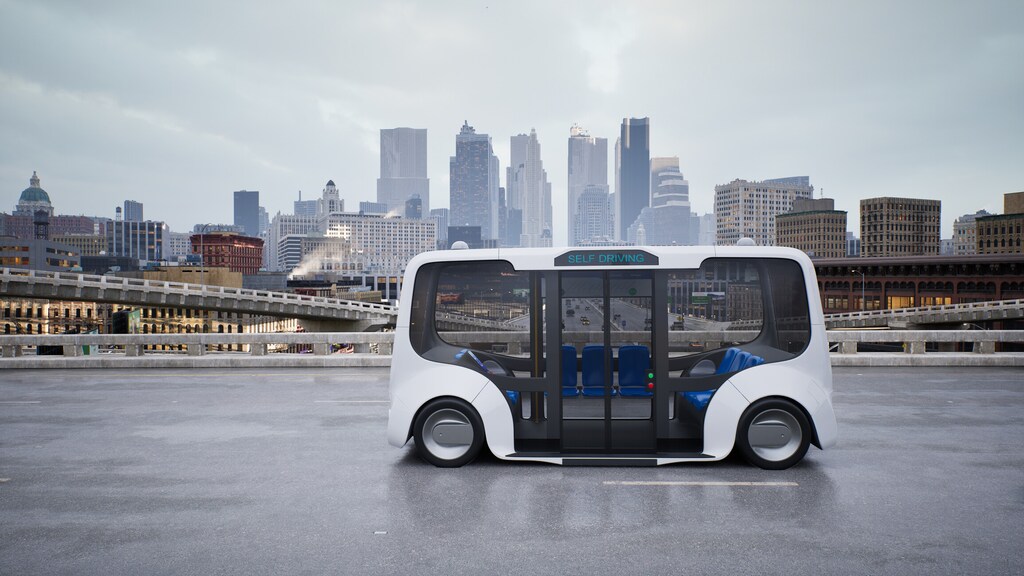
Autonomous vehicles (AVs) bring benefits such as reducing operational costs and providing mobility to those unable to drive or use public transport.
But simply replacing privately owned human-driven vehicles with AVs will only exacerbate existing transportation issues, such as congestion.
We advocate integrating AVs with public transport – the backbone of urban mobility systems – where the two can play complementary roles.
Autonomous vehicles (AVs) are at a critical juncture in their development.
They could bring immense benefits, including reducing the cost of operation, improving traffic safety and traffic management, and providing mobility and independence to people who are unable to drive or use public transport due to age, disability or other factors.
Yet there is considerable uncertainty about their impact. For example, the simplest path forward – replacing privately owned human-driven vehicles with privately owned AVs – will exacerbate existing transportation problems, such as increased traffic congestion, reduced urban livability and heightened mobility inequity.
How is the World Economic Forum promoting sustainable and inclusive mobility systems?
The World Economic Forum’s Platform for Shaping the Future of Mobility works across four industries: aerospace and drones; automotive and new mobility; aviation travel and tourism; and supply chain and transport. It aims to ensure that the future of mobility is safe, clean, and inclusive.
Through the Clean Skies for Tomorrow Coalition, more than 100 companies are working together to power global aviation with 10% sustainable aviation fuel by 2030.
In collaboration with UNICEF, the Forum developed a charter with leading shipping, airlines and logistics to support COVAX in delivering more than 1 billion COVID-19 vaccines to vulnerable communities worldwide.
The Road Freight Zero Project and P4G-Getting to Zero Coalition have led to outcomes demonstrating the rationale, costs and opportunities for accelerating the transition to zero emission freight.
The Medicine from the Sky initiative is using drones to deliver vaccines and medicine to remote areas in India, completing over 300 successful trials.
The Forum’s Target True Zero initiative is working to accelerate the deployment and scaling of zero emission aviation, leveraging electric and hydrogen flight technologies.
In collaboration with the City of Los Angeles, Federal Aviation Administration, and NASA, the Forum developed the Principles of the Urban Sky to help adopt Urban Air Mobility in cities worldwide.
The Forum led the development of the Space Sustainability Rating to incentivize and promote a more safe and sustainable approach to space mission management and debris mitigation in orbit.
The Circular Cars Initiative is informing the automotive circularity policy agenda, following the endorsement from European Commission and Zero Emission Vehicle Transition Council countries, and is now invited to support China’s policy roadmap.
The Moving India network is working with policymakers to advance electric vehicle manufacturing policies, ignite adoption of zero emission road freight vehicles, and finance the transition.
The Urban Mobility Scorecards initiative – led by the Forum’s Global New Mobility Coalition – is bringing together mobility operators and cities to benchmark the transition to sustainable urban mobility systems.
Contact us for more information on how to get involved.
How AVs will enhance or undermine urban mobility depends on four factors:
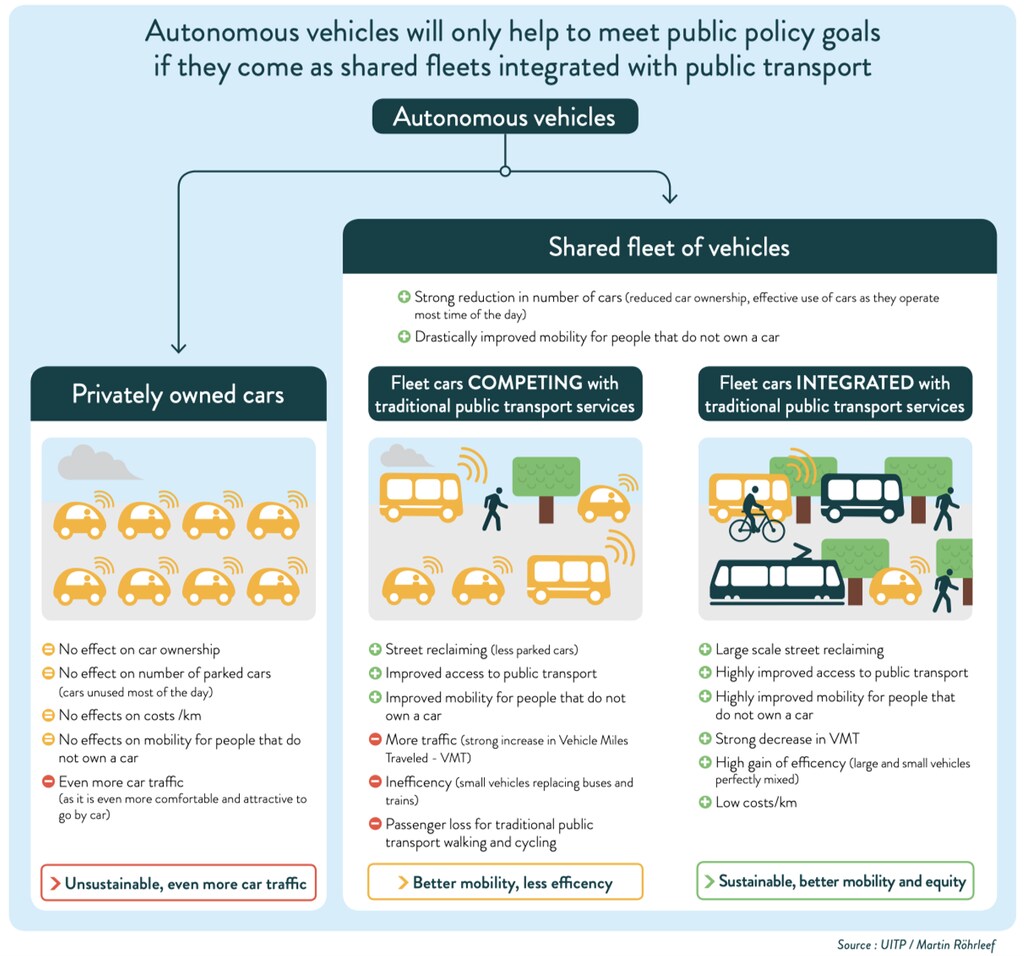
Whether we continue the private car ownership model or adopt a shared use model.
Whether AV deployment can be effectively coordinated with land use planning to avoid further urban sprawl, for example.
Whether AVs will operate under a rational, equitable pricing structure such as a surcharge on ghost vehicles.
Whether AVs will be integrated and coordinated with public transport (PT) systems. This blog focuses dives deeper into this aspect and highlights the benefits of a synergistic AV-PT deployment model.
Integrating AVs with public transport
We advocate for integrating AVs with public transport to create a synergistic AV-PT deployment model.
Public transport should remain the backbone of urban mobility systems as AVs and PT can play complementary roles: AVs offer direct, flexible and responsive service and PT provides high-capacity, space-efficient and scalable solutions.
Integrating AV and PT leverages the strengths of both systems to address diverse urban mobility needs. But we cannot take this complementary scenario for granted – AV and PT may very well turn out to be competitive, hurting both as a result.

There are opportunities in both regular services and special occasions. Regarding regular services, AVs can extend the reach of public transport by providing efficient first/last-mile solutions. Second, AVs can replace underperforming, low-productivity bus routes by offering on-demand, micro-transport options in low-density or rural areas. Third, integrated AV-PT systems allow for reconfiguring public transport network designs and service planning for greater efficiency. Increasing vehicle occupancy through AV-PT integration is the key.
Under special occasions, AVs can be swiftly mobilized to provide emergency transport services during major PT disruptions, and AVs can be allowed to use the bus priority lanes under specific conditions – for example, dynamic bus lanes usage without interfering with bus operation and only with high occupancy in the AVs.
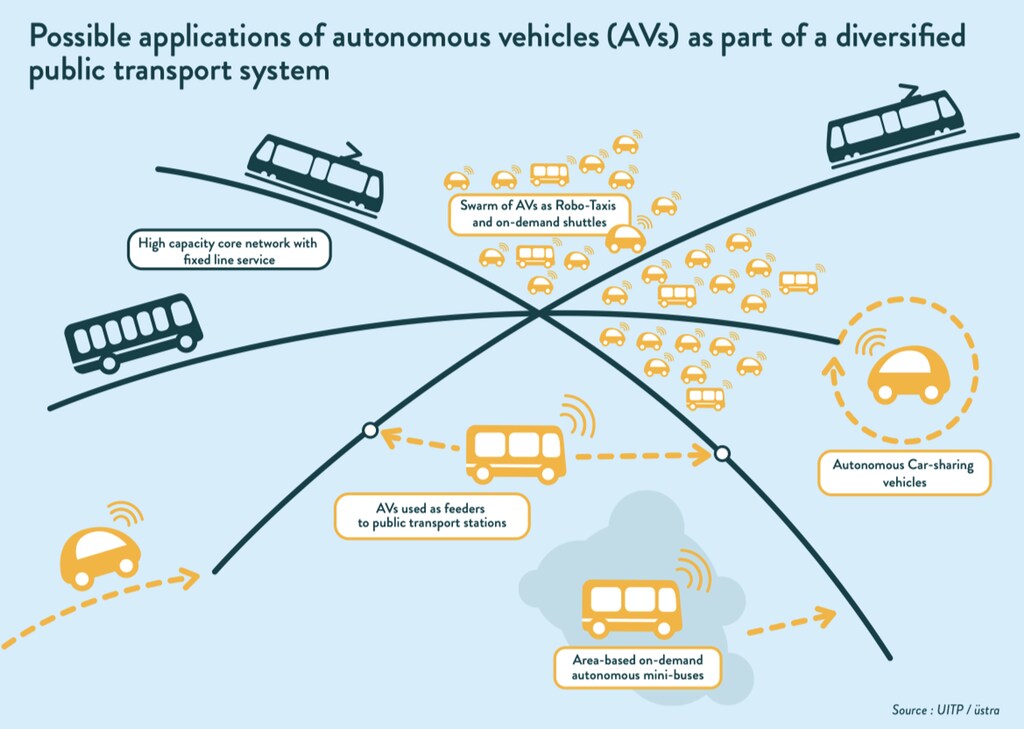
AV and PT integration requires five dimensions of joint design and implementation:
Information integration: unified data platforms enable seamless communication between AVs and PT
Pricing and ticketing integration: consolidated fare systems simplify access across AV and PT services
Operational and network integration: Coordinated network design, service planning, and operation control enhance efficiency and reliability
Business model integration: Collaborative business models across multiple service providers foster innovation and shared value
Regulation integration: harmonized regulatory frameworks, that is public and private mobility services, promote equitable and sustainable AV deployment
A pathway forward for urban mobility
There is a plethora of externalities that large-scale AV deployment without careful design may impose.
Without proper regulation, AVs could increase vehicle kilometres travelled (VKT) and exacerbate congestion. AV deployment could discourage walking and cycling, leading to a less active and healthy population. An unregulated AV market might weaken political and financial support for public transport. Plus, AVs could induce urban sprawl, further segregating urban populations and deepening mobility inequities.
Local governments possess regulatory tools to guide AV deployment and address these externalities. Example regulatory mechanisms include land use laws to ensure AV deployment aligns with sustainable land use practices, policing power to regulate AV operations to ensure safety and compliance, control over local streets to manage AV traffic to prevent congestion and maintain livability, data management power to govern the collection and use of data to protect privacy and optimize mobility services, and authority over public transport to effectively integrate AVs and PT.

Despite significant investment, the AV industry has yet to demonstrate clear social benefits – and integrated AV-PT deployment presents an opportunity to fulfill these goals.
By embedding AVs within a transport-centred urban mobility framework, the AV industry can unlock financial rewards while contributing to the urban mobility system.
Urban mobility stakeholders—including policy makers, public transport authorities, and the AV industry—must collaborate to design and implement an integrated AV-PT system to ensure that AV deployment enhances rather than detracts from the overall urban mobility objectives.
The public authority can tender mobility services to private AV operators through open competition, imposing efficiency, equity and sustainability criteria while providing regulatory and financial support to the mobility service industry.
By doing the above, we can help create improved urban mobility systems for cities that are more inclusive, environmentally friendly, and beneficial for residents.