
Amid slower growth and rapid AI disruption, Chinese firms are having to constantly reinvent themselves. Four critical transformation traps many of these firms have encountered – and the strategies that have helped some overcome them – offer vital lessons for global leaders in a polycrisis world.
Firms today are operating in a polycrisis world, simultaneously navigating slower growth, geopolitical fragmentation and AI disruption.
How should leaders build organizations capable of continuous transformation?
This question is front and centre in the minds of CEOs in China. Their early answers to this conundrum hold important lessons for the rest of the world.
After nearly three decades of expansion-driven growth, many Chinese companies are now operating in a radically changed environment. In 2024, the country’s retail consumption growth fell below GDP growth for the first time in 35 years (excluding the pandemic years 2020-2022). This gap remains even now. BCG’s Transform and Special Situations (TSS) Index shows roughly 30% of Chinese companies are under transformation pressure, with nearly a quarter facing more severe restructuring pressure.
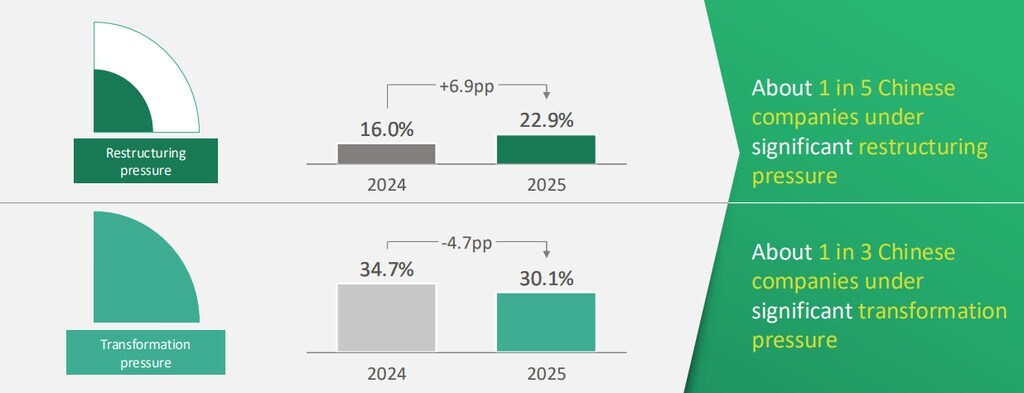
For the leadership at these firms, many of whom are first-generation Chinese entrepreneurs, the business environment is markedly different than what they are used to. They built their judgement over three decades of uninterrupted high growth, where certain assumptions about markets, resources and trade-offs reliably held true. The instincts it produced, however well-earned, are increasingly being tested by conditions they were not designed for. Against this internal and external backdrop, Chinese businesses are being forced to transform on multiple fronts at once. They are expected to reinvent growth, improve productivity, accelerate digitalization, redesign organizations and strengthen resilience all at the same time. All these entail large-scale transformations.
However, as firms undertake them, there are four distinct traps they need to be aware of.
Four transformation traps – and how to avoid them
Trap 1: Assuming alignment rather than engineering it
Many transformation efforts fail because leadership teams remain only superficially aligned on what their ambitions mean in practice. Executives may agree on becoming more customer-centric or innovation-led, while holding very different assumptions about what either of these entail. This dissonance is exacerbated in Eastern corporate cultures where hierarchy often stifles open disagreement or debate, creating agreement at the slogan level, but variance at the execution level.
How to avoid it: Alignment must be engineered, not assumed. Leading companies address low-quality strategic alignment by institutionalizing consensus and embedding priorities into operating routines, KPIs, talent decisions and managerial accountabilities.
For example, at one Chinese automotive company, the chief executive, finance leader and strategy leader operated through a tightly managed transformation forum with shared ownership of outcomes. Rather than managing strategic direction, financial discipline and execution cadence separately, they integrated them into a single operating rhythm – making alignment operationally concrete instead of aspirational.
Trap 2: Prioritizing speed over absorptive capacity
Chinese firms are renowned for operating at enviable speeds, but speed alone is not enough during a major transformation. Many organizations still treat change as a sprint, launching multiple initiatives simultaneously. But every organization has limits to how much disruption it can absorb at once. When transformation exceeds that absorptive capacity, execution often deteriorates. Employees become overloaded, compliance turns formal, and day-to-day operations lose focus.
How to avoid it: Plan deliberately, then move fast. Insufficient planning before execution often hampers transformation, so some of the most effective companies manage transformation as a sequencing challenge. Rather than attempting enterprise-wide reinvention immediately, they use pilots to build confidence and refine operating routines before scaling.
For example, a multi-category retailer used a small number of model stores to test new ways of working before expanding them across its network. Early results helped build confidence, while lessons from the pilots made the wider rollout faster and more sustainable, generating practical capabilities and frontline confidence that allowed the transformation to scale smoothly over time.
Trap 3: Neglecting organizational redesign
Every transformation reshapes power, routines and identity inside the organization. As a result, resistance often emerges in the middle layers, where managers are expected to translate strategic priorities into day-to-day execution while adapting to new structures, roles and ways of working. This makes transformation a human and organizational system challenge. Under these conditions, organizational clarity, managerial trust and employee engagement become critical determinants of execution quality.
How to avoid it: Bring people into the redesign. Change management is a critical and often neglected element of transformation – managing morale, achieving early wins and maintaining organizational confidence are vital to success.
For example, a food company experienced a sharp deterioration in frontline engagement during a difficult transformation period. Performance stabilized only after the company reset managerial expectations, involved employees in redesign workshops, clarified decision rights and aligned operating routines more closely with the evolving business model.
Trap 4: Treating transformation as a one-off project
When change is constant, rather than episodic, transformation can no longer rely solely on one-off programmes driven by a central taskforce. Companies need institutional capabilities for continuous adaptation. They need to embed transformation into the management system itself – through clear governance, shared metrics and rapid feedback loops. Absent this, every transformation exercise will need to start from scratch, thrusting the firm into the traps described above multiple times.
How to avoid it: Make transformation a permanent discipline. Key transformation priorities include pursuing new growth models rather than competing solely on price, requiring firms to embed transformation into their operating model as an ongoing discipline rather than a temporary intervention.
For example, a medical technology company built a multi-layer governance system linking senior sponsors, a full-time transformation office and high-potential managers to shared transformation KPIs. By tying accountability, progress tracking and talent development together, the company made transformation part of the management system rather than a parallel initiative.
What China’s playbook means for global leaders
What looks today like a China story is, in fact, an early chapter of a much longer global one. The forces that are pressing on Chinese companies – slower growth, intensifying competition, technological disruption – are the same ones beginning to reshape businesses everywhere. The four traps described here are not, therefore, unique to any one market.
Management assumptions built during decades of globalization and expansion might not hold true anymore. China’s corporate sector is simply the first to operate at scale under these conditions, offering important signals for global business leaders.
In a world where the gap between shock and response keeps narrowing, competitive advantage will depend less on whether companies can design the right strategy once, and more on whether they can realign leadership teams, organizations and operating models continuously as conditions change.