A blueprint for plastics action: 3 lessons from the Montreal Protocol
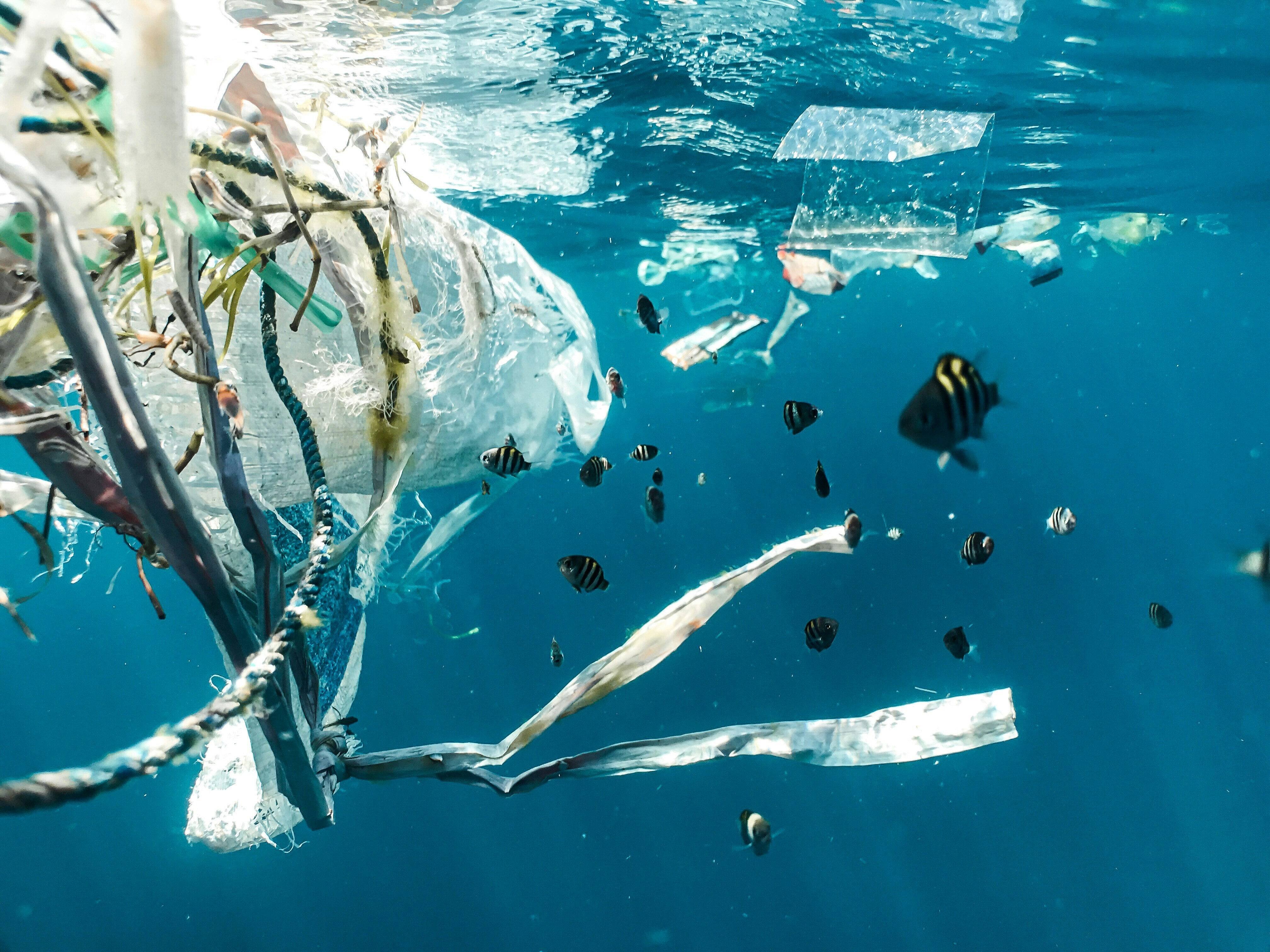
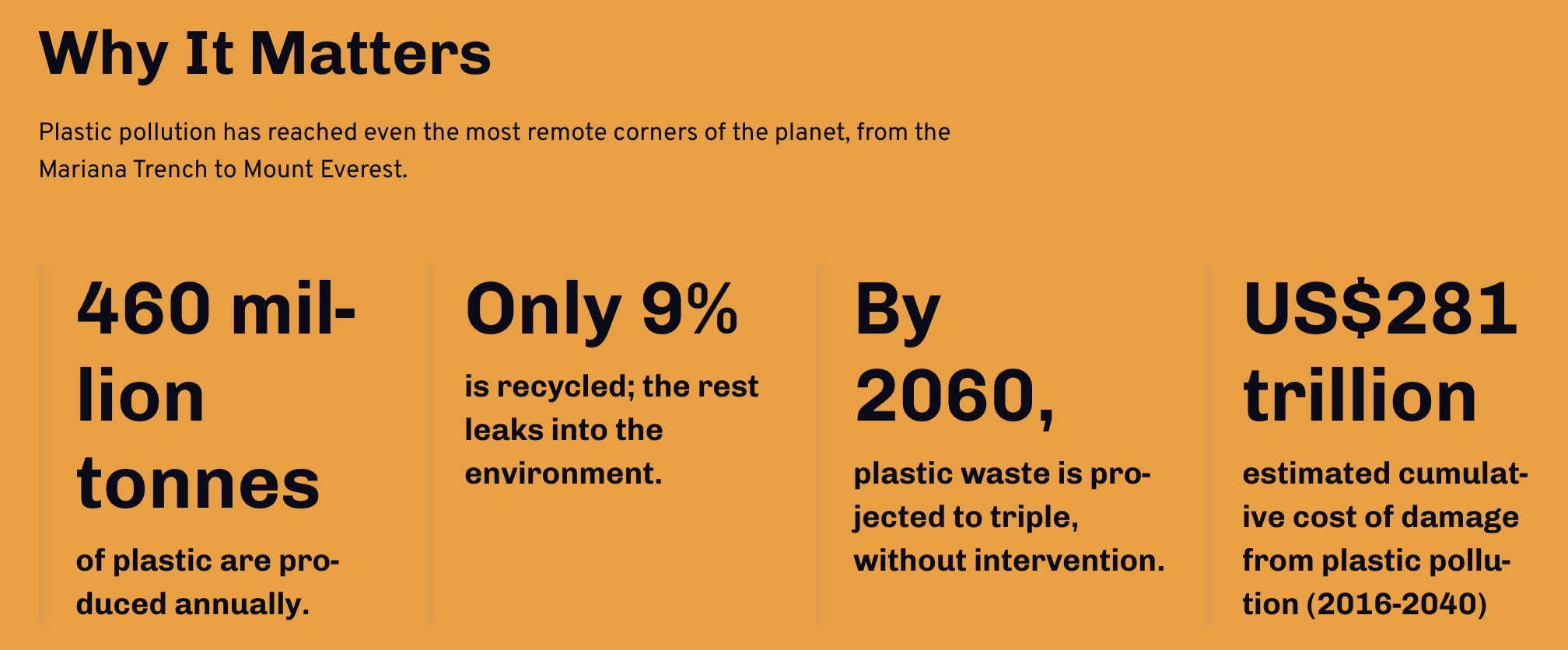
The world produces 460 million tonnes of plastic each year, yet only 9% of plastic is recycled. Image: Naja Bertolt Jensen/Unsplash
Philippine de T'Serclaes
Chief Sustainability Officer; Chief Executive Officer, Sustainability Business and Board Member, Dassault Systèmes- Efforts towards global alignment on plastics have fallen short, with last year's Global Plastics Treaty talks failing to reach agreement.
- This proved a stark contrast to the 1987 Montreal Protocol, which achieved consensus on phasing out ozone-depleting substances like CFCs.
- The Montreal Protocol successfully aligned politics, economics and technology in pursuit of a bigger goal – a lesson we can learn from to drive plastics action.
By the time you finish reading this article, more than 4,000 tonnes of new plastic will have been produced (the equivalent weight of 20 blue whales). However, less than 10% will be recycled.
For a problem of these dimensions, isolated actions do not suffice. As the Ellen MacArthur Foundation’s recent 2030 Plastics Agenda for Business highlights: “[Plastic] challenges are systemic because the solutions currently cost more, rely on widespread behaviour change, and/or require substantial coordinated action and collective investment.”
Global, collaborative, systemic change is much harder to implement than piecemeal, individual change, which is why the Global Plastics Treaty needs to happen if real progress is to be achieved.
The politics: from argument to alignment
It is however no walk in the park. Efforts towards global alignment on plastics management have fallen short so far. Last year’s talks in Geneva broke down over disagreements among nations wanting measures to curb production of plastics and oil-producing states that wanted any treaty to focus more narrowly on waste management.
It’s a stark contrast to the Montreal Protocol, the first universally ratified United Nations (UN) treaty in history. Key to its success was establishing a shared, science-based definition of 100 or so “ozone-depleting substances” that needed to be curbed. As a result, the ozone layer should return to pre-1980 levels by around 2075.
Collaboration at scale requires an alignment on fundamentals such as agreeing to recognize the harm caused by certain substances and then committing to phasing them out in a responsible manner. For instance, in May 2026, the Business Coalition for a Global Plastics Treaty released a set of policy recommendations. The first item was “agreement on an initial global list” of targeted plastics.
And to be effective any such list, in turn, needs to be based on credible science. The Global Plastics Policy Centre at the University of Portsmouth identified a critical lack of technical understanding as a key hurdle to effective discussion.
Here, science-backed artificial intelligence (AI) solutions powering virtual twins to create a single shared source of truth, can play a major role. Collaboration at scale relies on consensus around the science.
The economics: from penalization to pro-active incentivization
Any political agreement must incentivize real market change. The staggered transition timeline proposed by the Montreal Protocol recognized this, putting developed countries on a shorter transition timeline than developing ones. Those most responsible for pollution and most able to pay shouldered the initial burden. Then, as innovations were scaled and costs fell, the industry transitioned globally.
For plastics, the equivalent mechanism here is different but the concept remains the same. Extended producer responsibility (EPR) uses levers like taxes to shift the costs of plastic pollution away from end-users and towards producers.
EPR policies have seen widespread implementation. However, bodies like the Ellen MacArthur Foundation argue that current measures are failing to drive investment in higher-value solutions. We need measures that target circular outcomes beyond the point of sale, that directly incentivize circular design and recovery solutions.
For example, the foundation identifies re-use as a more valuable circular loop than recycling and has highlighted the importance of eco-modulation fees – i.e. you would be taxed less for something that is reusable than for something that is “merely” recyclable – as a driver. In other words, for the economics of a collaborative circular plastics economy to work, we must reward innovation, and penalize waste.
Appropriate regulations and tech-based solutions such as digital product passports, life cycle assessment and virtual twins can help accelerate the transition by enabling traceability, transparency and collaboration. These simplify how producers collect, rationalize and share product data, in turn enabling a more sophisticated compliance regime that targets circular innovation in more granular, proactive ways.
The technology: from standalone to scalability
The political and market successes of the Montreal Protocol would not have borne fruits without the existence of viable alternative products. So, chemists formulated alternatives to chlorofluorocarbons (CFCs). Refrigeration systems became more efficient. Satellite-based monitoring allowed us to better track and analyze atmospheric volumes of CFCs over time.
On the surface, there’s plenty of innovation going on in plastics. Companies like Tetra Pak and Hera are pioneering packaging alternatives based on plant fibers. Where plastic remains essential, advanced lightweighting means we use less of it.
Have you read?
Standalone technological fixes alone won’t be enough, however. Be it for products, processes, or business models, the ultimate test in innovation is scalability. And scalability will be difficult to achieve without the economic alignment. As long as the use of virgin plastics remains cheaper than recycled plastic, circularity will remain a luxury. Reducing cost and time-to-market on new innovations is critical.
It also means that the industry must become more standardized and that appropriate regulations and incentives need to be implemented, for products and infrastructure to become globally interoperable.
Technological limitations or varying regulatory regimes can mean that a formulation that is recyclable in one country, may not be recyclable in another.
For instance, within the United States, the State of Oregon notes that plastic bags, produce bags and plastic wrap – e.g., cling wrap, dry cleaner bags and the plastic packaging for toilet paper and paper towels – are not to be put in the household recycling bin.
Meanwhile, the State of California notes that products and packaging are considered “recyclable” in California only if they are accepted for collection by jurisdiction recycling programmes collectively serving at least 60% of the state’s population, among other criteria.
And the situation gets even more complex internationally, where regulatory focus, intent and enforcement may be very different in practice. For efforts to be effective, ecosystems must operate in harmony, not as fragmented siloes.
I recently wrote about Carbios, which is developing recycling products while simultaneously building ecosystems where those products can be deployed, and it’s likely that these kinds of collaborative initiatives will become more prominent (and thanks to digital collaboration solutions, more feasible) as we move forward.
Getting the circular economy turning for action on plastics
The Montreal Protocol sets a precedent of success in aligning politics, economics and technology in pursuit of a bigger goal. Sound policy results in smarter markets. Smart markets incentivize innovation, which broadens the horizon of possibility for policy-makers.
For example, improved monitoring technology could enable more detailed enforcement measures; expanded collection infrastructure could justify more ambitious circularity targets. It is a virtuous circle, where the whole industry from public institutions to private organizations and individual consumers, cooperate organically in a process of systemic change.
And if top-down efforts are struggling to get that virtuous circle turning, then we need to push from the bottom-up too. That’s something that really excites me: finding cutting edge ideas that could make a big difference and equipping the teams behind them with the tools and capabilities to take those ideas and commercially scale them.
Asking for bigger commitments on plastics action without providing the necessary tools is setting ourselves up for failure. Conversely, make change easy and you make change likely.
Don't miss any update on this topic
Create a free account and access your personalized content collection with our latest publications and analyses.
License and Republishing
World Economic Forum articles may be republished in accordance with the Creative Commons Attribution-NonCommercial-NoDerivatives 4.0 International Public License, and in accordance with our Terms of Use.
The views expressed in this article are those of the author alone and not the World Economic Forum.
Stay up to date:
Plastic Pollution
Related topics:


Forum Stories newsletter
Bringing you weekly curated insights and analysis on the global issues that matter.
More on Circular EconomySee all

James Pennington
September 21, 2026


