
Geoengineering could offer a temporary bridge to climate stability but responsible deployment requires extensive research, testing and investment. Public trust depends on transparent communication, community engagement and inclusive governance.
As we rapidly approach planetary tipping points in global temperatures, it is becoming increasingly likely that we may need to extend the time frame for decarbonization (the only lasting solution to climate change) with geoengineering strategies to stave off a catastrophic climate crisis.
Scientific knowledge suggests we can actively cool the planet with sulfate aerosols. However, safely and effectively developing and implementing these strategies would require close coordination among scientists, policymakers and the public to guide testing, planning, deployment and regulatory frameworks.
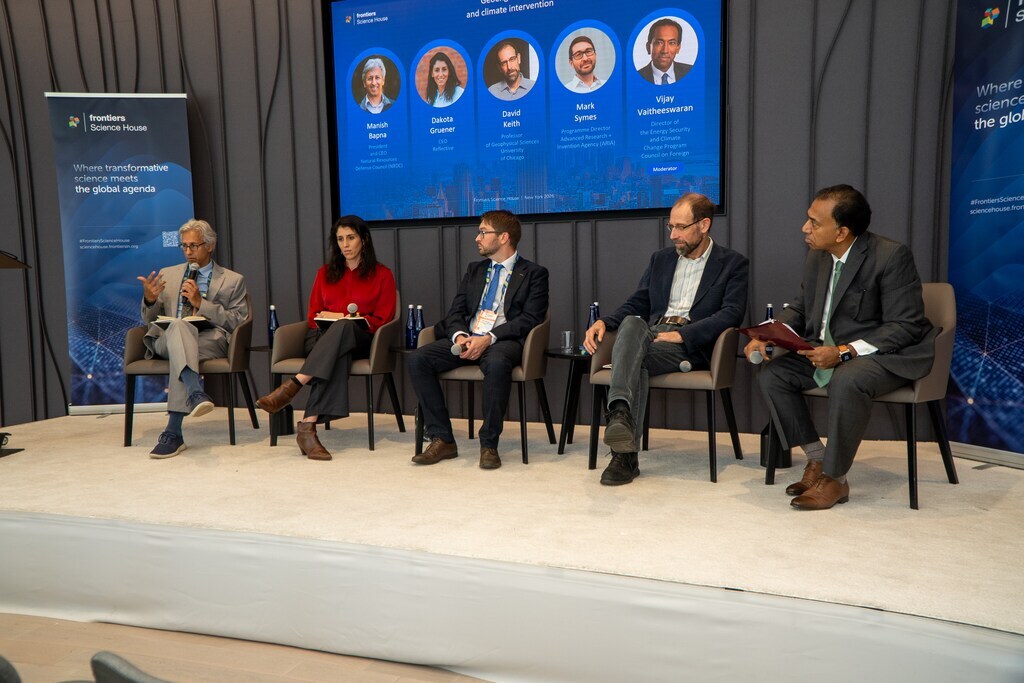
This was the subject of the Frontiers Science House New York event, which convened a panel with a variety of perspectives to discuss “Geoengineering and Climate Interventions” and how to embed science and scientists into these policy decisions.
The debate suggested a roadmap for engagement that must include scientists, policymakers and the public to enable timely actions that anticipate, mitigate and avert catastrophic global outcomes.
How do sulfate aerosols support climate intervention?
Science suggests that sulfate aerosols may provide a key geoengineering solution to combat global warming because they reflect incoming solar energy. Historically, major volcanic eruptions that ejected sulfur dioxide into the atmosphere have caused periods of global cooling, leading scientists to investigate these particles.
Their ability to scatter shortwave solar radiation, combined with their affordability, makes them a promising candidate for widespread deployment to offset the impacts of greenhouse gas emissions temporarily
“For sulfate aerosols we have so much knowledge; there are 15,000 papers dating back to the 1960s. There is a deep reservoir of science to assess the risks and they seem small compared to the benefits,” said panellist David Keith, professor of Geophysical Sciences at the University of Chicago.
However, considerable uncertainties remain about how to deploy them. Modelling, monitoring, and carefully controlled field experiments are critical to identify and avoid unintended consequences for the environment, public health, global economies and other sectors.
For example, releasing too much could block sunlight needed for crop production, reducing yields and unintentionally leading to food shortages.
Alternatively, releasing them at inappropriate altitudes could cause acid rain or deplete the ozone layer. This knowledge is essential to guide potential implementation strategies and provide credible cost-benefit and risk-benefit analyses.
“There are foundational questions that need answering. We want to ensure that when decisions are made, they are not made in the dark,” says panellist Dakota Gruener, CEO of Reflective, a non-profit research organization dedicated to proactive research and planning around solar geoengineering solutions.
In September 2026, the organization Reflective published a research roadmap to sulfate aerosol deployment. It states: “[We have outlined] what decisions we will face and for each, what work is required to inform that decision. What are the costs and timelines? How far away are we?”
Altogether, the report estimates that we are at least 10 years and $370 million away from informed deployment.
Given this timeline, now is the moment to invest in research and planning to develop science-based roadmaps for testing and implementation, to establish the appropriate scale, location, timing, logistics and safeguards.
This investment, at local and global scales, is essential to avoid panic-driven actions or rogue actors undertaking projects likely to cause unexpected complications or even catastrophes.
“The alternative is that we reach some crisis point and decision makers reach for something to solve that problem without scientific evidence. It’s much better to have evidence and know if something is a bad idea and what the impacts would be,” said panellist Mark Symes, programme director of Advanced Research + Invention Agency, a UK government-funded organization dedicated to climate risk management.
Why public trust is key to achieving successful geoengineering solutions
Not everyone supports such evidence gathering. Controversy and fear around geoengineering strategies are driving public and government pushback. Concerns are rising not only about large-scale deployment but also about small, controlled field experiments. Many people feel that even testing this approach is unsafe and could cause irreversible environmental damage.
In addition, some question the ability to contain these tests, with concerns that tests conducted in one region could significantly impact weather patterns, including natural disaster risks, in other areas that have not consented to these experiments.
“This issue is getting very quickly polarized and the middle is shrinking rapidly, which is worrisome,” says Bapna. Building public trust and informed consent around geoengineering research and governance is critical to its success. Otherwise, public resistance may undermine geoengineering efforts to save the planet and protect society.
“If we want to avoid geoengineering becoming more politicized there are lessons about what not to do from data centres and [artificial intelligence] that we need to reflect on,” said panelist Manish Bapna, president and CEO of the Natural Resources Defense Council.
The lessons to be learned here involve open communication, transparency and inclusivity.
“Public engagement and acceptance are non-negotiable in these experiments. Deployment timescales will not be governed by technical issues but by social issues.
“If the public is not on board, it’s never going to happen, regardless of how necessary it might be,” says Symes, indicating that local communities must be included in the process before field research is implemented to inspire curiosity, trust and support rather than scepticism.
“Trust will define the pace that this can move forward,” said Bapna. “We have seen in [the United States] already 70 bills passed aiming to slow or stop geoengineering. Creating the social and political systems to build public trust for this to be acceptable might be the even more difficult question we must grapple with.”
How we build the global governance framework for sound science policy
“The point of the research governance is precisely to stop research from becoming a political issue... It puts in place the guardrails to persuade people that research is safe and trustworthy, allowing us to collect the evidence that we need,” relayed Symes.
To that end, political systems will need a broad set of stakeholders, including scientists, communities and policymakers, to approach governance questions, initially through national and international governance frameworks for research and in particular, field studies, including standardized rules for testing, oversight and accountability. T
These foundations can then be built into deployment frameworks.
“Constructing an architecture that is inclusive and equitable and yet can move at the speed we need it to, is some of the hard work we need to do,” reflected Bapna.
Climate intervention is a paradigm of a science-policy challenge. The path to responsible geoengineering depends on generating evidence, earning public trust and creating transparent governance systems before climate emergencies force difficult decisions under crisis conditions.