
Our recently published research shows that 25% of the world’s data centres are sited in places with at least one month of water scarcity per year – and that could increase in a warming world. But there are ways to reduce water risk.
Almost all the electricity that an AI server draws in ends up as heat. And the cheapest way to remove that excess heat is to evaporate water – within both a data centre and the power plants that supply it.
In research published in Environmental Science & Technology, we mapped 9,347 data centres worldwide against monthly gaps between renewable water availability and consumption. One in four of these data centres is already located in a region with at least one month of water scarcity a year. And that could grow to one in three data centres as soon as the 2040s, amid a changing climate.
The numbers are already stark. Some 15% of the data centres we studied are in regions with five months or more of scarcity annually; 6% are in places with nine months or more. Duration matters. The impact of a particularly dry month can be lessened with stored water, but where gaps last five months or more that usually means drawing down groundwater and river flows. Data centres run around the clock – they cannot simply be paused in the midst of a drought.
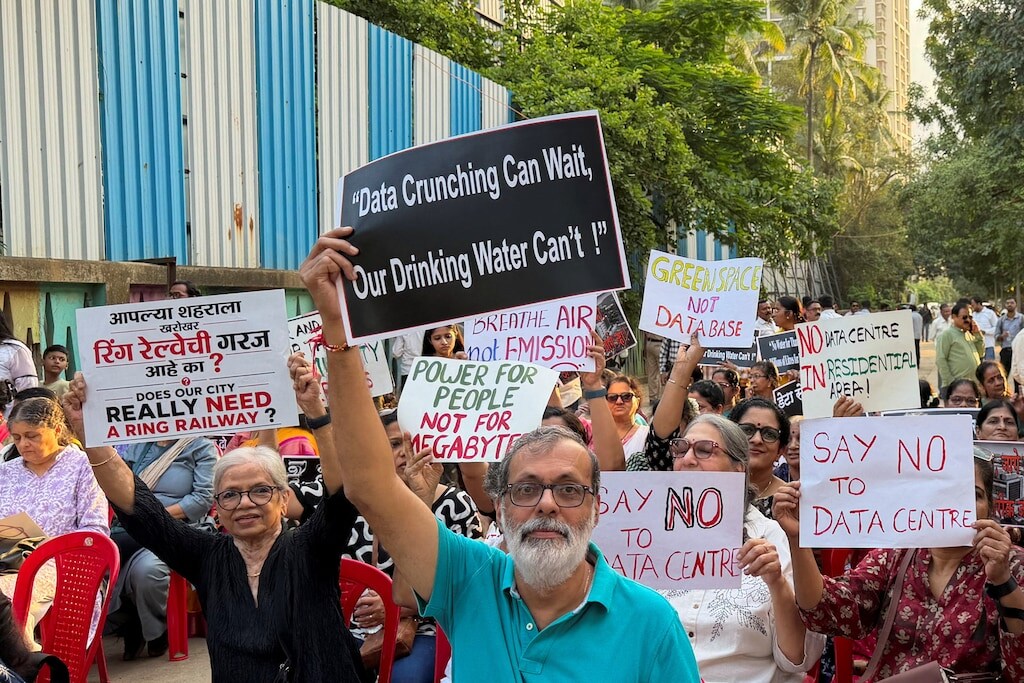
Such concerns around water use are fast becoming part of a wider backlash against data-centre expansion. In the US, 75 major data centre projects collectively worth about $130 billion were blocked or delayed amid organized local opposition in the first three months of 2026, often over water and power issues. In South Korea, 17 out of the 33 projects permitted were delayed by community opposition this year, according to a report by the World Economic Forum.
Globally, data centre investment could reach $7 trillion by 2030, according to the WEF’s report. That makes water-related siting decisions crucial.
The country furthest advanced in terms of buildout illustrates the issue. The US hosts 39% of the world's data centres, and slightly more than a fifth of those are located where water scarcity occurs at least one month a year. Some 14% are sited in places with five months or more of scarcity.
Just as striking is who data centres share their water with. Globally, 41% sit in basins where cities are the main water users, and 28% are in areas where that main user is agriculture. That raises important questions about how scarce water is allocated between data centres and neighbouring households, farmers and ecosystems.
Small globally, large locally
At a global scale, data centres' relative water consumption is still small. By 2030, their direct consumption is projected to reach about 1.2 billion cubic metres a year – still only about 0.1% of global consumption, and about 1/800th of what irrigated agriculture consumes.
But water shortages are local, not global. Data centres continue drawing it in dry months in specific basins, alongside nearby cities and farms.
Local impact can also be larger than a facility's meter suggests; an estimated 72% of water consumption occurs off-site. A data centre's overall water footprint falls into three parts:
On-site cooling. Evaporative cooling typically consumes one to three cubic metres of water per megawatt-hour of computing, and that is heaviest during hot months. Yet, it accounts for only 28% of water consumption across the data centre value chain.
Power. Roughly half of the water consumption in the data centre value chain goes into electricity generation. The International Energy Agency projects that data centre electricity demand will more than double between 2024 and 2030, to 945 terawatt-hours (about as much as Japan uses currently). Much of that extra power will come from thermal plants that need water for cooling. In earlier research, we found that 43% of global coal-fired capacity is already located in regions that endure water scarcity at least one month a year.
Chips. Manufacturing advanced semiconductors requires large volumes of ultrapure water – a single “fab” (factory) can use as much water as 33,000 US households. Also: 40% of existing fabs, and more than 40% of those now planned, are sited in watersheds projected to face high or extremely high water stress in the coming decades.
This means a facility reporting low on-site water use may still be drawing heavily on stressed basins through its power and chips.
Solutions that shift pressure
There are four main ways to cut water risk. However, each tends to move pressure elsewhere, instead of removing it entirely:
Siting in water-rich basins. Locating facilities where water is plentiful is the most powerful solution, though these kinds of places may lack grid capacity, fibre-optic links to internet hubs, or nearby customers.
Reusing wastewater. Treated wastewater can replace drinking water for cooling. But reuse is not a basin-scale fix; water recycled locally would otherwise have flowed downstream to other users and ecosystems.
Desalination. Seawater and salty wastewater from industries such as oil and gas can be treated and used to cool data centres, instead of fresh water. But desalination uses a lot of energy, and the concentrated brine it leaves behind must be disposed of without harming the environment.
Dry or hybrid cooling. Air-based and closed-loop systems can cut on-site water use dramatically. But they need electricity – and if that power is thermal, water demand moves back upstream.
From facility metrics to basin decisions
Data centres are viable for the long term only if surrounding energy and water systems can support them – and host communities trust them.
Putting that into practice requires a common way to judge when water is too scarce for water-intensive cooling. Some companies are already moving in this direction – Japan’s NEC screens sites at the river-basin level, according to the WEF’s report, assessing surface water, groundwater and drought history, and counting the water used to generate its electricity before it chooses a cooling technology.
A framework can be used to rank each basin by how many months a year demand (including for local ecosystems) exceeds renewable water supply – and rules can be set for each tier. Water consumed at a data centre and its supplying power plants could be counted together, so dry cooling that merely shifts the burden to the grid does not count as a saving. Chipmaking water, which is harder to trace to a single basin, could be reported – rather than tiered.
Water consumption and withdrawals should be reported monthly, across all three scopes. Non-potable water should be prioritized, water within the same basin should be replenished upstream of where it is consumed, and the cities, farmers and utilities sharing a basin should be consulted before a site is chosen.
Developers who adopt these principles early are likely to face fewer permitting fights – and keep their licence to operate. The WEF report estimates that sustainability and resilience measures could help unlock as much as $1 trillion in planned data centre investment by 2030, thanks to reduced delays and cancellations.
Data centre electricity demand is set to more than double by 2030, and much of the capacity needed to run AI has yet to be built. Each new facility will draw on the same rivers and aquifers for decades. If we properly treat siting as a decision about how to best share finite water among cities, farms, power plants and data centres, that quarter of all data centres now in water-stressed areas does not have to become a third.