Agriculture is generating growing volumes of data, but fragmented systems and unclear rules limit its value for farmers.
India’s AgriStack shows how connected records can accelerate services, including disaster-relief payments.
Common standards, clear accountability, meaningful consent and visible benefits for farmers are essential to build trust and scale impact.
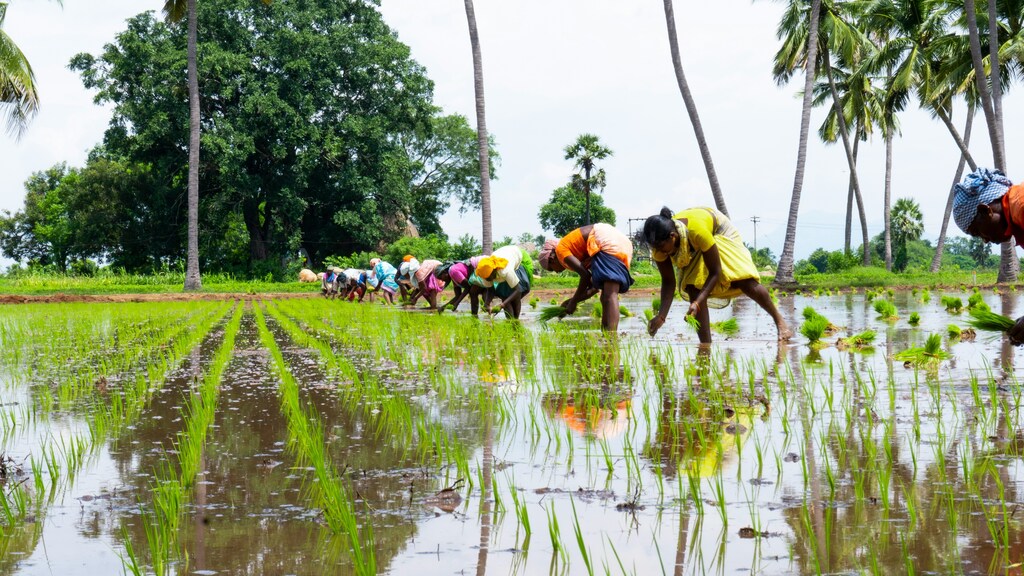
The monsoon season in south-west India, from July to October, is when Kharif or autumn crops like rice and groundnuts are grown. Farmers’ livelihoods depend on the success of these crops, which are increasingly vulnerable to climate change.
When floods and heavy rains damaged crops across the state of Maharashtra during the 2025 Kharif season, millions of farmers faced the same urgent question: how quickly would financial help arrive?
Disaster payments have traditionally depended on lengthy processes to identify affected farmers, verify their land and crops, and connect those records to bank accounts. But this time, Maharashtra used AgriStack – India’s digital public infrastructure for agriculture – to verify 8.9 million farmers and transfer more than INR 14,000 crore (approx. $1.46 billion) in disaster relief within five days.
For farmers trying to recover before the next planting season, speed matters. The Maharashtra example shows what connected agricultural data can enable: instead of repeatedly proving who they are, what land they farm and whether they qualify for support, farmers can receive payments through information that has already been verified.
But this remains the exception rather than the rule. Agriculture is generating more data than ever, but much of it is still not translating into better decisions, faster services or improved livelihoods for farmers. Why? Because information is often scattered across systems that cannot communicate, the rules governing its use are unclear and farmers may not trust who can access it or how it will be used.
Why more agricultural data isn’t enough
Satellites, sensors, drones, farm machinery, mobile phones and government registries now produce vast amounts of information about land, crops, weather, inputs and markets. Combined effectively, this data could help farmers decide when to plant, use water and fertilizer more precisely, manage climate risks, and gain access to credit or insurance.
In practice, the information is often scattered. A farmer’s land record may sit in one government database, crop history in another, soil information with a laboratory and machinery data on a manufacturer’s platform. The systems may use incompatible formats, while records can be incomplete, duplicated or out of date.
There is also a question of trust. Farmers may not know who can access information about their land, income or production, how it will be used, or whether they will share in the benefits. The Organisation for Economic Co-operation and Development (OECD) has warned that fragmented and unclear data-governance arrangements can make farmers less willing to adopt digital tools. That reduces the information available not only to farmers, but also to researchers, policymakers and innovators developing new services.
The challenge, then, is not simply to collect more data. It is to make existing information useful, connected and trusted.
Making agricultural data useful depends on three things:
Systems must connect. Common standards should allow authorized data to move between platforms, so farmers do not have to provide the same information repeatedly.
Rules must be clear. Everyone should know who can use the data and why, while farmers need simple ways to correct records or challenge misuse.
Farmers must remain in control. Consent should be informed and easy to withdraw, with privacy and security built in.
Together, these elements can make data more useful and trusted. But farmers must also see practical benefits.
AgriStack’s early lessons
AgriStack shows how these elements can work at a national scale. It brings together three state-managed building blocks: a registry assigning each farmer a digital identity; geo-referenced maps linking that identity to agricultural land; and a crop-sown registry recording what is being cultivated.
By 3 August 2026, India had created more than 103 million Farmer IDs. During the 2025–26 Rabi (winter crop) season, its digital crop survey covered more than 313 million plots. These linked records can support services including government payments, crop insurance, credit, procurement and personalized agricultural advice.
Official guidance says state governments retain ownership of the data and that sharing with external organizations requires farmers’ explicit consent. A consent manager is intended to let farmers authorize particular uses, while encryption and access controls protect information as it moves between systems.
Maharashtra’s relief programme offers an important proof point: connected, pre-verified information can remove administrative steps precisely when farmers are most vulnerable. The state linked AgriStack with its existing benefits platform, allowing farmers to access multiple state and national schemes through one interface using their Farmer ID.
But reach is not the same as universal inclusion. AgriStack’s Farmer ID is created by matching a farmer’s details with digitized land records. While not a technological limitation of the platform itself, this reliance on existing legal and policy frameworks governing land ownership can create difficulties for tenant farmers, sharecroppers and women who cultivate land but are not listed as its formal owner. In cases where the record remains in the name of a deceased owner, or the cultivator’s identity does not match it, farmers may face additional steps to establish eligibility.
The lesson is that digitizing a record does not automatically make it complete or fair. Mechanisms to update information, recognize different forms of land tenure and appeal decisions are as important as the technology itself.
Europe tests another route
The Common European Agricultural Data Space (CEADS) is testing a different model. Rather than building a central database, it aims to connect existing platforms and organizations through shared standards and governance. It does not store or sell data; the intention is for information to remain at source while authorized users gain access under agreed conditions.
Its 36 partners across 15 countries are testing eight use cases, including sustainability reporting, agricultural risk management, improving AI models and making farm-machinery data portable between systems.
The machinery pilot addresses a common frustration. Equipment and farm-management platforms may use different formats, making it difficult for farmers to combine their own operational data or switch providers. Starting with potato and cereal farming, which involve machines from planters to sprayers, the shared datasets could help farming become more sustainable through monitoring the use of water, fertilizers and fuel.
CEADS is still being developed, however, so its pilots should be treated as tests rather than evidence of impact. They must demonstrate that shared standards work across diverse farming systems, participation is affordable, and consent remains a genuine choice when a powerful buyer, lender or platform requests access.
Both AgriStack and CEADS show that systems can exchange information securely without removing farmers’ control.
That means common standards, clear accountability, meaningful consent and effective safeguards against exclusion. Above all, data initiatives should start with problems farmers recognize and produce value they can see – whether that is less paperwork, faster disaster relief, better advice or fairer access to finance. Without those foundations, agriculture will continue to generate more data while leaving much of its potential value untapped.