Asia-Pacific accounts for nearly half of new breast cancer cases globally and 45% of deaths. How can society work together to put the right breast cancer care systems in place?
A woman diagnosed with breast cancer is more than a patient in the health system. She is a woman with ambitions and future plans that can be derailed, with ripple effects that often reach her family, workplace and wider society.
Across Asia-Pacific, women are critical to both economic and social progress. With 43.9% participating in the labour force and women shouldering around 80% of unpaid care work, the stakes extend well beyond healthcare alone.
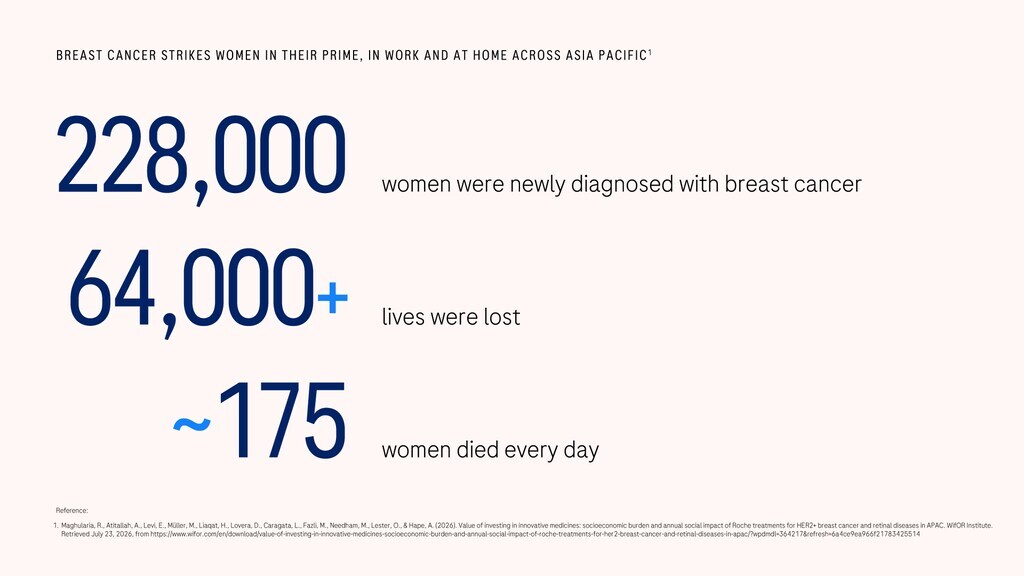
Asia-Pacific accounts for approximately 48% of new breast cancer cases globally and 45% of breast cancer deaths. Close to 980,000 women were diagnosed across the WHO Western Pacific and South-East Asia regions in 2024 alone. Women in Asia are also often diagnosed younger than their Western counterparts, during years when they are supporting families, building careers and contributing to their communities.
At the recent World Cancer Congress in Hong Kong, breast cancer prevention and control was recognized as an ASEAN health priority. There were also renewed calls to invest in breast cancer care as a socioeconomic imperative, examples of flexible and decentralized models that bring care closer to women, and stronger partnerships across the region.
The real opportunity is turning this momentum and progress into something that works at scale, so more women are diagnosed earlier and can access the right care at the right time, and societies thrive as a result.
The cost of HER2-positive breast cancer in Asia-Pacific
New research from the WifOR Institute, sponsored by and developed in collaboration with Roche, helps measure the scale of breast cancer impact.
The study examined HER2-positive breast cancer across 11 Asia-Pacific economies: Australia, Hong Kong SAR, Indonesia, Malaysia, New Zealand, the Philippines, Singapore, South Korea, Taiwan, Thailand and Vietnam.
HER2-positive breast cancer is characterized by its aggressive nature and higher risk of recurrence. It is particularly prevalent in Asia, accounting for up to 23% of cases. Between 2017 and 2027, HER2-positive breast cancer is estimated to result in approximately 4 million disability-adjusted life years (DALYs) lost, meaning roughly 4 million years of healthy life lost. These lost healthy life years are linked to an estimated $116 billion in productivity losses. In 2023, HER2-positive breast cancer cost the 11 Asia-Pacific markets $10 billion in productivity losses, a figure that is expected to jump to $13 billion by 2027, representing a 30% increase in just four years.
Innovation creates value beyond the hospital
Science, innovation and our understanding of breast cancer care are advancing at a promising pace. The priority now is to turn these advances into better outcomes for patients and society.
The treatments the WifOR study examined were associated with $1.65 billion in economic gains and around 21,300 quality-adjusted life years (QALYs) gained across the same 11 economies between 2017 and 2027. QALYs capture both quality and quantity of life, reflecting more time and healthier time for women.
Where and how does society gain the most?
When assessing the impact of addressing breast cancer, it is also important to identify the greatest opportunities to create meaningful value for individuals and society. Evidence shows treating breast cancer at an early stage is 2.5–3 times more cost-effective than treating metastatic disease and is associated with a survival advantage. However, up to 25% of patients in Asia are diagnosed when their breast cancer has already spread to other parts of the body. Closing this gap is where some of the greatest returns sit.
Strengthening the “front end” of breast cancer care through earlier detection, faster diagnosis and quicker connection to appropriate treatment can help more women stay healthier for longer, while reducing avoidable health system costs and disruption for families and workplaces.
For every woman, additional healthy years can mean something different. It might mean more independence, more chances to progress in her career, more time caring for the people she loves, being there for an important moment or simply more time to live on her own terms.
Together, these findings point to a broader question for decision-makers: how can society work together to put the right breast cancer care systems in place?
Three shared priorities for fighting breast cancer
Different economies are at different stages in strengthening breast cancer care, but a common fundamental shift is needed everywhere: looking beyond the cost of individual point of care and considering what earlier intervention and better outcomes make possible for patients, health systems and society.
With this broader lens, there are three shared priorities for all stakeholders to consider:
Invest with a full-value view: Clinical outcomes and health-system costs will always matter, but they do not tell the whole story. Investment decisions can also weigh credible evidence of the wider social value of better health, including the contributions people can continue to make in both paid and unpaid roles.
Create conditions for better care: National cancer strategies, practical plans and coordinated implementation can guide and support breast cancer care models that bring services closer to women and connect awareness and diagnosis with appropriate treatment, so women enter the system earlier and move through it without delays. Sustained commitment and investment from all partners will help these models last.
Collaborate to scale what works: A shared regional framework can help align standards for breast cancer care, bring individual progress to system-level improvement and narrow differences in access between locations. This framework can then be translated into locally driven implementation, shared accountability and more on-the-ground partnerships, creating a virtuous cycle of learning, scaling and impact.
These priorities build on work already under way across the region. Earlier diagnosis and timely care give more women the chance to keep the ambitions and plans they had before breast cancer, and their families, workplaces and communities share in that.