It’s not just electric cars and solar panels. China is now a fast-growing net exporter of chicken, and its meat is making waves in a changing world with at least one constant: an appetite for “the most engineered creature in history.”
Captains of industry convened at a New York City hotel in the winter of 1947, dreaming of a super bird.
They’d recently glimpsed an enticing possible future, as wartime red-meat shortages briefly elevated chicken’s dinnertime status. Science had just delivered the atom bomb, so surely a plumper, juicier fowl was also conceivable. Something people would truly desire, not just a protein compromise. It was agreed: judging for the Chicken of Tomorrow contest would take place that July.
The multi-year competition is now credited with birthing the modern poultry industry. A capacity to churn out chicken at industrial scale brought with it a need to tap new markets, and a thriving global trade followed.
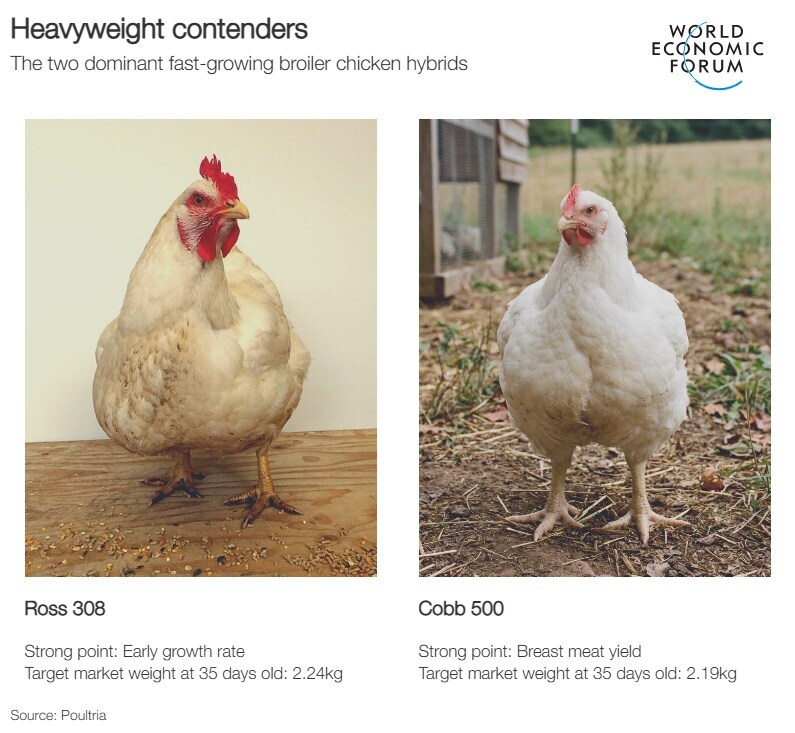
Enter the Cobb 500. A chesty hybrid with broad appeal. It’s a descendant of birds bred to compete for Chicken of Tomorrow glory, and it makes up the bulk of shipments from Brazil, which has been the world’s top exporter for decades.
But there’s also the Shengze 901, a hybrid developed in China. Last year, the country became a net exporter of chicken. It’s projected to swiftly ascend the ranks of global Gallus gallus domesticus merchants, by following a familiar playbook: innovate, then deliver at a low price.
China increased its poultry exports to the European Union at more than twice the rate of Brazil between the first half of 2021 and the same period this year, while often selling at a significant discount. Last month, the EU suspended imports of Brazilian meat due to safety-standard concerns, leaving the future of local chicken sourcing seemingly wide open (though the ban may not last too long).
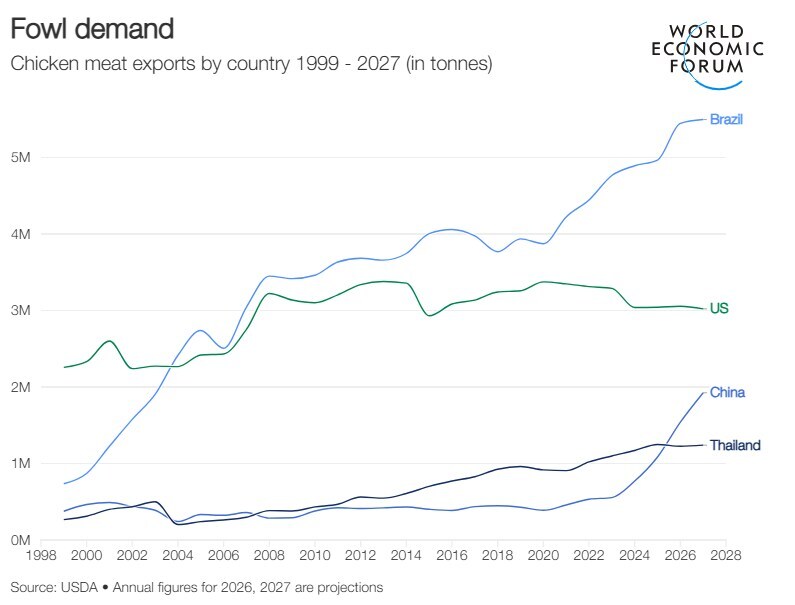
The UK, ancestral home to the Ross 308 hybrid, has also seen an uptick in Chinese imports. Government data indicate that the value of cooked chicken arriving from China through August of this year exceeded what was imported in all of 2025. And that’s not one of China’s fastest-growing markets; those are places like Russia and the UAE.
China’s expanding global chicken footprint has triggered dynamics familiar to anyone who’s followed market trends in electric cars or green technology. The EU and the US have hit low-cost Chinese cars with punitive anti-dumping duties and tariffs. They and other countries have dished out much the same to Chinese solar panels and batteries.
Similar protectionist measures may greet China’s cresting wave of bargain-priced legs, breasts, and thighs. The European Commission is “monitoring the market,” a spokesperson said recently.
The chicken has come a long way from its roots as the “red junglefowl,” an avian recluse in the wilds of Southeast Asia. The mostly domesticated birds outnumber humans by about four-to-one at this point, and we still can’t get enough of them. They’re prominent enough to present yet another opportunity to reshape a global economy tilting to the East, as it fractures into enclaves increasingly focused on self-reliance and food security.

The US still produces more chicken than any other country, but it tends to keep most of that for domestic consumption.
It’s not as if the bird was exactly shunned in pre-Chicken of Tomorrow America. It was just more delicacy than mainstay. US President Abraham Lincoln favoured a version served in heavy cream sauce during his time in the White House nearly 170 years ago. The contemporary iteration, which is developed like a refined widget, has surged in popularity.
For every five fried chicken sandwiches an American consumed at a restaurant in 2019, they added another to their diet by 2024. One US fast-food chain offers six different varieties (plus wraps, and nuggets). The country’s most-eaten meat doesn’t seem to be at risk of falling out of favour. And the National Chicken Council wants to make clear that very little of it comes from China. Though that’s not for lack of trying.
China managed to gain access to the US chicken market several years ago. The ruling only allowed for cooked meat, but was a meaningful foothold gained amid a constant cycle of trade friction.
A heavy reliance on imports from China, after all, was at the root of a home-grown industrialization programme under the previous White House administration, and waves of tariffs under present US leadership. Yet China continues to export more goods every year. And America’s trade deficit, a yawning measure of how much more it buys from abroad than the other way around, persists.
It’s almost as if fixes from the past can’t always be wedged into the global economy’s present – where many things once difficult to imagine are now undeniable. A couple of decades ago, Chinese car brands were struggling to make inroads in the European market due to safety concerns. Chinese brands now hold 10% of that market.
It’s not just about selling things. China is increasingly the source of much of what’s being built around the world, like mines, roads, and the factories and showrooms for its ascendant cars.
The car industry and the chicken trade share something lately: glut. But overcapacity isn’t necessarily enough to slow production drives fuelled by a desire for self-sufficiency. Those drives have become a hallmark of the global economy lately.
They can certainly spur single-minded innovation. China’s bid to grow more of its own soybeans despite a finite amount of farmland, for example, has channelled investment into related research. Same goes for chicken. The success of the Shengze 901 hybrid was heralded with this sensational headline: Chicken breeder achieves fruitful result by following policies.
Few things in the natural world have been as tinkered with. It’s “the most engineered creature in history,” writes the author of Why did the Chicken Cross the World? That’s created concerns about health and ethics, and startling efficiency. The average broiler chick can now reach maturity in less than a couple of months.
It’s a fitting protein for a more expensive world. Rising costs for beef have made chicken more attractive lately, in a callback to the days of war rationing. Brazil built much of its export prowess on low prices. Thanks to China, that’s less viable now.
China’s path forward as its massive chicken supply outstrips local demand is laden with the same kind of risks other exporters face, of course. Poultry farming’s expansion there has not come without an environmental cost, for example.
Then there’s the weather. It’s important for raising poultry. And it’s part of the reason just one Brazilian state out of 26, Paraná, can churn out over a third of that country’s chicken meat. Lately, weather has become more difficult to rely on. The prospect of an unusually powerful El Niño event is now threatening Brazil’s chicken industry with flooding and higher feed costs. A changing climate promises more extreme weather variations to come.
That kind of flaw isn’t something that will be easily engineered away.