$10 trillion will likely be invested in automation and robotics by 2030.
But ageing warehouses struggle to adopt new technologies.
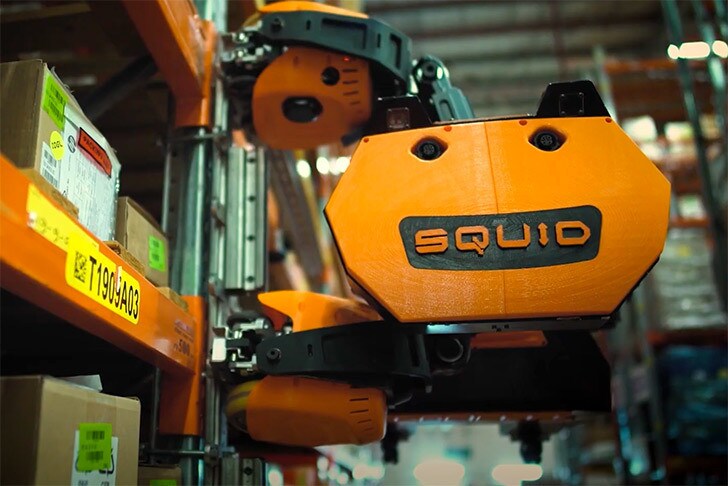
Step forward the SqUID – a new type of box-carrying robot that can be retrofitted to any space, and can even climb the racks.
Robotics and automation are on the rise – $10 trillion will have been invested in these technologies by 2030, according to some forecasts – and now a new kind of ‘climbing’ robot looks set to transform ageing warehouses.
Automation is all very well, but if your business has out-of-date infrastructure, the chances are the new technology won’t fit. So how can a business take advantage of the opportunities new digital technologies offer, without having to build expensive new warehouses?
This is where Israeli firm, BionicHIVE, steps in.
Its recently unveiled SqUID robot will, the company says, work with a “standard pallet rack, at any working facility”.
The SqUID can navigate around a warehouse autonomously, thanks to on-board sensors and machine learning, transporting goods wherever they are needed. The robot, which can carry weights of up to 15.8 kilogrammes, can then climb the existing racks of shelves within the warehouse, by attaching itself to vertical sets of rails and runners.
Retrofitting the future
There are many solid business reasons for investing in automation. In many lower-margin sectors, such as food retail, warehouse robots are increasingly commonplace. The UK online-only grocer, Ocado, is known for its use of robotics and is providing its technology to other grocers, notably Kroger in the US.
But COVID-19 has accelerated the digital transition, according to Susan Lund of the McKinsey Global Institute. “Firms are not just going back pre-pandemic, but completely reimagining how they work,” she told The Economist. And automation, in particular, is high on the corporate agenda.
What is the World Economic Forum doing about the Fourth Industrial Revolution?
The Centre for Frontier Technologies and Innovation brings together scientists, policymakers and business leaders to make sense of emerging technologies and their real-world implications.
By enabling collaboration and experimentation, the Centre helps partners translate innovation from research into practical applications that address shared global challenges.
The shift to hybrid workplaces
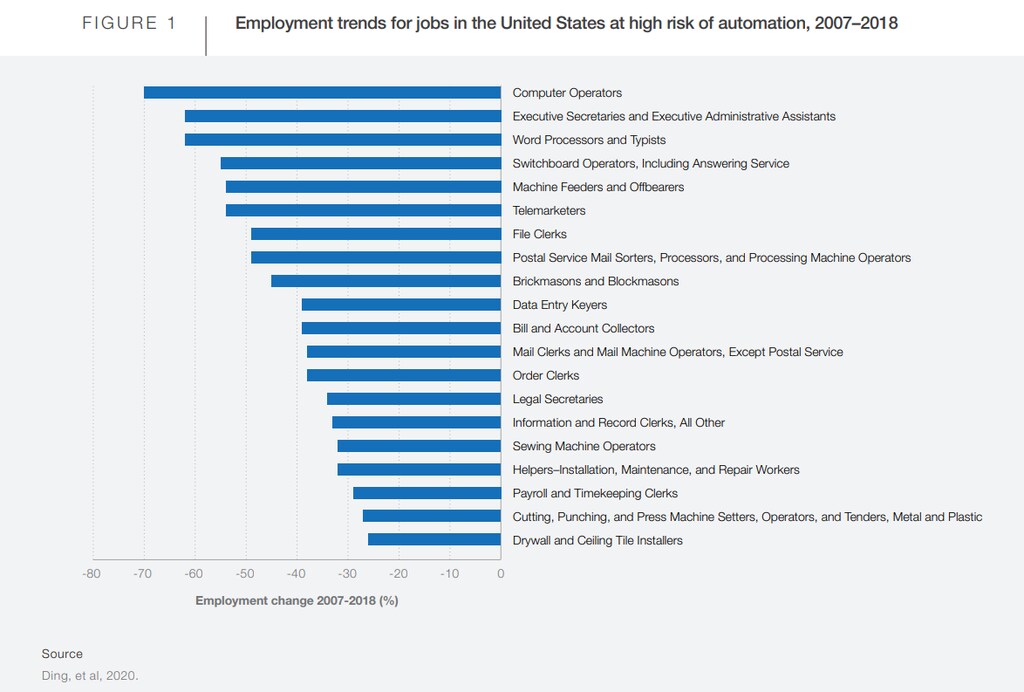
By 2025, 85 million jobs may be displaced by a shift in the division of labour between humans and machines, according to the World Economic Forum’s 2020 Future of Jobs report. The report also states that while there will be more jobs created than destroyed by the Fourth Industrial Revolution, some old roles are disappearing faster than new ones are emerging.
One of the most obvious benefits of warehouse automation, as with any sector, is that it eases many issues relating to employing a human workforce: there are tasks better suited to robots, such as those involving repetitive or dangerous activities. Plus, in countries dealing with labour shortages, robots can take some of the pressure off hiring and wage costs.
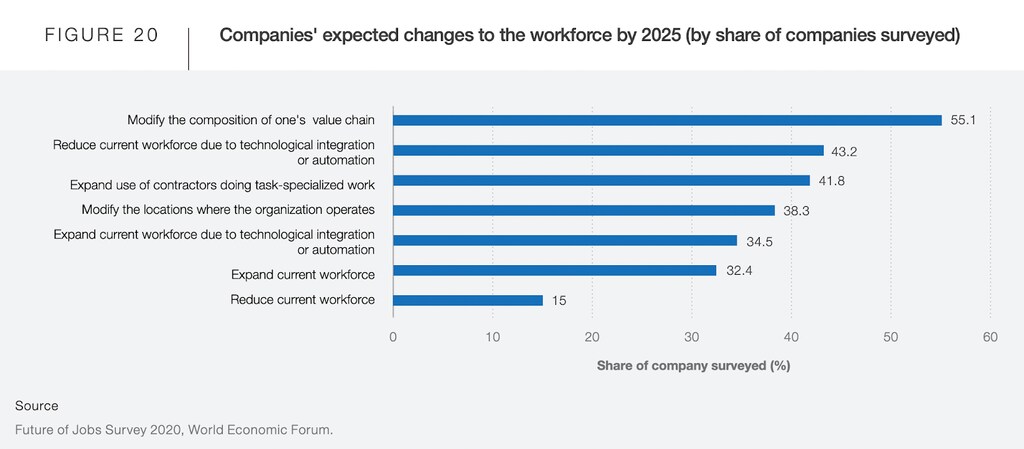
The Future of Jobs report also points out that there is now a double wave of disruption facing workers, thanks to the combination of automation and the pandemic. The increased use of automation will lead 43% of businesses to reduce the size of their workforce. But by 2025, the report says, there will be a roughly equal split between humans’ and machines’ workloads.