
Ford has developed a prototype smart car window that lets blind people “see” the passing landscape.
The “Feel the View” prototype, which was developed with Italian startup xyz, uses vibrations to give blind and visually impaired passengers a sense of the scenery outside.
The smart window takes pictures using an external camera and turns them into high-contrast grayscale images. These images are reproduced on the glass using special LEDs. When a passenger touches the image, different shades of gray vibrate with a range of 255 intensities. The idea is that blind or visually impaired passengers can touch the scene and use the varying intensities of vibration to create in their mind what the landscape looks like.
Ford’s team in Italy worked with agency GTB Roma and Aedo, a local start-up that specializes in devices for the visually impaired.
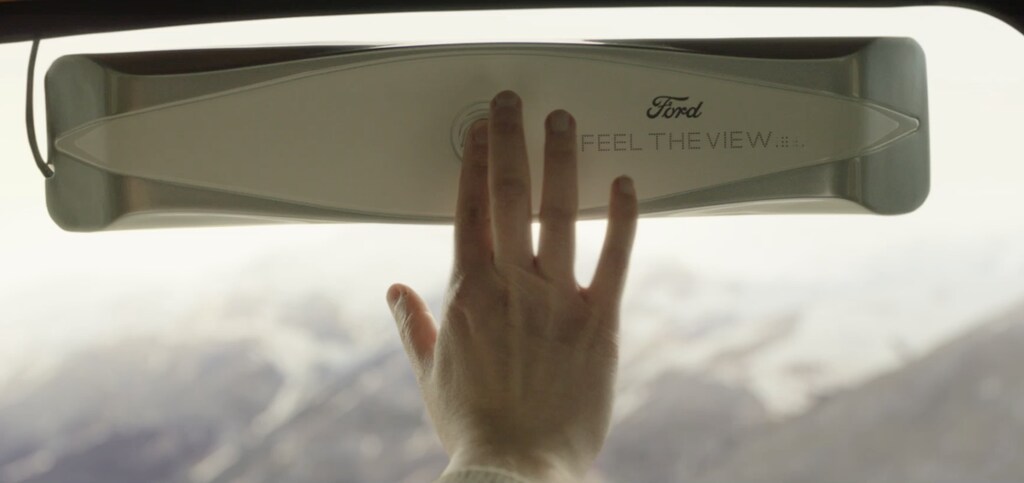
The smart window also has an AI voice assistant that taps into the car’s audio system and put what the passengers are feeling into context. For instance, it might tell the passenger “snowy mountain,” as depicted in the video, or “lake.”
The prototype is part of Ford’s advanced research, which means there are no plans (at least not publicly) to bring this to market.
This is the kind of technology that could show up in Ford’s autonomous vehicle program. The company has been testing its technology and its future business model through pilot programs with Dominos and Postmates. The company has been using research vehicles to learn the logistical challenges of delivery by a driverless vehicle. One of those challenges is how an autonomous vehicle will interact with passengers and give them the information they need as they travel from Point A to Point B.