Electricity was a major focus at COP31 in Türkiye but despite much evidence of progress, nations struggled to agree on how to generate it. Read about this and more top energy news. Plus, for more on the World Economic Forum’s work in the energy space, visit the Centre for Energy and Materials.
1. COP31 advances electrification push
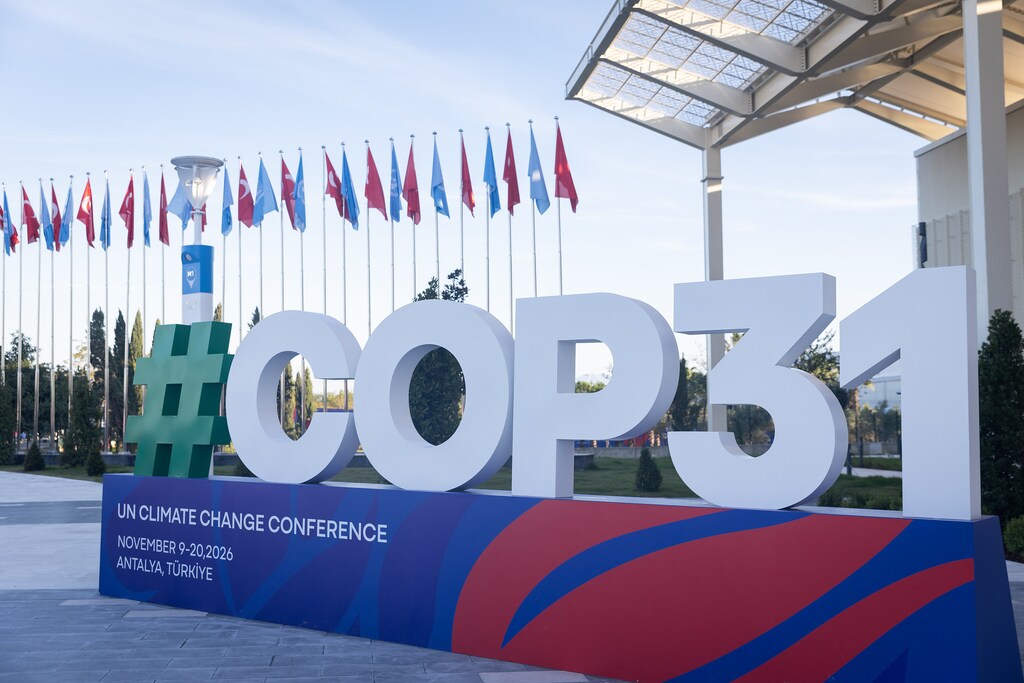
New electrification pledges and investment plans were announced at the 31st United Nations Climate Change Conference (COP31) in Antalya, Türkiye, in what the UN described as a “significant boost for electrification.” But countries failed to agree on an overarching climate pact that made no clear references to curbing fossil-fuel use.
The summit’s flagship '35 by 35' initiative aimed to increase electricity’s share of global final energy consumption to 35% by 2035. Countries representing around half of the global economy pledged support for the target or said they would aim to achieve it earlier.
A wider Electrification Delivery Package presented by the COP31 presidency brought together activities profiled or announced at COP31 across more than 150 countries, alongside cities and businesses. Featured investment plans included at least $156 billion annually for grids, renewable energy and storage.
Several European countries have published national roadmaps for moving away from fossil fuels. But the final draft of a deal at COP31 removed earlier proposals calling on nations to accelerate the phase-out of coal, oil and gas, highlighting a gap between voluntary national action and an agreed global direction.
Fossil fuels continue to make up a significant share of overall energy investment across regions.
2. Grid bottlenecks could threaten electrification ambitions
While delegates at COP31 made electrification pledges, a World Economic Forum report warns that grid constraints could threaten countries’ ability to translate ambition into reliable and affordable power.
Enabling the Electricity Era: From Proven Solutions to Execution at Scale, produced in collaboration with Accenture, says proven technologies are available but that rules, permitting and investment incentives must evolve to accelerate deployment.
More than 2,500 gigawatts of renewable energy, storage and large electricity demand projects are stalled in connection queues worldwide. Annual grid investment must hit about $600 billion by 2030 – roughly 50% above current levels – to meet projected needs.
The report identifies three priorities: extracting more capacity from existing networks, connecting major users such as data centres on flexible terms, and accelerating infrastructure construction.
Grid-enhancing technologies could unlock capacity to connect 450-700 gigawatts of stalled projects globally, it estimates.
Governments, regulators, utilities and investors must coordinate action while ensuring communities benefit and consumers are protected from unfair costs.
3. News in Brief: More energy stories from around the world
Energy world changed by Hormuz crisis: The Hormuz crisis has fundamentally changed the energy landscape, according to International Energy Agency (IEA) chief Fatih Birol, with impacts likely to deepen the longer disruption continues. The agency’s latest World Energy Outlook looks at possible future scenarios that could emerge from the crisis and warns countries must be careful not to replace one dependency with another as they pursue energy security. “I don’t see any credible pathway for the energy world to return to the way it was before,” Birol said. “But encouragingly for the future, energy security and energy transitions have never been so closely aligned.”
Transition skills becoming a business priority: As economies transform how they produce, secure and use energy and natural resources, the availability of skilled workers will determine the pace and scale of that transition, according to a white paper from the World Economic Forum. New Economy Skills: Skills for the Energy and Resource Transition says the transition is becoming a broader business priority for energy producers, extractive industries and also sectors that depend on reliable access to energy and materials. Ultimately, transition skills will increasingly determine whether economies can deliver growth, it says.
Oil production outstrips consumption: The world oil market will return to a surplus during the last few months of this year as Middle East exports recover faster than global oil demand. Despite continued attacks on shipping, fourth-quarter oil supply is expected to exceed demand by 1.7 million barrels per day.
Shares in alternative power Enagás fall: Shares in some companies developing small modular reactors, fuel cells and geothermal energy have fallen from their peaks in the past 12 months as a “fear factor” hits the AI power boom, the Financial Times reports. Big tech has been investing in such emerging energy technology in an attempt to secure alternative power sources for data centres.
ASEAN leaders seek to tackle energy security: Southeast Asian leaders have met in Manila, Philippines, to seek a coordinated response to surging energy costs, among other priorities. The meeting came as higher fuel prices linked to the Middle East conflict are squeezing the region’s import-dependent economies and testing ASEAN’s ability to act collectively. Accelerating the region’s energy connectivity through the proposed ASEAN power grid was also on the agenda.
European energy firms hire security experts: Energy companies in Europe are recruiting defence and security experts to help protect against potential state-backed cyberattacks and sabotage operations. The Financial Times reports Finnish companies Fortum and Neste are bringing geopolitical expertise in-house while grid operators are making critical infrastructure more secure.
Green light for Spanish hydrogen site: Repsol has approved a €400 million ($438 million) renewable hydrogen project in Tarragona, Spain, alongside partner Enagás Renovable. A large-scale 150-megawatt electrolyzer will have the capacity to produce more than 22,000 tonnes of renewable hydrogen a year for renewable methanol and other low-carbon products.
4. More on energy from Forum Stories
Australia’s Hazelwood coal-fired power plant was once one of the country’s most significant energy assets. Ryan Auger, Head of Corporate Affairs, Australia & New Zealand at ENGIE Group, explores how its closure and transformation into a platform for next-generation energy infrastructure offers lessons on the importance of balancing environmental, economic and community outcomes when redeveloping legacy assets. The World Economic Forum’s Coal to Clean initiative brings together stakeholders from energy, finance and civil society to forge partnerships and exchange best practices to accelerate coal-transition projects.
At a time when countries around the world are seeking to strengthen energy security, Egypt’s green transition is a leading example of why renewable energy is both an environmental imperative and a viable long-term economic strategy, writes Odile Renaud-Basso, President of the European Bank for Reconstruction and Development (EBRD). Its renewables journey offers broader lessons around targets and investment for emerging markets.
The electrification of Europe’s buildings, infrastructure and industries has been held up as the solution to Europe’s energy sovereignty, enabling its energy system to run on local, clean power sources. But the bloc’s electrification rate has remained largely stagnant over the past decade. Laurent Bataille, Executive Vice-President, Europe Operations at Schneider Electric, looks at how the EU’s Electrification Action Plan presents an opportunity to break the pattern.
To learn more about the work of the Centre for Energy and Materials, contact Ella Yutong Lin: ellayutong.lin@weforum.org