AI data centres are driving an electricity-demand surge, while electric vehicle charging is growing more gradually. However, the bigger challenge for power grids is not just how much electricity we use, is when and where we need it, and whether smarter technology can turn these new demands into an opportunity.
Electric vehicles (EVs) and data centres will be among the most important drivers of electricity demand over the coming decades. However, their trajectories differ by market.
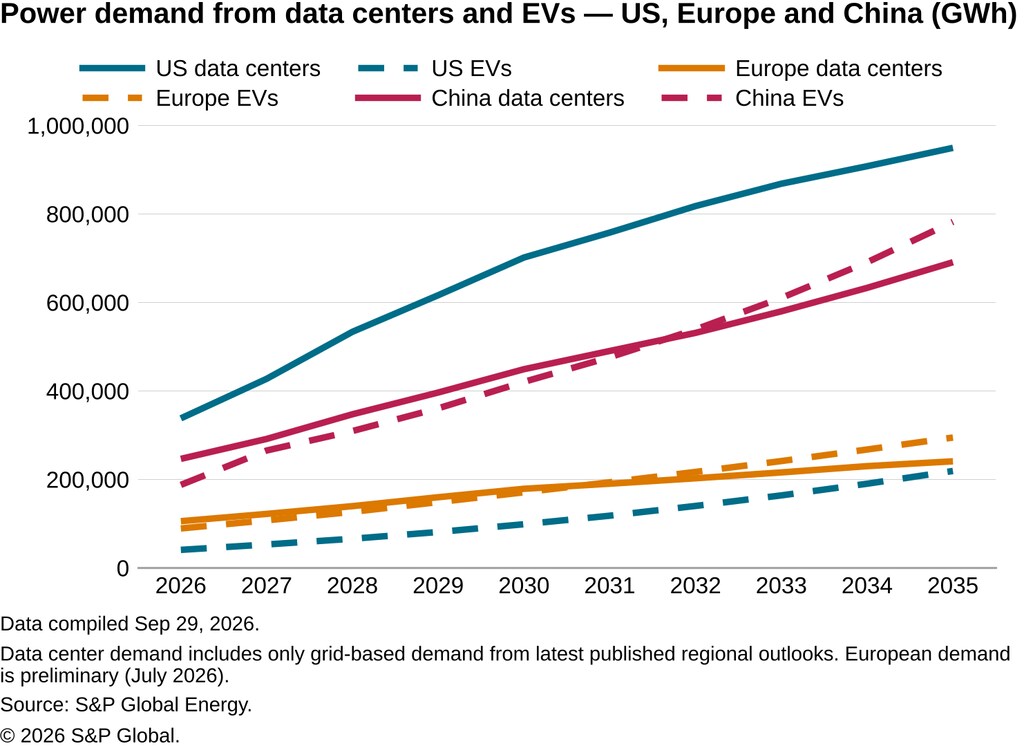
In the United States, data centres are the sprint, dominating electricity-demand growth; in China and Europe, EV charging increasingly looks like a marathon as EVs accumulate steadily in the fleet.
1. AI data centres and EVs are driving electricity demand in different ways
S&P Global Energy research shows data-centre demand substantially exceeds EV charging demand today across the United States, China and Europe. From here, however, the paths diverge.
US data centres are expected to remain in higher demand for the foreseeable future. In China and Europe, EV electricity consumption builds more gradually but compounds as millions of vehicles enter the fleet and remain on the road for many years.
2. When will EV charging demand overtake data centres in China?
S&P Global Energy’s latest forecast shows that in China, EV charging demand will overtake data-centre demand no later than 2032. China’s 15th Five-Year Plan targets average battery-electric vehicle consumption of 11.5 kilowatt-hours (kWh)/100 kilometres (km) by 2030, down from around 15 kWh/100 km in 2025.
Incorporating these efficiency improvements, S&P Global Energy forecasts new EV charging demand at about 420 terawatt-hours (TWh) in 2030, slightly below data centres at 449 TWh.
Efficiency therefore delays the crossover but does not reverse the underlying trend: as China’s EV fleet expands toward 110 million vehicles by 2030, charging becomes an increasingly important power-system load.
This distinction matters for power-system planning. In the United States, data centres could account for a significant share of national electricity consumption and contribute disproportionately to demand growth.
Their rapid arrival is already forcing utilities to reconsider generation, transmission and interconnection planning. In China, both data centres and EVs are growing rapidly but against a much larger and fast-growing power system.
Their national shares may therefore appear less dramatic even while they create substantial challenges in particular locations.
3. Why electricity demand growth matters more than total consumption
Annual TWh consumption tells only part of the story. Energy, measured in kilowatt-hours or TWh, describes total electricity consumption over time; power, measured in kilowatts, megawatts or gigawatts, describes demand at a particular moment. The timing, location and coincidence of that demand determine the grid capacity required.
Data centres typically create large, concentrated loads at individual locations and require reliable electricity around the clock. Their load is not necessarily flat, however: training workloads may offer some flexibility, while inference, data processing and customer-facing applications can vary considerably through the day.
4. How EV charging affects electricity grids and where flexibility can help
EV charging is structurally different. It is dispersed across millions of locations and strongly influenced by consumer behaviour. Residential charging can cluster after people return home. Commercial charging follows commuting and business activity.
Fast-charging stations can impose very high loads over short periods, particularly during travel peaks. The resulting challenge often appears not in national generation adequacy but in local distribution networks, transformers and substations.
In residential and workplace settings, many vehicles remain connected for longer than they need to charge. This creates scope to delay, modulate or sequence charging while still meeting drivers’ mobility needs. Unmanaged charging can reinforce peaks; managed charging can spread the same energy demand across lower-stress periods.
5. How smart charging can reduce pressure on the electricity grid
That difference also creates an opportunity. In the United States, where low-power home charging is especially important, time-of-use tariffs and automated smart charging can shift demand away from peaks. Home energy management, coordination with rooftop solar and selected vehicle-to-home applications – where an EV battery supplies electricity directly to a residential property – can add further flexibility.
China is targeting more than 40 million charging facilities by 2030. Rather than treating them simply as new loads, the electricity system is proactively managing when vehicles charge – and eventually when they discharge.
Time-of-use tariffs and smart charging can move demand away from evening peaks toward periods of abundant renewable generation. In denser urban environments, shared and public charging may require closer coordination among charging operators, building managers and utilities. Bidirectional charging may provide additional flexibility over time.
6. How AI data centres can integrate clean energy and support grid flexibility
Data centres offer a different flexibility pathway. In the United States, demand agreements, on-site generation and storage can provide some flexibility but the concentration of large facilities still creates substantial connection and capacity requirements.
China is increasingly encouraging new computing capacity to develop alongside clean electricity. A national action plan set a target for green electricity to exceed 80% of consumption at new data centres built in national computing hubs. At the same time, green-power direct-connection policies create opportunities to link large consumers directly with renewable projects.
Combined with storage, flexible computing and grid backup, such arrangements can help meet new demand while reducing pressure on already-congested grid interfaces.
7. How to meet rising electricity demand without overwhelming the grid
These new loads do not have to congest the power system; they can increasingly be designed around it. For utilities and system planners, that means anticipating transmission, distribution and flexibility needs before demand arrives. For governments and regulators, it means creating price signals and market rules that reward flexibility.
For data-centre operators, automakers and charging companies, it means designing facilities with smart controls, storage and two-way communication from the outset. And for technology providers, it creates a growing market for AI-enabled grid management, batteries, virtual power plants and intelligent charging.
The coming decades will bring much more electricity demand from both computing and mobility. No single model will integrate EV demand. Detached-home and private-charging environments may support household-led management, while dense urban areas may require coordination across buildings, charging operators and utilities.
Both conditions can exist within the same country. The goal should not be to constrain these new consumers but to build a power ecosystem ready to welcome them and enable them, in turn, to become part of the solution.