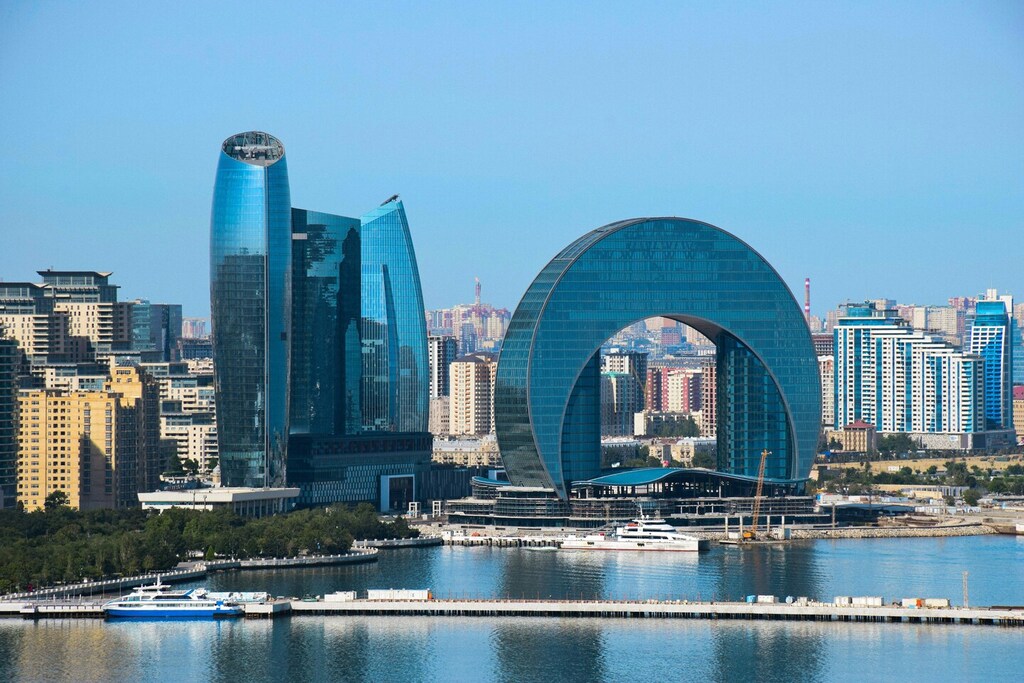
Azerbaijan has the foundations to build a more diversified economy, with a broad productive base and growing non-oil exports. The challenge now is turning that potential into lasting growth by getting finance flowing to productive businesses, helping them to invest, expand, and compete in international markets.
Azerbaijan has made significant progress in diversifying its economic output. The next phase is to build on this progress by supporting more companies that can invest, scale and compete internationally.
In 2025, non-oil and gas activity grew by 2.7% and accounted for 71.5% of gross domestic product. Non-oil and gas goods exports reached $3.63 billion, an 8.1% increase in nominal value, although they declined in real terms.
Together, these figures highlight the progress achieved and the need to further strengthen productivity, export performance and international competitiveness.
Azerbaijan has already strengthened macro-financial resilience following the 2015 global oil-price shock. It must now bolster firm-level competitiveness and sustainable private-sector development in line with Azerbaijan 2030 National Priorities.
Finance can be an important enabler. At the end of 2025, banking-sector assets stood at approximately $33.6 billion, the capital adequacy ratio was 17.6% and the aggregate liquidity coverage ratio was 154.5%. Business lending rose 8.9% to about $9.47 billion.
While these figures suggest Azerbaijan’s banking sector is resilient, sustainable growth can be supported in three ways.
1. Turn business data into stronger financing track records
For some smaller businesses, limited financial histories, documentation or conventional collateral can hinder access to finance. Digitalization has helped by providing verified invoices, purchase orders, transaction flows, warehouse receipts and recurring payments more easily, generating additional insight into cash generation and operating performance.
The country’s digital-finance infrastructure makes current digitalization scalable. In 2025 customers made 1.06 billion transfers worth approximately $298.5 billion; digital channels accounted for 94.4% of transfers by number and 82.5% by value.
Azerbaijan’s implementation of Open Banking has also turned financial data into a more usable input for credit assessment. By mid-2026, all banks had joined the ecosystem and were actively operating on the platform, while standardized APIs (application programming interface) enabled consent-based access to account and transaction information across institutions.
Consolidating this information gives lenders a broader view of cash flows, transaction patterns and repayment capacity, strengthening the data foundation for credit decisions and more personalized financial services.
As a result of the country’s move to Open Banking in 2025, customer consent, data protection and cybersecurity are robust enough to support record-keeping and reduce documentation requirements, while strengthening cash-flow assessments.

2. Match different sources of capital with different types of risk
Diversification projects often have financing needs and risk profiles best addressed through a mix of institutions and instruments. Factories, logistics infrastructure, energy-efficiency investments and export-oriented projects may involve construction, foreign-exchange, collateral or maturity risks even when their long-term economics are attractive.
Public risk-sharing and development mechanisms can complement commercial finance. For qualifying investment projects in the Karabakh and East Zangezur economic regions, state guarantees can cover up to 90% of the loan amount and interest subsidies can reach up to 10 percentage points for up to 36 months.
The Entrepreneurship Development Fund provides another established platform: in 2024, preferential lending increased by 28% to approximately $146 million and reached 5,722 entrepreneurs.
Commercial banks can bring origination, credit assessment and monitoring. Public development institutions and international financial institutions can provide longer-tenor funding, guarantees, technical expertise or risk participation. Local-currency structures can help limit foreign-exchange mismatches, while capital markets can provide greater scale and duration.
Recent International Finance Corporation (IFC) transactions illustrate this approach. In December 2024, IFC issued a four-year Azerbaijani-manat bond equivalent to $20 million to support medium- and small-sized enterprises (MSMEs), low-income households and green projects (climate projects).
A month earlier, IFC provided $20 million of local-currency financing to Bank Respublika for MSMEs, low-income households and climate projects. The transactions exemplify how international capital can be mobilized in local currency, helping channel longer-term funding into the economy without transferring foreign-exchange risk to local borrowers.

3. Support firms as they move from domestic growth to international markets
Companies’ financing needs evolve as they grow. Exporters need more than term lending: working-capital facilities, guarantees, letters of credit, receivables finance and foreign-exchange solutions can help manage cross-border risks and establish repeatable international relationships.
The green transition creates another major opportunity. The Ministry of Energy stated in 2025 that renewables were planned to represent 33.7% of installed capacity by 2027, 37.9% by 2030 and 42.5% by 2035. Beyond large renewable projects, local engineering, equipment, maintenance, transport, storage and industrial energy-efficiency supply chains can also create commercially viable financing opportunities.
As firms mature, banks can support their progression from bilateral borrowing towards syndicated finance, bond issuance and, where appropriate, equity markets. This direction is consistent with the Central Bank's 2024-2026 Financial Sector Development Strategy, which seeks to deepen and diversify capital markets and expand market access.
Azerbaijan has established strong macro-financial foundations and developed a substantially larger non-oil economy. The next phase offers an opportunity to build further on these achievements by strengthening productivity, corporate scale and international competitiveness.
Financial institutions can contribute not only by providing financing, but by improving information, sharing risk appropriately, mobilizing longer-term capital and helping companies access broader financial instruments as they grow.
Together, commercial banks, public institutions, international financial institutions and capital markets can help translate Azerbaijan’s financial resilience into sustainable productive growth and support the country’s long-term diversification priorities.
Ultimately, progress can increasingly be reflected not only in the contribution of the non-oil economy, but also in the number of Azerbaijani companies able to invest, innovate, expand into international markets and compete successfully over the long term.