What lies behind global growth figures – and who risks being left behind? This month’s economics round-up explores key questions from the IMF and World Bank Annual Meetings, from the pressures shaping the economic outlook to why leaders warn the financial system is failing the most vulnerable countries.
At the International Monetary Fund–World Bank Annual Meetings, discussions across the public and private sectors centred on five key questions about growth, AI, jobs, economic statecraft and global imbalances. The World Economic Forum Future of Growth Initiative was present to advance dialogue and enable collaboration around these questions.
How much longer can growth hold up?
The IMF expects global growth of 3.1% in 2026 and 3.4% in 2027. But its latest
World Economic Outlook, Resilience Under Strain, Urgent Choices, points to the fragility beneath those figures: inflation, energy-price shocks and geopolitical tensions could weaken growth. At the same time, high debt leaves governments less room to respond.
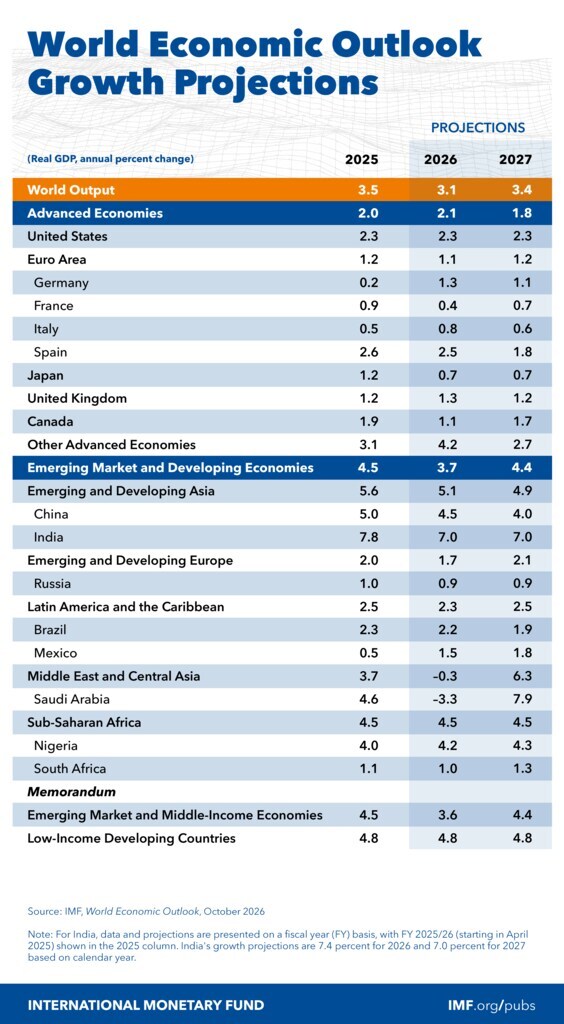
The global figures also mask important differences. While some nations are benefitting from AI investment, for example, others like energy-importing countries outside the technology value chain face a tougher outlook, the IMF says. Bloomberg’s account describes a world economy nearing the limits of its ability to absorb further disruption.
High debt and the resulting limits on government spending were recurring concerns at the Annual Meetings, with rising borrowing burdens and the high cost of essentials including energy and fertilizer, squeezing developing economies, according to the International Institute for Sustainable Development (IISD). Governments have helped households and businesses weather disruption, but energy subsidies cushioning those shocks are putting pressure on public finances. This Guardian report examines the IMF’s warning that many countries cannot sustain support on this scale for much longer.
France offers a stark European example: 10-year borrowing costs reached almost 5% in October, their highest since 2002. Investors are also watching the gap between French and German bond yields – the premium they demand to hold French debt rather than that of Europe’s safest borrower. France’s strained public finances and student protests have drawn international scrutiny.
For economist Dambisa Moyo, the concern is how many risks are converging. In this Project Syndicate commentary, she argues that factors such as high inflation, soaring public debt, market concentration and geopolitical volatility are familiar individually; what is rare and potentially dangerous is their prominence at the same time.
Growth may still be holding up. But governments face a harder task when supporting their economies, managing debt and maintaining public confidence all demand attention at once.
Can AI deliver on its economic promise?
AI could lift productivity and growth. It could also disrupt employment, concentrate economic power and create new financial vulnerabilities. How should economies prepare for both possibilities?
At the Annual Meetings, IMF Managing Director Kristalina Georgieva compared AI to a Formula 1 car that needs barriers to prevent it from hurting people, warning that the risks could exceed the opportunities without adequate safeguards and an ethical foundation.
Jobs are one concern. New roles may emerge as repetitive work disappears, but displaced workers will not necessarily find opportunities with comparable pay or prospects. Bank of Canada Governor Tiff Macklem drew a parallel with trade: benefits for an economy as a whole do not remove the need to support those who lose out.
For developing economies, the opportunity may look less like building frontier models and more like putting existing tools to work. This Guardian article examines the World Bank’s interest in “small AI”: applications that could improve public services and business performance. Practical examples could include helping farmers raise yields, teachers tailor lessons, and entrepreneurs reach customers.
The investment picture is already diverging. In China, technology stocks have already suffered a sharp reversal, Reuters reports, as concerns about AI demand and export restrictions undermined lofty valuations.
US companies, meanwhile, continue to seek substantial funding for expansion. According to the Financial Times, Meta is planning a $95 billion stock offering to fund its AI expansion, while Anthropic’s IPO preparations have revealed rising sales but substantial losses. The scale of that investment raises a more difficult question: will the productivity gains from AI be enough to justify it?
Where will the next generation’s jobs come from?
Around 1.2 billion young people in developing countries will reach working age over the next 10-15 years, but only about 400 million jobs are projected to become available. That potential jobs gap shaped World Bank Group President Ajay Banga’s Annual Meetings address: “A job is not a statistic. A job is dignity.”
To help smaller businesses grow and hire, the World Bank launched a new strategy for micro, small and medium-sized enterprises (MSMEs), focused on access to finance, markets and simpler business rules. Speakers explained how lending rules and servicing costs can make small-business loans uneconomic, and discussed reforms, guarantees and risk-sharing arrangements to attract investment.
The strategy forms part of a wider effort to channel private capital into developing economies – but reaching the poorest countries remains a challenge. The Bank’s overall private-capital mobilization more than tripled to $112 billion over four years, while remaining flat at about $3 billion in low-income countries.
Financing job creation also means addressing the pressures on governments themselves. The G24 called for more affordable finance and protection for public investment, while The Guardian reported on UK foreign secretary Ed Miliband’s push for a “new deal” for countries struggling with debt and high borrowing costs. The stakes extend to employment: governments help fund the infrastructure and services businesses need to expand and hire.
How do you do business when economics becomes statecraft?
How to navigate intensifying geoeconomic competition was another question running through the discussions. The challenge extends beyond tariffs to the use of subsidies, export controls and other economic tools to pursue strategic objectives.
This International Institute for Strategic Studies (IISS) analysis argues that economic statecraft is shifting from occasional pressure on adversaries to a more permanent focus on resilience: reducing dependencies and rebuilding industrial and technological capacity. Businesses are adapting by diversifying supply chains, localizing production and building in-house expertise to navigate increasingly complex restrictions.
Technology offers a clear example. The US Treasury has proposed expanding restrictions on American investment in sensitive technologies in China and other “countries of concern”, aiming to prevent US capital from strengthening potential adversaries’ military capabilities. Meanwhile, countries such as Kazakhstan are seeking partnerships with both US- and China-led AI groupings, hoping to benefit from both. That balancing act is becoming harder: Washington has warned that participation in competing AI initiatives could undermine countries’ standing as trusted partners in its own bloc.
But economic competition does not mean every connection is being severed. China’s bond market is attracting foreign borrowers seeking cheaper funding, according to Bloomberg. Meanwhile, Deutsche Bank’s account of German issuers using panda bonds provides another perspective: borrowers can diversify their financing even as governments reassess dependencies.
For countries outside the two largest powers, that creates opportunities as well as constraints. The challenge is attracting investment and technology without allowing new commercial relationships to become strategic vulnerabilities.
Can global imbalances be reduced without weakening growth?
Large, persistent gaps between what economies save and invest can create risks beyond their borders. At a G20 meeting held in Bangkok on the sidelines of the IMF-World Bank Annual Meetings, China’s central bank governor Pan Gongsheng called for a broader view of global imbalances, encompassing financial flows as well as trade and exchange rates. Days later, APEC finance ministers agreed that rebalancing trade was in their common interest and pledged closer policy coordination – but set out no specific measures.
The IMF’s 2026 External Sector Report identifies China and the US as the main contributors to widening excessive current-account balances in 2025. The underlying pressures differ: high private saving and weakening investment in China, and low saving alongside large government budget deficits in the US.
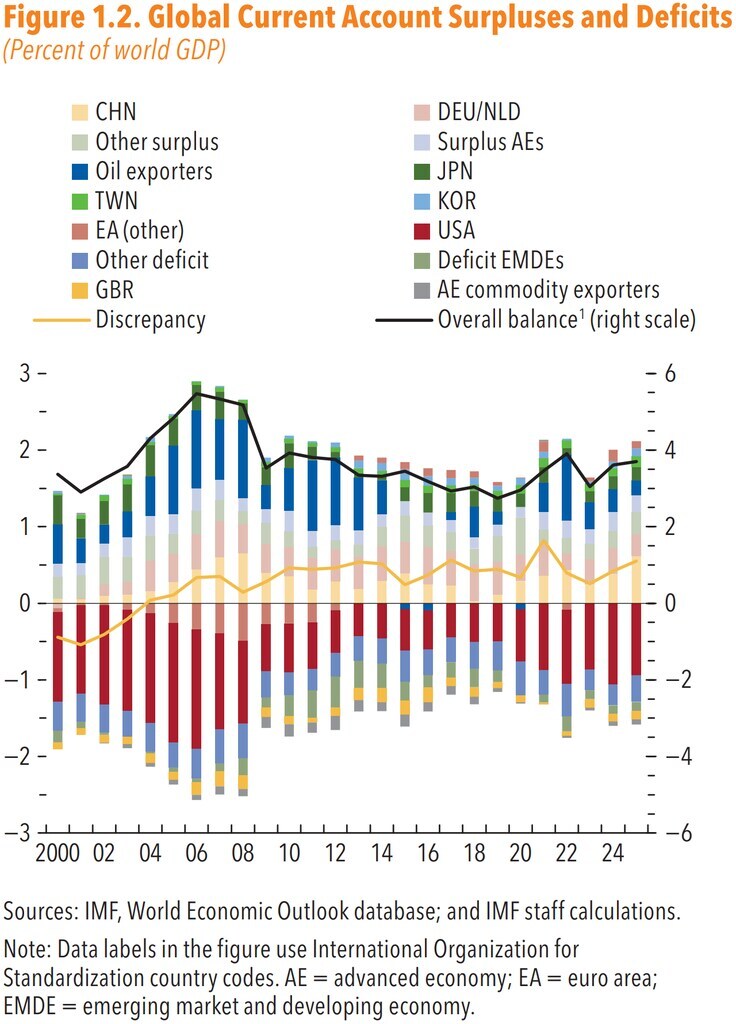
Tariffs alone cannot resolve those pressures. This Foreign Affairs exchange argues that reducing global imbalances requires action by both surplus and deficit countries—not pressure on China alone.
Meanwhile, concerns about Chinese overcapacity are prompting responses with consequences for production and jobs elsewhere. An initial EU-China trade agreement announced on 9 October, still requiring EU leaders’ approval, could curb Chinese electric and plug-in hybrid vehicle imports to the bloc by up to 50%, according to the EU’s trade commissioner.
The IMF’s coordinated rebalancing scenario combines US deficit reduction, stronger social safety nets to support Chinese consumption, and reforms to lift euro-area investment. Stronger activity in China and the euro area could offset the drag from US fiscal restraint, helping narrow imbalances while supporting global growth. The difficulty is finding a combination of national changes that makes the world economy more balanced without making it smaller.
Alongside the meetings, the Forum brought together leading public and private sector leaders, academia and civil society for dialogues to design and shape solutions for navigating growth in the new economy, as part of its Future of Growth Initiative. The Future of Growth Initiative supports leaders to 1) share views and build a holistic understanding of the emerging frontiers of the new economy, 2) exchange new ideas and best practices on enabling growth, productivity and innovation in the new economy, and 3) enable public- private cooperation in areas of mutual interest.