Despite rapid economic growth in South Asia, the majority of workers in the region have low-paid jobs in the informal economy, where productivity is sub-standard and social protection is lacking. In fact, a new report on labor in India – by the Institute for Human Development (IHD) in New Delhi – estimates that 276 million workers live below a poverty line of $2 per day and their bargaining positions have declined as the economy has grown.
What can be done to create better jobs in the region? Preet Rustagi, a Professor at the IHD, argues that the key will be improving the quality of human capabilities, notably through better education and skills training. As for job opportunities for women – many of whom have been bypassed by the economic boom – she notes that the garments sector has served women well in South Asia, although in the coming years the region will have to cope with stepped-up global competition. Women should also look toward the growing services sector, she adds, which holds the promise of jobs in areas like health and education, entertainment, hotels, and IT).
The IHD leads the South Asian Network for Labour and Employment (SARNET), together with the support of the International Labour Organization (ILO) and the UN Economic and Social Commission for Asia and the Pacific.
This post first appeared on The World Bank Blog
Author: Preet Rustagi is a professor at the Institute for Human Development (IHD) in New Delhi, India.
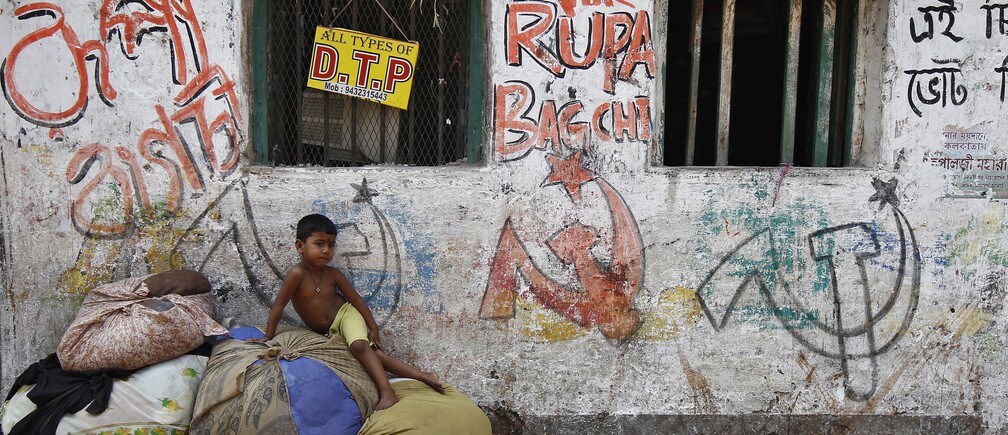
Image: A child sits on sacks filled with clothes in front of graffiti showing the Communist Party of India-Marxist (CPI-M) party symbol at a secondhand cloth market in Kolkata April 11, 2014. REUTERS.