Top finance stories to know this month: a critical funding shortfall, AI stocks tumble after US election and regulatory alarm over concentrated debt, and digital assets go mainstream.
1. World faces $33 trillion financing shortfall by 2030
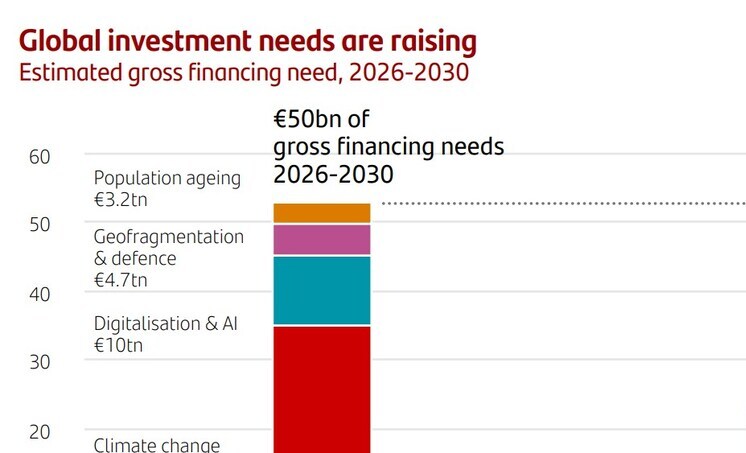
The global financial system faces a financing shortfall of around $33.6 trillion over the next five years to meet critical investment needs, according to new Banco Santander analysis.
Preliminary estimates outlined in The Year Ahead 2027 indicate that the world needs to mobilize approximately $56 trillion in gross capital between 2026 and 2030, driven overwhelmingly by climate mitigation and adaptation. Banco Santander calculates that funding power grid modernization, renewable energy, storage and broad electrification accounts for between $24.6 trillion and $29.1 trillion of the total divide, with AI infrastructure, defence commitments and ageing demographics compounding the deficit.
The findings corroborate broader warnings across multilateral institutions tracking the widening divide between capital supply and demand. Parallel modelling from the OECD's climate finance monitoring similarly places the global clean transition investment requirement at $5 trillion annually through 2030, underscoring that public resources alone cannot close the gap.
To resolve the shortfall, Santander emphasizes that the burden must shift to private balance sheets through structured public-private collaboration, with commercial banks deploying their capacity to mobilize deposits and finance real-economy projects.
Speaking at a release event for the report, Santander Executive Chair Ana Botín noted that addressing the gap will require banking sector reforms to create a framework "built for growth, not just stability." Botín was joined by International Monetary Fund Managing Director Kristalina Georgieva, who warned that high sovereign debt-service costs are increasingly "suffocating for governments" and "bad for business."
2. AI stocks tumble and watchdogs warn of 'AI exuberance' risks
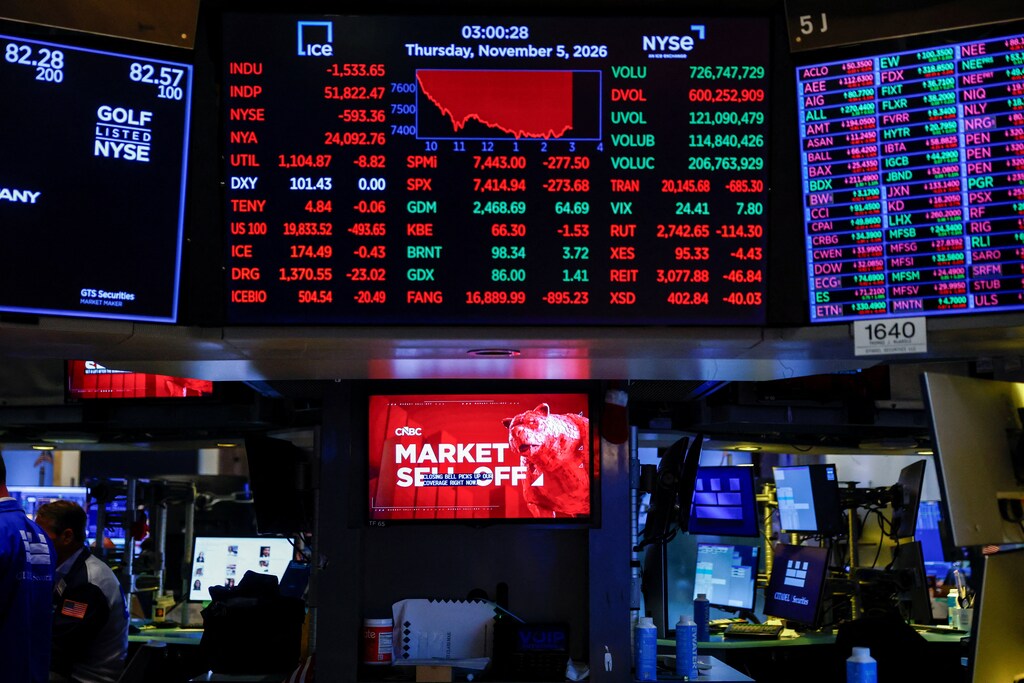
AI stocks fell after the US midterm elections fuelled concerns of an industry slowdown due to increased scrutiny and regulation.
Stocks bounced back, but the market turbulence also followed multilateral regulators and central banks warning that debt-funded capital expenditure across the AI ecosystem poses a growing risk to global financial stability.
In its October 2026 Global Financial Stability Report, the International Monetary Fund (IMF) identified an "AI-driven market correction" as one of the most salient risks to global financial stability. Weaker or less durable technological breakthroughs could trigger a sharp pullback in AI-linked equities and credit, which now account for a massive share of both markets.
Growing leverage across this ecosystem is also becoming a central concern; as free cash flows rapidly decline due to massive capital expenditure demands, hyperscalers are increasingly turning to debt financing.
A review of interconnected transactions since 2023 points to approximately $650 billion in debt, $300 billion in equity, and $1.4 trillion in future revenue commitments. These complex structures present a "wrong-way risk" that could severely amplify losses if anticipated returns fail to materialize just as underlying assets depreciate.
Echoing this analysis, a recent report from the Bank for International Settlements warned that the growing financing of AI infrastructure through long-term debt and off-balance-sheet vehicles is concentrating credit risk among a handful of large companies. With capital expenditure by the five largest US hyperscalers projected to exceed $800 billion by the end of 2026, the BIS notes this obscures exactly where losses would fall if returns disappoint.
These vulnerabilities around debt-funded tech buildouts now intersect with a reshaped political landscape in Washington. With Democrats now set to take control of Congress, inquiries into hyperscaler tax breaks and data-centre subsidies, are expected to expand alongside increased regulatory and anti-trust scrutiny on major technology companies.
3. More finance news to know
Tesla and SpaceX shares fell ahead of the US market opening after the US midterm results, with investors weighing the implications of tighter AI regulation and increased scrutiny of Elon Musk’s business interests. Uncertainty around a potential merger between the two companies may also be weighing on sentiment. Tesla fell around 5% in premarket trading, while SpaceX shares dropped 6.9%.
US financial markets stabilized following the midterm election results. Futures tracking the S&P 500 and the Nasdaq 100 gained 0.6% and 0.5% respectively, while the US dollar fell 0.5% to a one-month low. Market strategists noted that a decisive outcome eliminated the immediate tail risk of a contested election, while the resulting divided government under Republican President Donald Trump creates traditional legislative gridlock in Washington – a dynamic historically welcomed by financial markets as it curtails major policy shifts and reins in debt-funded fiscal expansion.
Bitcoin’s latest recovery is showing signs of faltering, with technical indicators pointing to the possibility of further losses. A break lower could see the cryptocurrency test support levels at $75,001 and $73,188, with a deeper fall potentially taking it towards $62,000. However, a move above its 30-day moving average of $81,319 could signal a shift in momentum, opening the way towards $84,800 and potentially $90,000.
Nearly 70% of companies initially chosen for OKXICE — a planned 24/7, stablecoin-settled venue run by OKX and NYSE parent Intercontinental Exchange — have moved to block the tokenization of their shares. Citing SEC rules allowing issuers to bar unaffiliated third-party tokenization, 50 companies including Nvidia, Microsoft, JPMorgan Chase and Nike have filed objections, reflecting corporate caution over market structure and trading oversight.
Revolut has become Europe’s most valuable start-up with a $115 billion valuation, mounting a direct challenge to centuries-old banking giants. The firm has expanded rapidly over the past decade from a fintech offering cheaper foreign exchange fees into a major rival to traditional European banks.
4. Read more on Forum Stories
How can financial institutions defend against the next generation of AI-powered fraud? As criminals use deepfake voices, fabricated emails and forged documents to create convincing false transactions, traditional verification checks are no longer enough. This article outlines five essential controls to independently verify high-risk payments and prevent fraud.A new report by the World Economic Forum and Boston Consulting Group examines how regulators can keep pace with the growing digital assets market. Drawing on developments across 35 jurisdictions, Regulation of Digital Assets in a Shifting Global Landscape identifies nine key areas for policymakers, including legal certainty, custody, financial crime, market integrity and cross-border cooperation, and provides a framework for developing effective digital asset regulation.
Digital finance has undergone a seismic shift over the past decade. And while new tools have lowered barriers to accessing the financial system and opened new pathways to economic stability, they have also exposed consumers to new risks. This article explores why the next phase of financial inclusion should not focus on access alone, but should also ensure individuals have the right tools and protections needed to build long-term financial resilience.
How the Forum helps leaders understand change in global financial systems
The Centre for Financial and Monetary Systems convenes leaders to make sense of transformation across global financial systems, from sustainability and resilience to innovation and digitalization.
By fostering cooperation and insight, the Centre helps partners align financial systems with long-term economic stability and shared prosperity.