How a local startup is helping San Francisco’s airport turn food waste into economic opportunity
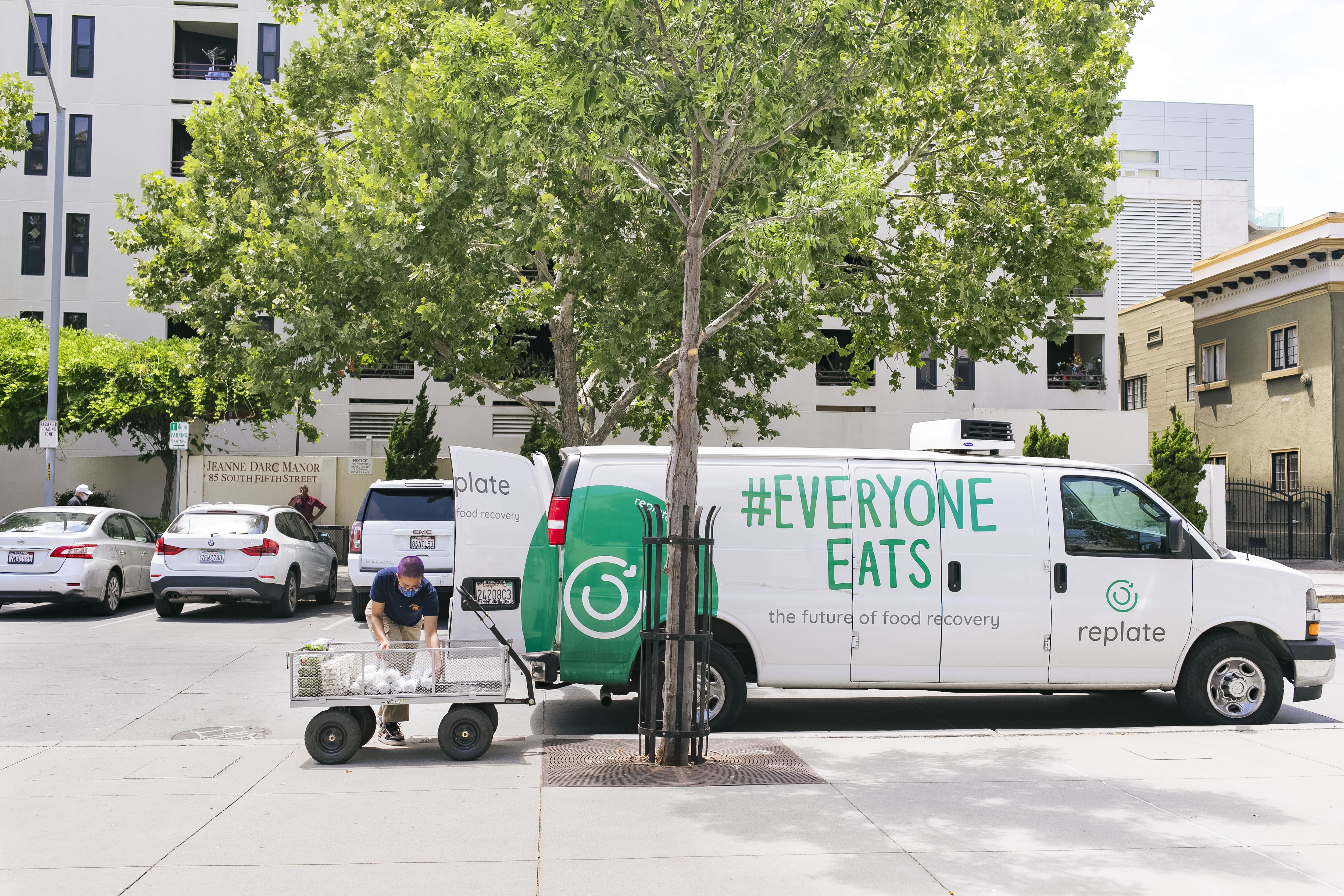
Food recovery has wider repercussions for communities and economies. Image: Replate
- Airports and other visitor-economy institutions can serve as real-world laboratories for local innovation.
- Food waste is not only an environmental problem, but also a market inefficiency that represents lost economic value.
- Partnerships between visitor-economy institutions, local startups and community organizations can improve efficiency, retain economic value and strengthen local resilience.
Airports are more than transportation hubs. They are complex economic ecosystems, bringing together businesses, workers, visitors, suppliers and surrounding communities.
As the travel and tourism sector grows, destinations are under increasing pressure to make that growth more sustainable, inclusive and locally valuable. Recent World Economic Forum analysis has emphasized the need to broaden how success is measured across the visitor economy – looking beyond visitor numbers and spending to consider community well-being, environmental stewardship and long-term resilience.
Briana Zhen and Maen Mahfoud see airports as valuable testing grounds for local innovation. San Francisco International Airport (SFO) is working with Replate, a San Francisco-based food-recovery startup, and an original Yes/SF Innovator that is now part of the Forum's growing Yes/Cities global network, to rethink how food waste is managed across the airport’s restaurants, lounges and concessions.
The partnership treats surplus food not simply as a charitable donation or environmental liability, but as a resource with economic value. Food that would otherwise enter the waste stream can be redirected to community organizations, while the data generated through the process can help businesses reduce over-purchasing and operate more efficiently.
The model reflects a broader principle in urban transformation: when major institutions work with local innovators, they can improve their own operations while strengthening the communities and economies around them. Zhen, Senior Environmental Operations Specialist at SFO, and Mahfoud, Founder and CEO of Replate, outline their vision:
Why should food waste be viewed as an economic and efficiency issue?
Briana Zhen: I studied economics and environmental science, so I think a lot about inefficiency. When I think about waste, I see it as an inefficiency.
“In the natural world, there is no waste. What is produced becomes fertilizer, is consumed by another organism or decomposes. Food recovery is one way of trying to create a more circular system.
There is also a climate dimension. Organic material sent to landfill generates methane, which is a potent greenhouse gas. But there is an economic loss as well. Food has already required land, water, energy, labour, transportation and money to produce. When it is thrown away, all of that value is lost.
Maen Mahfoud: We often talk about food recovery as charity, but that is only one part of the story. The bigger question is how we create a system that recognizes the value of food before it becomes waste.
Food that is no longer needed by one business may still have value to another organization or community. Replate helps identify that value and creates the marketplace and logistics needed to move the food where it can be used.
That requires more than good intentions. It requires technology, data, reliable transportation, safety standards and accountability. We are building a system that helps businesses manage a resource more efficiently.
What role can local startups play in the visitor economy?
Maen Mahfoud: Travel and tourism create enormous concentrations of economic activity. Airports, hotels, stadiums, convention centres and entertainment districts bring together many businesses and large numbers of people. They also generate complex operational challenges.
That creates an opportunity for local startups. A solution developed in a city can be tested in a real environment, with real constraints and real customers. If it works, it can potentially be adapted for other airports, venues and destinations around the world.
But local innovation does not scale in isolation. It needs institutions willing to test new approaches and work through the operational details. A startup may bring technology or a new business model, while a major institution provides the environment in which that solution can be refined and demonstrated.
What did SFO learn from its earlier food-recovery efforts?
Briana Zhen: SFO first tested a food-recovery programme in 2017. It relied on volunteers from recipient charities to collect food, but that created inconsistency. If a charity did not have a volunteer available, food could sit in the donation hub for too long. That undermined trust with the concessions donating it.
We later ran a smaller pilot, from March 2022 to March 2024, with less than 30% of concessions participating. That pilot recovered 27,000 pounds of food.
The full-scale programme relaunched on 9 March this year. Since then, we have recovered more than 12,000 pounds, and 57% of our 114 food concessions are actively participating.
One of the biggest lessons was that the infrastructure has to be designed around how the airport actually operates. More than 90% of our food concessions are located post-security. During the earlier pilot, a concession employee might have had to leave the secure area, walk to a donation hub and then go through security again.
That was not operationally realistic. We now have six food donation hubs, three pre-security and three post-security. The goal is to make participation as seamless as possible.
How does the programme help businesses operate more efficiently?
Briana Zhen: The data can help businesses understand where surplus is being generated. One SFO lounge was donating large quantities of buffet food. After reviewing its dashboard, the operator adjusted its procurement and reduced the amount it needed to donate.
That is one of the most valuable outcomes. Food recovery should not become an excuse to over-purchase. The goal is to understand what is being wasted, right-size procurement and sell more of what is prepared.
Maen Mahfoud: Food waste can result from forecasting errors, changing passenger flows, portion sizes, staffing patterns or unexpected cancellations. Once those patterns are visible, businesses can make better decisions.
Recovery is the immediate intervention, but prevention is the longer-term efficiency gain. The best outcome is not to recover more food indefinitely. It is to help businesses understand why surplus is being created and reduce it over time.
How can food recovery strengthen local economic ecosystems?
Maen Mahfoud: Food recovery can support food access, reduce emissions and create economic activity within the local community. Replate works with delivery partners, including non-profit organizations, and pays them to provide logistics services. That helps build local capacity and creates opportunities connected to the green economy.
There is also value in connecting major institutions to the communities around them. Some of the food recovered at SFO is currently going to San Francisco’s Tiny Homes Village, where many residents have individual rooms but no kitchen. Prepackaged food from the airport can be a particularly appropriate match.
That kind of connection matters in the visitor economy. A destination is not sustainable simply because visitors have a good experience. It also needs to create value for the people who live and work there.
What can other destinations learn from the partnership?
Maen Mahfoud: Good intentions are not enough. Food recovery needs to be treated as a professional service, with reliable logistics, safety standards, insurance, data and accountability.
It also needs to be matched to community needs. ‘Donation dumping’ happens when food is sent to a non-profit without considering whether it fits the preferences, dietary requirements or capacity of the people being served. If an organization cannot use it, the food may ultimately be discarded.
Briana Zhen: Build the infrastructure around the people who have to use it. Convenience matters. If a process adds too much time or distance for frontline workers, participation will be difficult.
Maen Mahfoud: The wider lesson is that local innovation can help visitor-economy institutions become more efficient, more connected to their communities and more resilient.
A startup does not need to solve every problem alone. But when institutions are willing to test new ideas, and when solutions are designed around local needs, economic value can be retained rather than lost.
Food that would otherwise be treated as a disposal problem can become a resource – supporting businesses, communities and the wider economy.
How can destinations deliver more for businesses, workers and communities?
The experience of SFO and Replate suggests that sustainable visitor economies will depend not only on attracting more visitors, but on making destinations work better for the businesses, workers and communities that support them.
Local startups can help identify overlooked inefficiencies and develop new ways to retain value within regional economies. But their impact depends on institutions being willing to test, adapt and embed those solutions into everyday operations.
In that sense, food recovery is about more than what happens to surplus meals. It is a practical example of how travel and tourism destinations can turn waste into a resource, connect innovation with implementation, and create shared value for visitors, businesses, communities and the environment.
Don't miss any update on this topic
Create a free account and access your personalized content collection with our latest publications and analyses.
License and Republishing
World Economic Forum articles may be republished in accordance with the Creative Commons Attribution-NonCommercial-NoDerivatives 4.0 International Public License, and in accordance with our Terms of Use.
The views expressed in this article are those of the author alone and not the World Economic Forum.
Stay up to date:
Circular Economy
Related topics:


Forum Stories newsletter
Bringing you weekly curated insights and analysis on the global issues that matter.
More on Food, Water and Clean AirSee all

Santiago Gowland
September 23, 2026


