Why the International Day of Peace matters in 2026

The UN’s International Day of Peace is marked each year on 21 September. Image: Reuters/Aziz Taher
This article has been updated.
- On 21 September, the United Nations marks the International Day of Peace amid continuing geopolitical tension and global conflict.
- This year’s theme is 'Invest in Peace – for Everyone, Everywhere, Every Day' with the UN calling on world leaders to act.
- State-based armed conflict is the second-biggest global risk identified in the World Economic Forum’s 2026 Global Risks Report.
The global outlook for peace is challenging, to say the least. There were 195 separate armed conflicts recorded in 2025 and over 1,300 experts worldwide have concluded that state-based armed conflict is the second-biggest risk in 2026, behind geoeconomic confrontation and ahead of extreme weather events.
Yet as the United Nations (UN) marks International Day of Peace on 21 September, its outgoing Secretary-General, António Guterres, reminds the world, “Peace is never a passive achievement”.
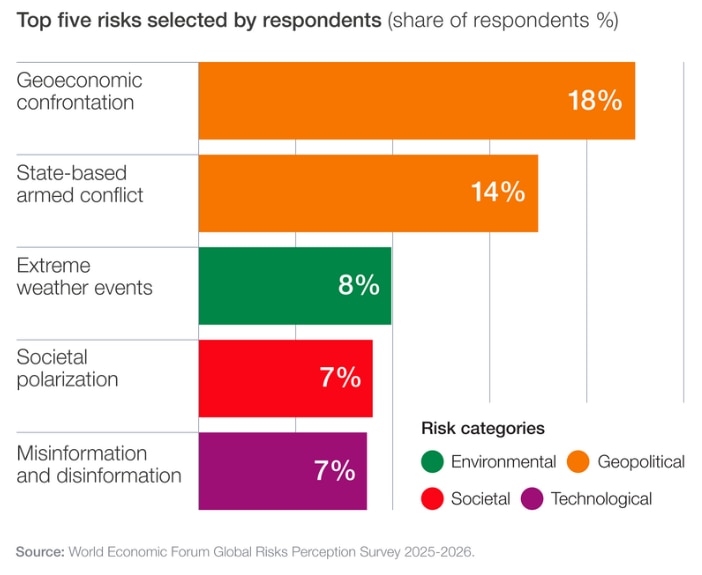
The 2026 Global Risks Report finds that "the world is balancing on a precipice. The turmoil caused by kinetic wars alongside deployment of economic weapons for strategic advantage is continuing to fragment societies".
Framed as 'The Age of Competition', the report says "stability is under siege" as cooperative mechanisms unravel and governments retreat from multilateral frameworks. Confrontation is replacing collaboration, it says, and trust is losing its value.
According to the 2025 Global Peace Index, there are more state-based armed conflicts ongoing than at any time since World War Two. So the UN's 2026 theme of 'Invest in Peace - For Everyone, Everywhere, Every Day' couldn't be more timely.
How did the International Day of Peace start?
The UN was established in October 1945, less than two months after the end of World War Two, with the specific aims in its Charter to “maintain international peace and security”, “reaffirm faith in fundamental human rights”, “promote social progress and better standards of life” and ensure “justice and respect for the obligations arising from treaties and other sources of international law”.
The International Day of Peace was established in 1981 by the United Nations General Assembly (UNGA), which takes place each year in September. A UN resolution declared it a day for “commemorating and strengthening the ideals of peace both within and among all nations and peoples”.
Twenty years later, UNGA passed a second resolution designating the day as a time of non-violence and cease-fire – advocating for a cessation of hostilities while promoting dialogue, conflict resolution and peace education.
Since 2001, the International Day of Peace has been held on 21 September.
How the Forum helps leaders make sense of regional, trade and geopolitical shifts
How is the International Day of Peace marked?
International Day of Peace activities take various forms across the globe.
In many parts of the world, the day is marked by a minute of silence, peace education events, intercultural dialogues and other activities that improve understanding and cooperation between cultures.
Each year, the day is marked at UN Headquarters with the Peace Bell Ceremony. The Peace Bell was cast in the early 1950s from coins and medals given by representatives of the UN member states and children from all continents.
"Man has ... suffered from wars since prehistory, and ... peace has been a long cherished wish of man," said Chiyoji Nakagawa, a member of the board of the Japanese UN Association, who donated the bell in 1954.
Investing in peace
Little progress has been made in the intervening years - indeed, conflicts have been escalating since the 2010s, Uppsala Conflict Data Program charts show.
With action for peace faltering, violence and division destroying communities, and conflicts worldwide deepening, volunteers, advocates and peacekeepers are stepping in where governments are failing, Guterres said at the bell ceremony.
Today, I call on world leaders to stand with us: take action, invest in solutions and do the hard work of building lasting, sustainable peace.
—António Guterres, UN Secretary-General
”The UN is urging world leaders to follow the lead of these 'champions of peace' by:
- Investing in sustainable development, including health, education and social protection
- Building trustworthy institutions and systems
- Safeguarding human rights
- Recommitting to the tools of peace: diplomacy, dialogue, negotiation and peacekeeping.
As Guterres said: “Each year, the toll of the Peace Bell reminds us of the most important and consequential job we have: building peace".
Don't miss any update on this topic
Create a free account and access your personalized content collection with our latest publications and analyses.
License and Republishing
World Economic Forum articles may be republished in accordance with the Creative Commons Attribution-NonCommercial-NoDerivatives 4.0 International Public License, and in accordance with our Terms of Use.
The views expressed in this article are those of the author alone and not the World Economic Forum.
Stay up to date:
Drivers of War


Forum Stories newsletter
Bringing you weekly curated insights and analysis on the global issues that matter.
More on Forum in FocusSee all

World Economic Forum
September 21, 2026