UNGA 2026: What is the UN General Assembly and what happens at the meeting?

The United Nations emblem is seen in the UN General Assembly. Image: REUTERS/Lucas Jackson
Listen to the article
This article has been updated.
- The United Nations General Assembly High-Level Week (UNGA) takes place in New York every September.
- The 81st session will focus on restoring trust and managing global transformation, with High-level Meetings covering climate action, sea-level rise, pandemic preparedness and the right to development.
- Alongside the assembly, the World Economic Forum will hold its Sustainable Development Impact Meetings, convening leaders from politics, business and civil society.
Every September, world leaders from United Nations member states gather at the organization's headquarters in New York to debate the most important global issues.
This year's 81st session takes place as the UN enters its ninth decade at a pivotal moment for multilateral cooperation. Geopolitical tensions, conflict, pressure on development financing, rapid technological change and a warming planet continue to test the international system.
The UN itself is also undergoing a period of change. Its UN80 Initiative, launched in 2025, is moving from review towards implementation, with reforms focused on improving efficiency, reviewing mandates and streamlining the UN system. At the same time, the process to select a successor to Secretary-General António Guterres – whose second term ends on 31 December 2026 – is underway.
Against this backdrop, the theme of UNGA 81, "Restoring Trust, Managing Transformation: A United Nations That Delivers for All", places renewed emphasis on cooperation and the ability of multilateral institutions to deliver tangible results.
As talks kick off this month, here's what you need to know about the UN General Assembly.
What is the UN General Assembly?
The UN General Assembly, the main policy-making body of the UN, was created under Chapter IV of the Charter of the United Nations, signed in San Francisco on 26 June, 1945.
The Charter outlines its key functions, including “promoting international cooperation in the economic, social, cultural, educational and health fields, and assisting in the realization of human rights and fundamental freedoms for all without distinction as to race, sex, language or religion”.
The assembly meets from September to December each year and then again from January to August, if required. Representatives debate and make decisions on issues such as peace and security and the admission of new members.
As outlined in the charter, the assembly may approve the UN budget, elect non-permanent members of the UN Security Council, and appoint the secretary-general – a process that is underway again in 2026 as António Guterres approaches the end of his second term – among other things.
UN General Assembly: This year's theme, dates
The 81st session of UNGA formally opens on 8 September, with the general debate running from 22-26 September.
The 2026 theme reflects a focus on rebuilding confidence in multilateral institutions while navigating geopolitical, technological, economic and environmental change.
Alongside UNGA, the World Economic Forum will hold its Sustainable Development Impact Meetings from 21-24 September in New York, bringing together leaders from business, government, international organizations and civil society.
What happens during the UNGA and General Debate?
The UN General Assembly opens with a minute of prayer or meditation and then the formal installation of the President.
This year's President is Khalilur Rahman, Foreign Minister of Bangladesh and a diplomat with more than four decades of experience in international affairs.
The UN will commence its ninth decade at a time when trust in our organization is being tested on multiple fronts.
”The main event of the UNGA session, and the one that generates the most headlines, is the General Debate. This year, it is scheduled to begin on Tuesday, 22 September, with world leaders taking turns to speak for around 15 minutes.
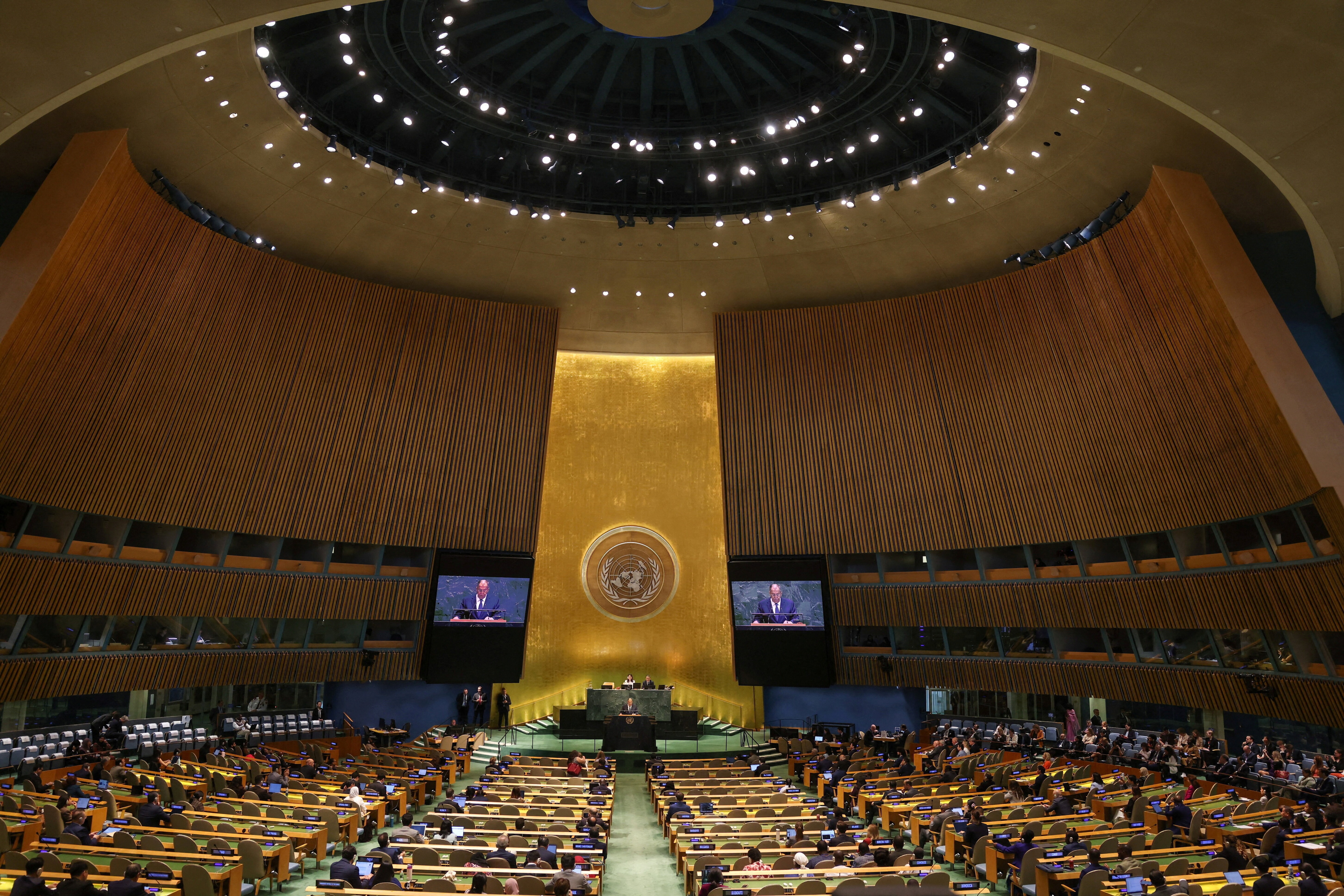
The General Assembly votes on resolutions brought forward by member countries, which can be referred to the Security Council to be made binding.
One of the General Assembly’s earliest achievements was to agree on the Universal Declaration of Human Rights in 1948, outlining global standards for human rights.
A key moment for the UN General Assembly was in September 2015, when the Assembly agreed on a set of 17 Sustainable Development Goals (SDGs) to be achieved by 2030. All countries pledged to work together to eradicate poverty and hunger, protect the planet, foster peace and ensure gender equality.
Progress towards the SDGs remains significantly off track. The UN's 2026 assessment finds that of the 139 SDG-related targets, 36% are on track or making moderate progress. Almost half (49%) are making only marginal progress, while 15% have regressed below their 2015 baseline. With less than five years until the 2030 deadline, accelerating implementation and financing remains a central challenge.
Financing pressures have also intensified. Official development assistance fell by 23.1% in real terms in 2025 – the largest annual decline on record – and the OECD projects further reductions in 2026.
In 2024, world leaders agreed on a landmark Pact for the Future, consisting of 56 Actions designed to "turbocharge" the SDGs, but in particular to speed progress on issues around peace and security, global governance, climate change, digital cooperation, human rights, gender, youth and future generations.
UNGA 2026: What is in the spotlight?
The high-level programme begins with the annual SDG Moment on 18 September. Convened by the UN Secretary-General, it will showcase action and solutions aimed at accelerating progress towards the SDGs at a time when most targets remain off track.
On 23 September, leaders will gather for a meeting on climate action and the just transition. The event comes as countries confront the challenge of accelerating emissions reductions while ensuring the transition to cleaner economies is socially and economically inclusive.
That same day, a High-level Meeting will mark the 40th anniversary of the UN Declaration on the Right to Development. Adopted in 1986, the declaration established development as a human right and emphasized people's ability to participate in and benefit from economic, social, cultural and political development. The anniversary meeting will focus attention on inclusive development and equal access to opportunity and resources.
On 24 September, the General Assembly will hold a High-level Meeting to address the existential threats posed by sea level rise, bringing together governments and other stakeholders to strengthen international cooperation and develop solutions – particularly for small island developing states and low-lying coastal communities most at risk. More than half a billion people live in low-lying coastal zones, placing them on the front lines of one of climate change's most serious challenges.
Pandemic prevention, preparedness and response will be the focus of a High-level Meeting on 25 September. It follows the landmark adoption of the WHO Pandemic Agreement in May 2025, designed to strengthen international cooperation and make future pandemic responses more equitable.
On 28 September, leaders will mark the 25th anniversary of the Durban Declaration and Programme of Action, adopted at the 2001 World Conference Against Racism. The UN describes it as a global framework for combating racism, racial discrimination, xenophobia and related intolerance, with this year's meeting intended to renew political support for its implementation.
You can view the full programme here.
Don't miss any update on this topic
Create a free account and access your personalized content collection with our latest publications and analyses.
License and Republishing
World Economic Forum articles may be republished in accordance with the Creative Commons Attribution-NonCommercial-NoDerivatives 4.0 International Public License, and in accordance with our Terms of Use.
The views expressed in this article are those of the author alone and not the World Economic Forum.
Stay up to date:
Sustainable Development
Related topics:


Forum Stories newsletter
Bringing you weekly curated insights and analysis on the global issues that matter.