Martin Schulz, the president of the European Parliament, has lashed out against the European countries that are refusing to play a part in accommodating the huge influx of refugees from Syria and sub-Saharan Africa.
The European Union is facing arguably its biggest challenge since its inception with a deep divide emerging across the member states over how to deal with hundreds of thousands of asylum seekers.
While some are calling for further border controls, others are pushing for each country to do their part. It comes against a backdrop of widespread border confrontations and chaos. On Thursday a man traveling with a large group of refugees from Afghanistan was shot by border guards near the southeastern Bulgarian town of Sredets and died on his way to the hospital, Reuters reported.
“Some member states are examples of solidarity and humanity.Others are examples of national egotism,” Schulz told CNBC.
He attacked the “completely unacceptable behavior of some EU member states, with heads of state agreeing on billions of euros to address the crisis and finance ministers subsequently arguing ‘they have no money’.”
There were no excuses, he said, and the attitude did serious harm to the credibility of the member states.
Philipp Rösler, head of the Centre for Regional Strategies and member of the managing board of the World Economic Forum, told CNBC that Europe’s deal with Turkey to provide more support for migrants coming from the Middle East was with another reason to be optimistic about Europe’s future as a whole.
Rösler, who was born in Vietnam and adopted as a child by a German couple, said that the situation facing migrants now was far harder than the one he faced as a child, coming from a Vietnamese orphanage.
“I think the situation of people who are now refugees is even more difficult than my situation was when I was adopted out of the Vietnam war, but what you can learn from this is that there can be success stories for immigrants.”
Rather than seeing immigration as a burden, Rösler said it presented an opportunity.
“Many of the quite successful Europeans today have an immigrant story in their family and that shows that immigration is never a burden but always a chance.”
This article is published in collaboration with CNBC.com as part of its Europe Needs Swagger series. Publication does not imply endorsement of views by the World Economic Forum.
To keep up with the Agenda subscribe to our weekly newsletter.
Author: Julia Chatterley is a CNBC anchor and European reporter covering key business and political events. Antonia Matthews is a Digital News Editor.
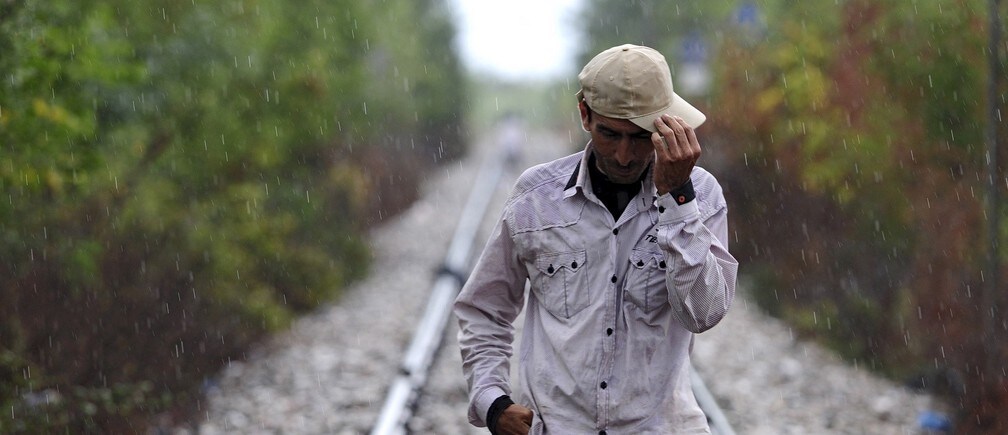
Image: A migrant walks towards Gevgelija in Macedonia after crossing Greece’s border. REUTERS/Ognen Teofilovski.