As African economies transform over the next 50 years, how will political and geopolitical tensions in the region be managed?
Dimensions to be addressed:
– Stabilizing political transitions beyond elections
– Overcoming religious and ethnic divisions
– Fostering conditions for investment and growth

Ian Bremmer May 10, 201312:06 pm
it’s been fun… i’ll also be liveblogging the 3:15pm summit (that’s 9:15am est) on africa’s economic outlook. very much looking forward to it– be sure to tune in!
Ian Bremmer May 10, 201312:04 pm
this sums up the panel discussion rather well:
That was one very good session #WEF. I liked the points covered by all panellists #Africa2063. So much work to be done — Hope Mwinzi (@hopemwinzi) May 10, 2013
Ian Bremmer May 10, 201312:02 pm
it’s been a great summit meeting, taking a bird’s eye view of africa 2013 versus africa 2063….
let’s zoom out far more for a demographic jawdropper.
between 1500 and 1900, the world’s population tripled; africa’s remained stagnant (or even fell by some accounts). in the 20th century, sub-saharan africa’s population grew seven-fold. between today and 2050, the population of africa is on pace to double. only after doing so, in 2050, would africa represent the proportion of the world’s citizens that it did back in 1500.
Ian Bremmer May 10, 201311:57 am
there is such a broad gap between africa of today and the aspirational africa of tomorrow:
In 2063, I’ll be in Kenya with my granddaughter. And she’ll ask me: is it true Kenya was once poor? – Sweden’s Borg #africa2063 #WEF #AF13 — World Economic Forum (@wef) May 10, 2013
today, 31 of 35 of the countries classified lowest in human development are in africa.
Ian Bremmer May 10, 201311:55 am 8 of 10 last years, the African lion economies have been growing faster than the Asian tigers – Børge Brende @wef #africa2063 #WEF #AF13 — World Economic Forum (@wef) May 10, 2013
Ian Bremmer May 10, 201311:51 am
when we talk about african infrastructure shortcomings, the expression ‘you get what you pay for’ comes to mind:
african state expenditure is rarely above 10-15% of gdp (compare that with a 36% average in oecd countries).
of course, the regulatory structure surrounding shipping / trade between african countries doesn’t have a high sticker price to fix. this is lower hanging fruit.
Ian Bremmer May 10, 201311:49 am
kenyatta– “too worried about protecting our taxpayers rather than… easing the tariff barriers that exist.”
Ian Bremmer May 10, 201311:48 am Open source technology to monitor elections developed by young Kenyan being used in Pakistan election- Naqvi. #WEF — Kim Norgaard (@KimNorgaardCNN) May 10, 2013
Ian Bremmer May 10, 201311:47 am
‘60% of the arable, uncultivated land in the world is in africa.’
Ian Bremmer May 10, 201311:47 am
discussion of lack of intra-african trade.
kenyatta– “herein lies the greatest potential for job creation.”
kenyatta stressing the importance of infrastructure in solving this.
Ian Bremmer May 10, 201311:45 am
we’re talking about domestic revenues for developing governments in africa.
here is a shocking one:
in south sudan, oil accounts for 98% of government revenue.
Ian Bremmer May 10, 201311:43 am
necessity is the mother of technological innovation. in africa with poor infrastructure and low state expenditure, people turn to tech to fill gaps.
Ian Bremmer May 10, 201311:41 am
diop mentioning women in liberia—
in general, in post-conflict african countries like liberia (or sierra leone, uganda, etc.), women are more likely to participate in the political process (voting, running for office, supporting candidates).
on the other hand, they are less likely to return to school (which has negative consequences for economic growth).
Ian Bremmer May 10, 201311:38 am
naqvi: “africa is not a monolith. extremely complex…over 50 countries.”
amen. it’s a continent of some 2,000 languages with a land area greater than china, the united states, and europe combined.
Ian Bremmer May 10, 201311:35 am
a savvy point– leautier: ’empower local governments.’ the conduit between national strategy and the people.
Ian Bremmer May 10, 201311:34 am
here is a statistic that shows the development gap for africa– and the gender gap within it:
in south sudan, the literacy rate is just 27%. among women, that rate falls to 16%.
Ian Bremmer May 10, 201311:33 am
A: rwanda. (nearly 60%)
Ian Bremmer May 10, 201311:33 am
Q: which african country has the highest proportion of women representatives in the legislature?
Ian Bremmer May 10, 201311:32 am To sustain growth in long term, every individual, every woman should be part of change: Uhuru Kenyatta #wef #africa — Pranjal Sharma (@pranjalsharma) May 10, 2013
Ian Bremmer May 10, 201311:31 am
here’s another statistic showing the gender gap in africa: only one in 26 salaried african women is employed in a senior management position; compare that with one in every six men.
perhaps relatedly: 28% of africa’s female graduates leave the continent to pursue careers elsewhere. (only 17% for male grads).
Ian Bremmer May 10, 201311:29 am 80% of our farmers are women yet they don’t own the land. If they don’t own the land, how do they access finance? – Diop #WEFAfrica — #ff @NaijaTeenz (@omojuwa) May 10, 2013
Ian Bremmer May 10, 201311:28 am
africa’s record on women’s economic empowerment has a long way to go– in africa’s seven largest economies, only 32.7 per cent of women participate in the workforce.
Ian Bremmer May 10, 201311:27 am
diop: ‘80% of africa’s farmers are women, but don’t own the land.”
Ian Bremmer May 10, 201311:26 am
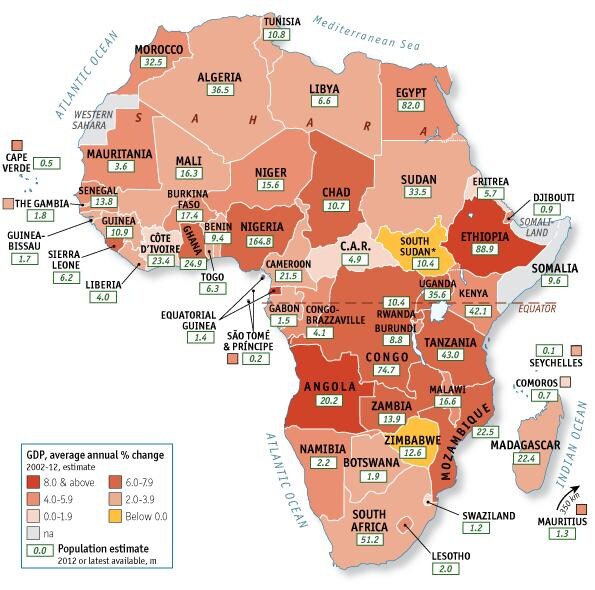
here’s a useful map of africa, displaying economic growth and population. h/t economist:
Ian Bremmer May 10, 201311:22 am
we are discussing africa in 50 years. between now and 2050, africa is projected to provide half of all global population growth. it is the demographic nexus of the coming decades
Ian Bremmer May 10, 201310:54 am
we’re underway.
“a panel on the future of africa.” the african union’s 50th anniversary…
Ian Bremmer May 10, 201310:53 am
when it comes to an african future of fragility AND stability, here is a telling statistic:
2/3 of africans are under 25 years old.
that’s a huge plus for economic growth; it could also spell political instability if this younger demographic’s aspirations are impeded
Ian Bremmer May 10, 201310:49 am
here’s an interesting statistic:
Inter African trade just 12% #EU is 65% #Asia 40% another growth chance in Africa make sure you retool the workforce as well #wef #africa — Philip Jennings (@PJenningsUNI) May 10, 2013
Ian Bremmer May 10, 201310:44 am
here’s a list of the heavy hitters present in cape town for the summit: http://www.forbes.com/sites/mfonobongnsehe/2013/05/09/the-richest-people-at-the-world-economic-forum-on-africa/?utm_campaign=forbestwittersf&utm_source=twitter&utm_medium=social
Ian Bremmer May 10, 201310:38 am
uhuru in the house…
President Uhuru Kenyatta just walked in for the Africa 2063 session. #WEFAfrica — #ff @NaijaTeenz (@omojuwa) May 10, 2013
Ian Bremmer May 10, 201310:36 am
ready and waiting to liveblog the upcoming summit on the future of africa– should be good fun..!