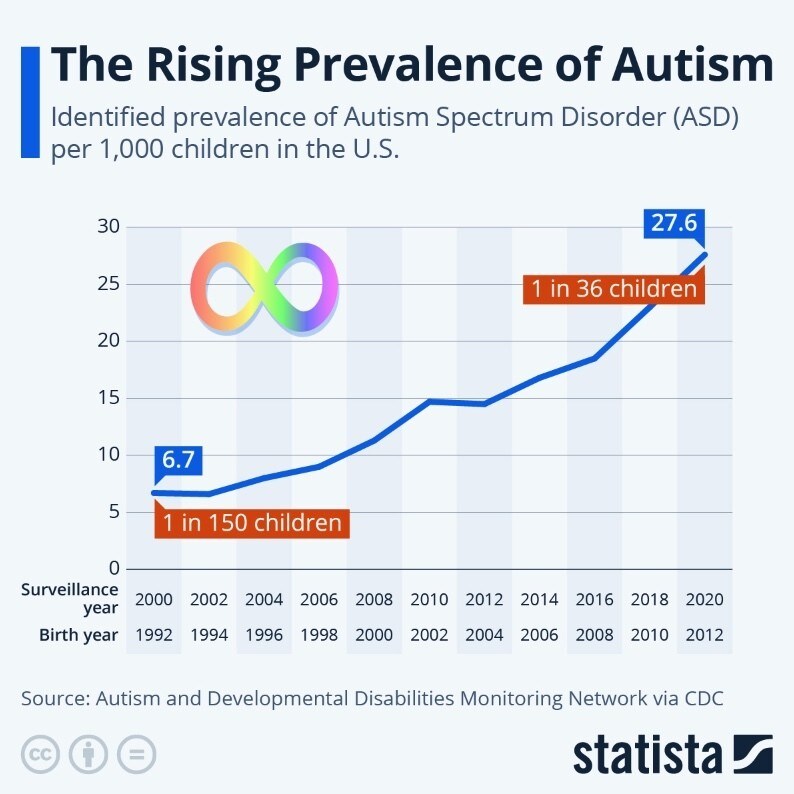
Around 1 in 36 children in the US get diagnosed with autism spectrum disorder, up from 1 in 150 children 20 years ago, according to the CDC.
Some possible factors include better awareness and screening for autism, changes in diagnostic criteria, and environmental or genetic factors.
Autism spectrum disorders are a very diverse group of conditions, and major progress has been made in increasing awareness and acceptance of autism in recent years.
According to the Centers for Disease Control and Prevention (CDC), the prevalence of autism among U.S. children has risen significantly in recent years. While 6.7 in 1,000 children were diagnosed with autism spectrum disorder (ASD) in 2000, that number had risen to 27.6 in 1,000 children by 2020. This means that currently 1 in 36 children in the U.S. get diagnosed with ASD, up from 1 in 150 children 20 years ago.

The reasons for this increase in prevalence are not fully understood and are likely complex. Some possible factors that have been proposed include better awareness and screening for autism, changes in diagnostic criteria, and environmental or genetic factors. Regardless of the reasons, this rise in the number of children with autism highlights the importance of early identification and intervention to help children with ASD reach their full potential.
In recent years, major progress has been made in increasing awareness and acceptance of autism. Thanks to that progress, many people are now aware that autism spectrum disorders are a very diverse group of conditions, that go far beyond the often-stereotypical depictions of autism in film and television. According to the World Health Organization, autism spectrum disorders are “characterized by some degree of difficulty with social interaction and communication. Other characteristics are atypical patterns of activities and behaviours, such as difficulty with transition from one activity to another, a focus on details and unusual reactions to sensations.”
What's the World Economic Forum doing about diversity, equity and inclusion?
The Centre for New Economy and Society connects leaders to make sense of how economic and technological change is reshaping jobs, skills and opportunity.
Through shared insight and collaboration, the Centre enables partners to explore inclusive economic models that support people and societies through transition.
This year’s World Autism Awareness Day, celebrated on April 2, promotes the transformation away from the narrative of curing or converting autistic people towards a focus on accepting, supporting and including them. “Toward a Neuro-Inclusive World for All” is the motto of this year’s observance, organized by the United Nations Department of Global Communications and Department of Economic and Social Affairs, in collaboration with the Institute of Neurodiversity (ION), an organization established and run by neurodivergent people for neurodivergent people and allies.