
This daily roundup brings you a selection of the latest news updates on the COVID-19 coronavirus pandemic, as well as tips and tools to help you stay informed and protected.
Today's top stories: The global death toll rises above 250,000; researchers in the US have doubled the country's death toll forecast; France's first known coronavirus case was in December; and world leaders pledge $8 billion to fight the virus.
1. How COVID-19 is impacting the globe
Confirmed coronavirus cases are at more than 3.5 million worldwide, according to Johns Hopkins University. More than 250,000 people have died from the virus, while over 1.1 million have recovered.
Researchers in the US have doubled the country's death toll forecast.
France's first known coronavirus case was in December, new testing shows.
Lockdowns ease around the world.
World leaders pledge $8 billion to battle coronavirus.
2. Why ‘shoe-leather’ contact tracing can’t be ignored: WHO briefing
While high-tech tools have enhanced modern contact tracing efforts, they are still no substitute for public health basics, said Michael J. Ryan, Chief Executive Director of the World Health Organization (WHO) Health Emergencies Programme.
Though apps and tools from countries such as South Korea and Singapore helped make tracing more efficient, these nations still leveraged classic tracing measures. They found cases at the community level, conducted community based surveillance and “got boots on the ground”.
“I.T. tools do not replace the basic public health workforce that is going to be needed to trace, test, isolate and quarantine," Ryan said.
3. How long could the COVID-19 pandemic last? US experts share their findings
A report published Thursday suggests the world could be grappling with the coronavirus pandemic into 2022.
Researchers at the Center for Infectious Disease Research and Policy (CIDRAP) found that the COVID-19 outbreak won't recede until 60% to 70% of the human population is immune to the virus. This could take between 18 and 24 months.
4. When will we see the COVID-19 vaccine? Bill Gates weighs in
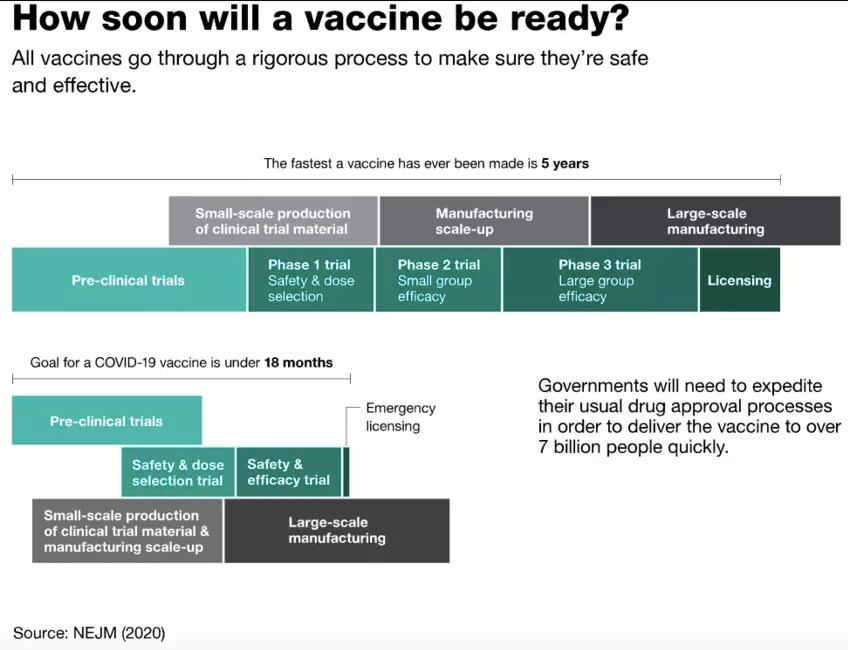
A vaccine for coronavirus is being developed at a record pace, Bill Gates explained in a recent edition of Gates Notes. While vaccines can take five years to develop, a COVID-19 vaccine could be available in as soon as 9 months or as long as two years. The founder of the Bill and Melinda Gates Foundation shared the below timeline from the New England Journal of Medicine to show how the process is being streamlined.
5. Are handshakes a thing of the past? Infectious disease experts think so.
COVID-19 has forced a rethink of the handshake. Handshakes are a “critical vector” for transmitting microorganisms, including viruses, according to a group of scientists in the Journal of Dermatological Science. Other infectious disease specialists long ago stopped shaking people's hands, claiming they have a cold when they meet new people. Since the coronavirus hit, even top US expert Dr. Anthony Fauci has stopped the practice. “You don’t ever shake anybody’s hands,” Fauci said recently. “That’s clear.”