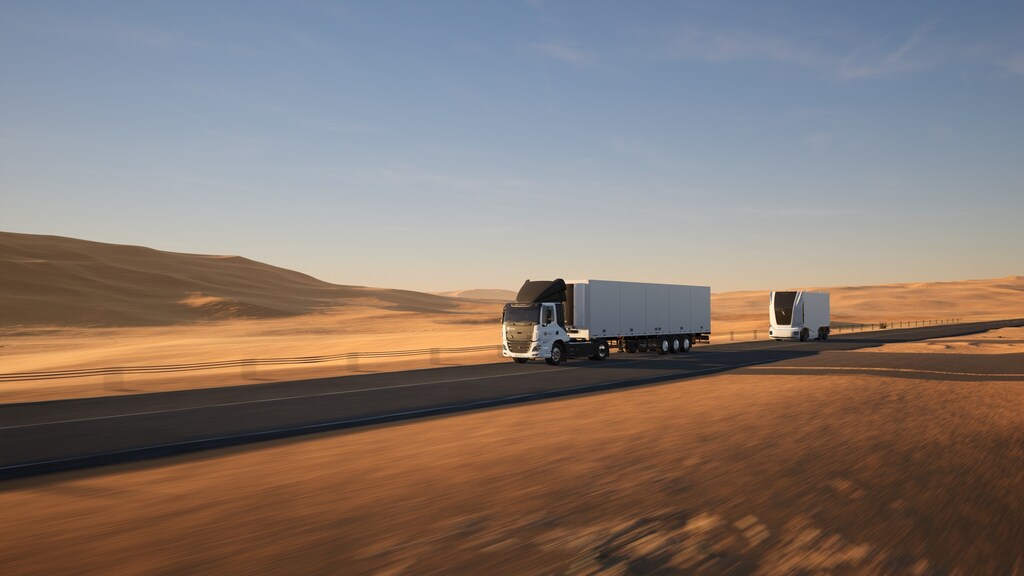
Road freight is where real change in carbon emissions can happen swiftly and it is also the perfect scenario for autonomous transport technologies.
Deploying autonomous solutions today means selecting the right use cases and a step-by-step approach.
A signed MoU between Einride and the UAE government plans to deploy 200 autonomous vehicles and an entire freight mobility grid across 550km.
Part of the job of innovators and entrepreneurs is to showcase the future, to give society the confidence it needs to support transformational change. The other part is getting us there. This includes finding the right partners, ensuring funding is in place, assisting the development of legal frameworks and, of course, deploying and scaling the solutions that will ultimately fulfil this vision.
By now, everyone knows the importance of electrifying vehicles to sharply reduce greenhouse gas emissions and avoid a climate catastrophe. But it’s not just a matter of completely eliminating tailpipe emissions; the opportunities in making the switch are far-reaching, particularly if you take innovation up a notch.
Let’s take a look at the freight industry, for instance. The sector has been struggling with low margins; low utilization, with vehicles making empty trips back; and a rapidly decreasing workforce with 3 million driver positions unfilled. Transportation represents 25% of global emissions.
How is the World Economic Forum promoting sustainable and inclusive mobility systems?
The World Economic Forum’s Platform for Shaping the Future of Mobility works across four industries: aerospace and drones; automotive and new mobility; aviation travel and tourism; and supply chain and transport. It aims to ensure that the future of mobility is safe, clean, and inclusive.
Through the Clean Skies for Tomorrow Coalition, more than 100 companies are working together to power global aviation with 10% sustainable aviation fuel by 2030.
In collaboration with UNICEF, the Forum developed a charter with leading shipping, airlines and logistics to support COVAX in delivering more than 1 billion COVID-19 vaccines to vulnerable communities worldwide.
The Road Freight Zero Project and P4G-Getting to Zero Coalition have led to outcomes demonstrating the rationale, costs and opportunities for accelerating the transition to zero emission freight.
The Medicine from the Sky initiative is using drones to deliver vaccines and medicine to remote areas in India, completing over 300 successful trials.
The Forum’s Target True Zero initiative is working to accelerate the deployment and scaling of zero emission aviation, leveraging electric and hydrogen flight technologies.
In collaboration with the City of Los Angeles, Federal Aviation Administration, and NASA, the Forum developed the Principles of the Urban Sky to help adopt Urban Air Mobility in cities worldwide.
The Forum led the development of the Space Sustainability Rating to incentivize and promote a more safe and sustainable approach to space mission management and debris mitigation in orbit.
The Circular Cars Initiative is informing the automotive circularity policy agenda, following the endorsement from European Commission and Zero Emission Vehicle Transition Council countries, and is now invited to support China’s policy roadmap.
The Moving India network is working with policymakers to advance electric vehicle manufacturing policies, ignite adoption of zero emission road freight vehicles, and finance the transition.
The Urban Mobility Scorecards initiative – led by the Forum’s Global New Mobility Coalition – is bringing together mobility operators and cities to benchmark the transition to sustainable urban mobility systems.
Contact us for more information on how to get involved.
The only way to tackle each and every challenge is to combine digital, electric and autonomous technologies in a complete ecosystem. It’s about turning road freight into intelligent movement.
This digital, electric and autonomous future has the potential to give cities back to people. With digital capabilities, traffic congestion is reduced by at least 20%, as is energy consumption – something current AI models in road freight can already deliver. Fully electric vehicles mean the air is cleaner and the streets are quieter. And, to top it all, autonomous electric trucks working seamlessly 24/7 have the potential to democratize access to goods and services as shipping costs are drastically reduced. The cabless trucks can also improve working conditions with the pivotal role of the remote operator, keeping a human in the loop and ensuring safety at all times.
Ambitious projects are key to pushing boundaries
The first project showcasing this complete ecosystem at scale was announced last May in a collaboration between the United Arab Emirates government and my tech company, Einride, with the ambitious goal of fast-tracking the region to sustainable shipping.
Through a signed Memorandum of Understanding (MoU), the project will look to deploy a freight mobility grid across Abu Dhabi, Dubai and Sharjah that includes 200 autonomous trucks, 2,000 electric trucks and the charging infrastructure to support their deployment with eight charging stations that amount to over 500 charging points.
The entire grid is connected to the freight operating system Einride Saga, which simplifies road freight management, removes industry inefficiencies, provides uninterrupted operations and improves energy use.
The impact on the region will be vast. In Dubai alone, the transportation sector is responsible for 10 million tonnes of CO2e emissions each year. When looking at the UAE, the transportation sector is responsible for around 760 million tonnes of CO and 134 million tonnes of NOx emissions each year.
The project comes at a time when the UAE has announced its own ambitious plans to reach carbon neutrality. The Net Zero by 2050 initiative combines programmes across several sectors. To achieve sustainable transportation, the country is looking to mobility management and electric and autonomous vehicles, among other strategies.
Einride’s autonomous vehicle made its first public appearance in Dubai during COP28 and we had the opportunity to highlight our local efforts alongside the UAE’s Ministry of Energy and Infrastructure.

A step-by-step approach at the core for autonomous vehicle fleets
Einride has an ambitious vision for autonomous freight. But we won’t get there overnight – be wary of those who promise that. There are a lot of challenges yet to be solved. It will take continuous development, investment and testing to reach its full potential.
This means taking a step-by-step approach to ensure the technology matures along with the market and society. The fleets of electric vehicles we currently deploy with customers globally are essential to building an autonomous future. We are teaming up with key private and public stakeholders to get the infrastructure in place and are educating an industry used to combustion engines – after all, it’s completely different to operating electric trucks as you have to take charging into account and orchestrate it perfectly to ensure delivery precision.
Then, there’s the selection of the best use cases for continuously improving autonomous technologies. When developing innovative solutions as transformative as autonomous transport, we have to start with the lower complexity scenarios and then evolve to more complex ones, step by step.
As the World Economic Forum covered earlier this year, Einride believes that the repetitive and predictable nature of freight makes it the perfect environment for autonomous technologies to be deployed and scaled. This is what we’re proving together with customer GE Appliances in daily autonomous electric operations in Selmer, Tennessee.
This partnership evolved into the daily transport of air conditioning units between GE Appliances’ manufacturing facility and warehouse from Monday to Thursday, after a successful pilot in 2022 that was followed closely by state and county officials. It all started with another important actor, the National Highway Traffic Safety Administration (NHTSA), which granted us the first U.S. approval to operate a cabless autonomous heavy-duty vehicle on public roads.
The breakthroughs happening in Tennessee highlight how collaborations are essential in accelerating the transition to a different and better way of moving goods. The same is true regardless of sector. We need public and private actors working together to ensure that innovation has the ideal conditions to flourish and that society can benefit from these solutions.
The only way to create the future we want is to build it.