This weekly round-up brings you key environment stories from the past seven days.
Top environment and climate change stories: China's President Xi Jinping vowed to 'eliminate' air and water pollution; Development bank climate finance grew in 2021; Oslo's mission to become the first capital with all-electric public transport.
1. News in brief: Top environment and climate change stories to read this week
President Xi Jinping on 16 October said China will give priority to environmental protection and promoting green lifestyles, and that the conservation of nature was an essential part of building a modern socialist country. In a speech opening the twice-a-decade ruling Communist Party Congress, Xi said China had made progress in tackling environmental problems over the last 10 years and vowed to 'basically eliminate' heavy air and water pollution while bringing soil contamination under control.
It comes as a World Bank report finds China needs up to $17 trillion in additional investments for green infrastructure and technology in the power and transport sectors to reach net-zero emissions by 2060.
Widespread flooding has killed more than 500 people in Nigeria, left around 90,000 homes under water and blocked food and fuel supplies, two government ministries said on 14 October. The floods have hit 27 of Nigeria's 36 states and impacted around 1.4 million people, the ministries for humanitarian affairs and for disaster management said.
Oslo, Norway, is on course to become the first capital city in the world with an all-electric public transport system, targeting that goal for the end of 2023 as part of its aim to become the world's first wholly emissions-free city by 2030.
How is the World Economic Forum promoting sustainable and inclusive mobility systems?
The World Economic Forum’s Platform for Shaping the Future of Mobility works across four industries: aerospace and drones; automotive and new mobility; aviation travel and tourism; and supply chain and transport. It aims to ensure that the future of mobility is safe, clean, and inclusive.
Through the Clean Skies for Tomorrow Coalition, more than 100 companies are working together to power global aviation with 10% sustainable aviation fuel by 2030.
In collaboration with UNICEF, the Forum developed a charter with leading shipping, airlines and logistics to support COVAX in delivering more than 1 billion COVID-19 vaccines to vulnerable communities worldwide.
The Road Freight Zero Project and P4G-Getting to Zero Coalition have led to outcomes demonstrating the rationale, costs and opportunities for accelerating the transition to zero emission freight.
The Medicine from the Sky initiative is using drones to deliver vaccines and medicine to remote areas in India, completing over 300 successful trials.
The Forum’s Target True Zero initiative is working to accelerate the deployment and scaling of zero emission aviation, leveraging electric and hydrogen flight technologies.
In collaboration with the City of Los Angeles, Federal Aviation Administration, and NASA, the Forum developed the Principles of the Urban Sky to help adopt Urban Air Mobility in cities worldwide.
The Forum led the development of the Space Sustainability Rating to incentivize and promote a more safe and sustainable approach to space mission management and debris mitigation in orbit.
The Circular Cars Initiative is informing the automotive circularity policy agenda, following the endorsement from European Commission and Zero Emission Vehicle Transition Council countries, and is now invited to support China’s policy roadmap.
The Moving India network is working with policymakers to advance electric vehicle manufacturing policies, ignite adoption of zero emission road freight vehicles, and finance the transition.
The Urban Mobility Scorecards initiative – led by the Forum’s Global New Mobility Coalition – is bringing together mobility operators and cities to benchmark the transition to sustainable urban mobility systems.
Contact us for more information on how to get involved.
More companies provided climate-related financial data to investors during 2021 but urgent progress is still needed, the G20's Taskforce on Climate Related Financial Disclosures (TCFD) said on 13 October.
Finance ministers from across Latin America and the Caribbean on 12 October called on the Inter-American Development Bank (IDB) to look at new finance tools to mitigate the economic shock of climate disasters.
The International Monetary Fund's Resilience and Sustainability Trust is now operational, adding an important financing instrument to help countries deal with climate change, pandemics and other longer-term issues, IMF Managing Director Kristalina Georgieva said on 12 October.
A growing number of African countries have introduced financial market policies related to environmental, social or governance issues, a study said on 13 October, as a global push to invest more sustainably gathers pace.
Small developing island states heavily exposed to the effects of climate change and often in critical debt situations spend at least 18 times more on debt servicing than they receive in climate finance, a report has shown.
2. Development bank climate finance rose 24% in 2021 - report
The world's biggest multilateral development banks increased their climate-related financing by 24% to $82 billion in 2021, a report by the lenders showed on 14 October, ahead of the next round of global climate talks.
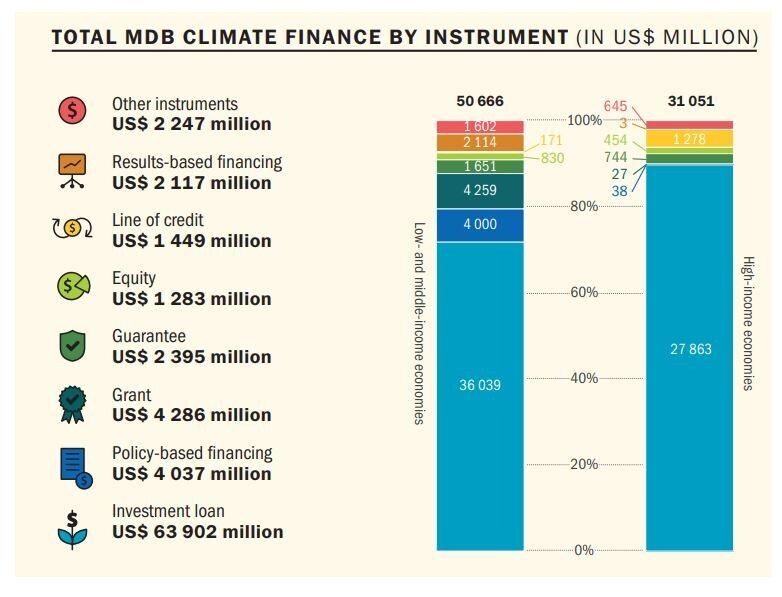
The role of such institutions, including the World Bank and European Investment Bank, in helping scale up financial support to developing countries is set to be one of the central talking points when countries meet in Egypt in November for COP27 talks.
Of the climate finance committed last year, around $51 billion, or 62%, went to low and middle-income countries. Of that total, more than $33 billion went to projects that aim to cut or mitigate climate-damaging emissions, the banks said in the report.
A further $17 billion went towards projects aimed at adapting economies to the increasingly costly impacts of climate change. At the same time, capital to the countries from private investors was $13 billion, the report said.
The 2021 figure remains a long way short of the estimated finance needed by emerging markets, however. A report by the world's biggest asset manager BlackRock last year put that figure at $1 trillion a year of public and private finance.
3. Carbon credit use could reduce companies' climate action, warns UK adviser
The use of cheap carbon offsets by companies to meet net zero targets could curb their efforts to cut emissions and slow the delivery of climate goals, Britain’s climate change advisers said on 13 October.
Many UK listed companies have set net zero emission targets, saying they would need to buy or generate carbon credits to offset residual greenhouse gases.
Offset credits, based on projects for planting trees or switching to less polluting fuels, currently trade in an unregulated, voluntary market with many different standards and approaches.
The current low price of many offsets, which can be purchased from exchanges for less than $4 a tonne of carbon dioxide, are providing a cheap way for companies to meet net zero goals which could reduce the incentive for them to directly cut emissions, a report by Britain's Committee on Climate Change (CCC) said.
“Offsets can mask insufficient efforts from firms to cut their own emissions, they often deliver less than claimed and they may push out other environmental objectives in the rush to capture carbon,” the report said.
4. More on the environment on Agenda
The UK has a target for all new heating systems to be low carbon by 2035, though key challenges will need to be overcome to achieve this, write two experts in this piece that looks at whether flexible, connected and smart heat pumps could be the solution to decarbonization.
Freshwater makes up just 3% of the water on Earth, while nearly two-thirds of the human population faces water shortages at least one month a year, according to the UN. This explainer looks at where freshwater comes from, why it's under threat and how we can safeguard it.
Many thousands of deaths could have been prevented by growing more trees and greenery in urban areas of the US over the past 20 years, according to a new study from Boston University. The researchers used NASA images to examine differences in tree cover around various US cities.