
World Economic Forum has released the first edition of the Net Zero Industry Tracker, in collaboration with Accenture.
A systemic and comprehensive assessment of the progress and gaps of heavy industries’ net zero journey reveals the scope of the challenge.
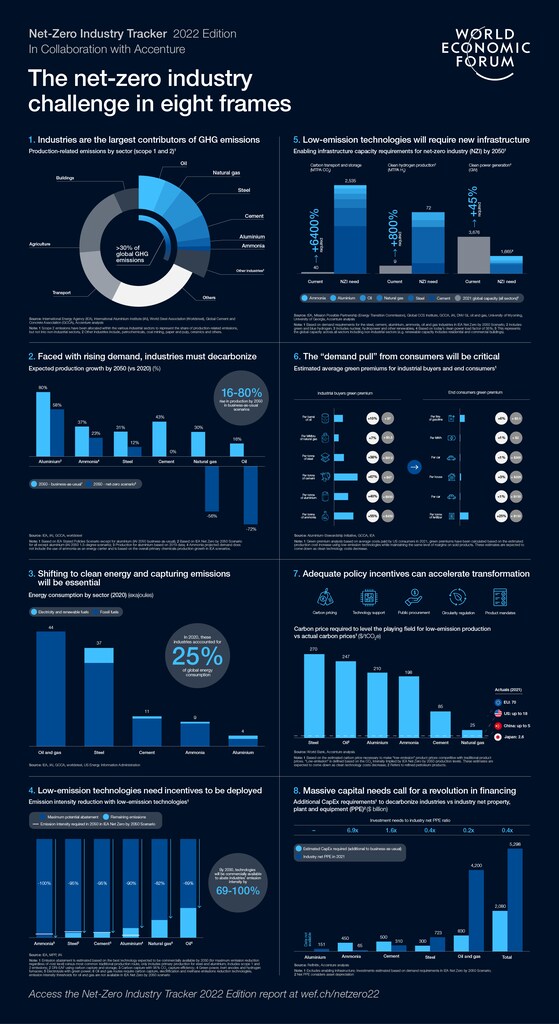
This infographic summarizes the extent of the gaps, highlighting the necessary actions for accelerated progress to net zero.
Industry accounts for nearly 40% of global energy consumption and more than 30% of global greenhouse gas emissions, so its decarbonization will be vital to tackling climate change.
A new initiative from the World Economic Forum, in collaboration with Accenture, will help this by monitoring and supporting the progress of heavy industries towards net zero.
The framework aims to track the "net zero performance" of various industries, as well as their "net zero readiness". In addition to explaining the framework, the report looks at priorities for six industries, as well as outlining seven cross-sectoral recommendations for immediate action.
The net zero industry challenge
"The challenges associated with industrial decarbonization are typically more complex than those of other carbon-intensive sectors," the report's authors write.
Work is under way, they say, but "no industry is anywhere near where it needs to be by 2050 and complex challenges within and across industries remain".
Created for the launch of the report and framework, this infographic outlines these challenges:
The World Economic Forum's First Movers Coalition is also working to support heavy industries' efforts to reach net zero. You can read more about the coalition here or watch below to learn more about its recent expansion.