As AI models evolve, designing them for model flexibility can reduce switching costs, protect existing investments and give businesses greater control over performance, security, data and deployment, as technology and market conditions change.
For much of 2026, the conversation around the value of artificial intelligence (AI) to the enterprise focused on model performance, token costs and the debate over frontier versus open-weight models.
Those factors are important but only part of the equation, as an evolving model landscape means companies must build systems that can keep pace with that change.
The best model for a particular workload today may be different six months from now. A proprietary large language model may be the right choice for one task, an open-weight model for another and a specialized small language model for a narrower workflow. Performance, security, cost, deployment location, data residency, sovereignty and policy requirements can all influence that choice.
This creates a long-term architectural question: how do you build AI systems that can adapt as the model ecosystem changes without repeatedly rebuilding the applications, workflows and governance around them? That is where optionality comes in, allowing companies to choose the right model for their current needs while preserving the ability to choose differently in the future.
1. The cost of switching AI models
Choosing a different model is only valuable if an enterprise can actually move to it. The value of an AI investment depends on how a model performs, what it costs to run and how easily a company can respond when a better option emerges.
Switching models is often harder than it looks. Prompts, workflows, and agent behaviour are often tuned to how a particular model interprets instructions, reasons through tasks and interacts with tools.
A different model may behave differently, so companies have to adapt that work and re-establish standards for accuracy, security and performance.
They may also need to transfer knowledge embedded in prompts, examples and context, because a new model may require that information to be structured or delivered differently.
These are real switching costs, including engineering work, knowledge transfer, testing, security review, validation and disruption to applications or business processes.
Architecture should contain those costs. A model change should require adapting and validating the intelligence layer, while the applications, workflows and governance around that layer remain intact.
2. Why enterprise AI architecture must support model flexibility
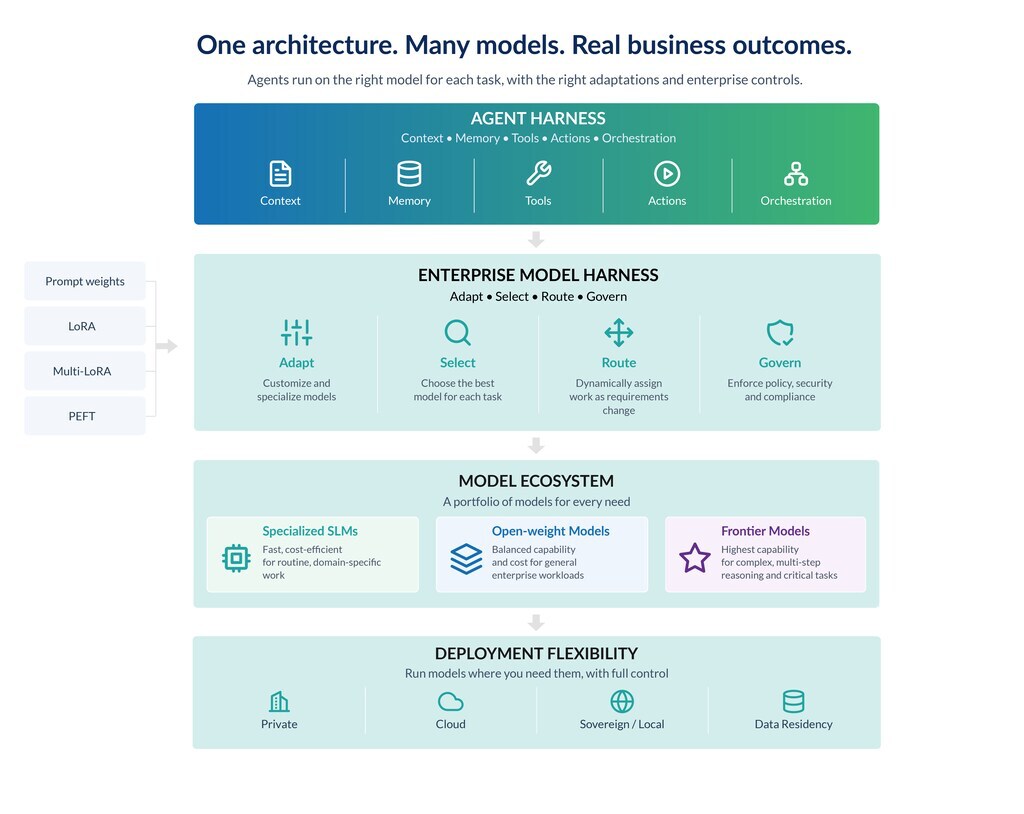
Optionality comes from a deliberate architectural choice to separate the model from the applications and business processes around it.
When an enterprise builds tightly around one model, dependencies accumulate. Applications and workflows become tailored to that model's behaviour and future changes become harder, even when a better or lower-cost model becomes available.
A well-designed AI system keeps the model separate from the applications, data, workflows and governance around it. Enterprises can then change a model when its performance, security profile, regulatory suitability or deployment requirements no longer meet the business's standards.
I think of the layer between applications and models as an AI harness. It controls how models are called, versioned and swapped, so applications can work across proprietary and open-weight models without being rebuilt around each one.
Evaluation systems can then test model and agent performance against enterprise standards before changes go into production. A model change becomes a contained technology change rather than an application rebuild.
That flexibility can also be applied continuously. Routine work can run on a smaller or specialized model. More demanding workloads can use a frontier model. Open-weight models can support workloads where deployment location, data residency or control are priorities. As quality, cost or policy requirements change, work can be reassigned across models.
3. AI model flexibility is becoming a strategic business advantage
Model optionality belongs on the board agenda. Enterprises are investing across infrastructure, data, applications, integrations, agents, governance and the operating changes required to scale AI in production.
Leadership should ask whether those investments can continue to create value, remain governable and adapt as the underlying technology changes.
Executives already apply this principle elsewhere. A company entering a major supplier relationship considers concentration risk, contractual flexibility and the implications of changing providers later. AI investments should be evaluated with the same discipline.
If a cheaper or better-fitting model appears next quarter, leadership should know how long it would take to put that model into production and what the transition would cost. If that move requires rebuilding the applications and processes around the model, the architecture has become the constraint.
A company that can evaluate a new model against its requirements and deploy it quickly can capture those improvements sooner, while keeping control over where its models run, where its data resides and how its AI infrastructure operates.
The ability to switch creates strategic and financial optionality but it also strengthens resilience. Instead of trying to predict which model provider will lead the market several years from now, enterprises can preserve their ability to choose as the market evolves, policies change or new sovereignty and deployment requirements emerge.
4. Building AI systems that adapt as models evolve
As enterprises plan their AI investments for 2027, they need to consider how easily their systems can adapt to new models while maintaining the necessary governance and control.
No enterprise can predict exactly which models will lead each category a year from now. Optionality means they do not have to. They can make the best decision available today while preserving their ability to make a different one tomorrow.
As AI becomes part of the infrastructure on which businesses operate, long-term advantage will come from the ability to choose, adapt and stay in control.
Enterprises need systems that can evolve as models, economics, regulations and geopolitical requirements change, without sacrificing the applications, institutional knowledge and controls built around them.