World Economic Forum Public Engagement Lead Naoko Tochibayashi
Tel.: 03-5771-0067 Naoko.Tochibayashi@weforum.org
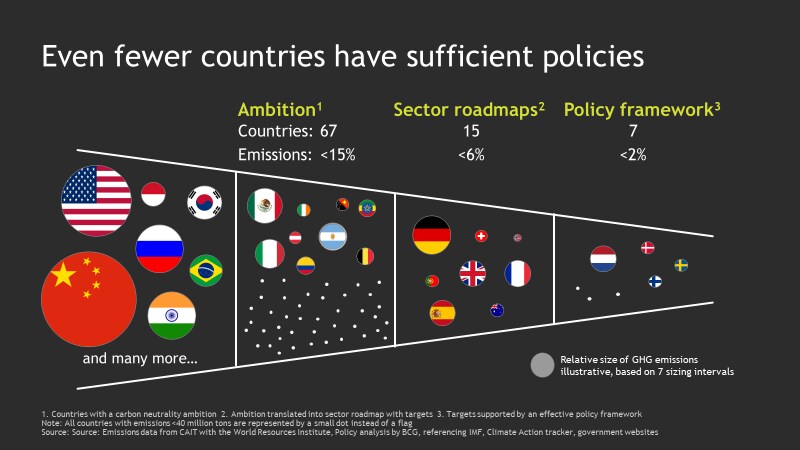
Currently, only seven governments worldwide are ambitious about climate action and support practical measures to achieve net-zero carbon emissions by 2050.
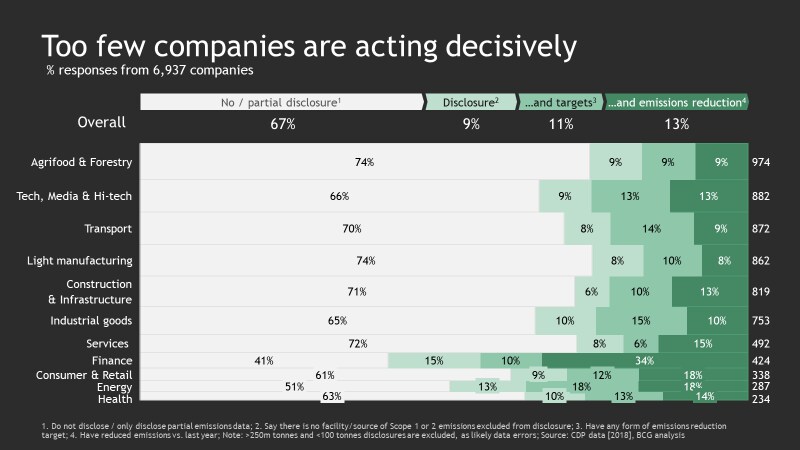
Of the companies that have already disclosed their carbon emissions, only one in eight has reduced emissions year on year.
Raising the level of ambition among governments and businesses is a priority for the World Economic Forum Annual Meeting in 2020 (commonly known as the Davos meeting), as well as for the Forum over the coming year.
The full report is available here.
Geneva, Switzerland, 11 December 2019 - The World Economic Forum has announced new findings in a new report, “The Net-Zero Challenge.” Four years after the Paris Agreement on climate change, concrete action by national governments remains far short even of the path needed to limit the average global temperature rise to 1.5°C. This is detailed in the recently published 2020 edition of the United Nations Environment Programme (UNEP) report titled “Closing the Gap.” In addition, most companies supporting emissions reductions are not taking the actions they should. In light of this situation, new incentives will be needed in 2020 to raise corporate targets to net-zero emissions by 2050 at the latest.
This report has been published against a backdrop of rising greenhouse gas (GHG) emissions. While the Paris Agreement called for annual emissions reductions of 3–5%, emissions have risen by an average of 1.5% per year over the past decade. If this continues, global warming will raise temperatures by 3°C–5°C by 2100, with devastating consequences for the planet and society. Meanwhile, the Intergovernmental Panel on Climate Change (IPCC) calls for GHG emissions to be reduced by 45% by 2030 and to reach net zero by 2050 in order to limit the temperature rise to 1.5°C.
“2020 will be a pivotal year for the Paris Agreement, and it is essential that governments and businesses work together ambitiously and begin setting and implementing targets. Amid a sluggish economic outlook, rapid collaboration on climate change between the public and private sectors could drive innovation, growth and jobs. What the world needs is to create a tipping point by combining public enthusiasm, policy certainty and business leadership,” said Dominic Waughray, a director of the World Economic Forum.
Governments: ambition on climate action is currently low relative to the scale of the challenge
To date, 67 countries have announced a target to reach net-zero emissions by 2050, and their GHG emissions account for about 15% of global emissions. Of these countries, only 16 (accounting for less than 6% of emissions) have established guidelines and interim targets. Even fewer have enacted policy frameworks that can provide practical support toward achieving net-zero emissions: Bhutan, Costa Rica, Denmark, Iceland, the Netherlands, Suriname and Sweden. These countries account for just 2% of global GHG emissions.
Nevertheless, the report also points to signs of progress, showing that some governments have begun setting ambitious climate action targets. Morocco, for example, has developed the world’s largest concentrated solar power plant, with the goal of sourcing 50% of its electricity from renewable energy sources within just 10 years. India is also currently carrying out the world’s largest renewable energy programme, targeting installed capacity of 175 GW by 2022.
Although ambitious climate action is not being implemented at the national level, the report notes signs of action at the local government level. For example, South Australia aims to raise its renewable energy share to 50% by 2025. In the United States, eight states aim to introduce zero-carbon energy systems by 2050.
Overall, the report emphasizes that much political work remains to raise ambition on climate action ahead of November 2020, when implementation of the Paris Agreement is scheduled to begin.
Business and climate action: new impetus needed
On business and emissions, the report also highlights the ambition gap that needs to be closed. An analysis limited to the approximately 7,000 companies that disclosed emissions to CDP, a nonprofit that monitors global emissions, found that only one-third fully disclose their data. The report states that only one-quarter have set specific emissions-reduction targets, and only one in eight has actually reduced emissions year on year.
There is also a difference between short- and long-term plans. The report finds that 65% of the emissions-reduction targets reported to CDP are short-term plans with end dates within five years from now.
The report also finds that, on average, both short- and long-term targets are only half of what is needed to limit the temperature rise to 1.5°C or less; that short-term targets currently aim for a 15% reduction rather than 30%; and that long-term targets currently aim for a 50% reduction by mid-century rather than net zero.
There are, however, some differences by industry. The report suggests that financial and energy-related companies are the most advanced in disclosing and setting targets and reducing emissions. In every sector, some companies are taking bold action, as early movers can gain a competitive advantage through improved efficiency, reduced risk and new environmentally friendly revenue.
The report, produced in collaboration with Boston Consulting Group (BCG), identifies two main reasons why corporate climate action has so far been modest. First, CEOs still face pressure to deliver short-term financial results, and that pressure outweighs the pressure to demonstrate progress toward climate goals. The proliferation of ESG (environmental, social and governance) guidelines has left the investment world, in the words of one bank CEO, “confused and without action.” The other reason is the lack of credible policy frameworks at the national and international levels. All 25 CEOs interviewed as part of the project said that, without a meaningful carbon price, the transition cannot be accelerated at the necessary speed and scale.
A call to action from the World Economic Forum
During 2020, the focus will be on diplomatic and multilateral political efforts to raise ambition among governments. The World Economic Forum will use its platform to call for more ambitious action among businesses.
This call to action begins at the 2020 Annual Meeting.
An updated “Davos Manifesto 2020” on the universal purpose of a company for all CEOs gathering in Davos to consider. It points out that companies are more than economic units that generate wealth, and says that performance should be measured not only by shareholder returns but also by how companies meet environmental, social and good governance goals.
An initiative under way by the Forum’s International Business Council is to develop a clear methodology for standard ESG principles that companies can adopt, with support from the “Big Four” accounting firms, to complement standard financial metrics. This includes a common approach to setting and tracking greenhouse gas emissions targets.
The “Lighthouse Projects” catalogue also provides concrete examples of how many leading companies have set and implemented bold emissions-reduction strategies aligned with net-zero emissions by mid-century, and how other companies can join or replicate these efforts. These Lighthouse Projects include the Mission Possible Platform, RE100, the UN-convened Net-Zero Asset Owner Alliance, CDSB, and more than 50 other examples of corporate action on climate and the broader environmental agenda.
To support these efforts, the World Economic Forum has also convened a community of CEO Climate Leaders, leaders of some of the world’s largest companies committed to supporting proactive climate action.
“Climate change is the greatest threat facing humanity. Companies that do not take climate action seriously will face a backlash not only from stakeholders but also from the planet,” said Alan Jope, CEO of Unilever.
<Reference>
The full report is available here
Make the Annual Meeting the most sustainable ever: wef.ch/sustainability
Read the Forum Agenda: http://wef.ch/agenda
Facebook: http://www.facebook.com/japanweforum/ Video channel: http://wef.ch/video
Twitter: @wef or @davos, join the conversation with the hashtag #wef19
Instagram: http://wef.ch/instagram
LinkedIn: http://wef.ch/linkedin
Subscribe for updates: http://wef.ch/news
Impact: http://wef.ch/impact
Follow the conversation on WeChat at davos_wef