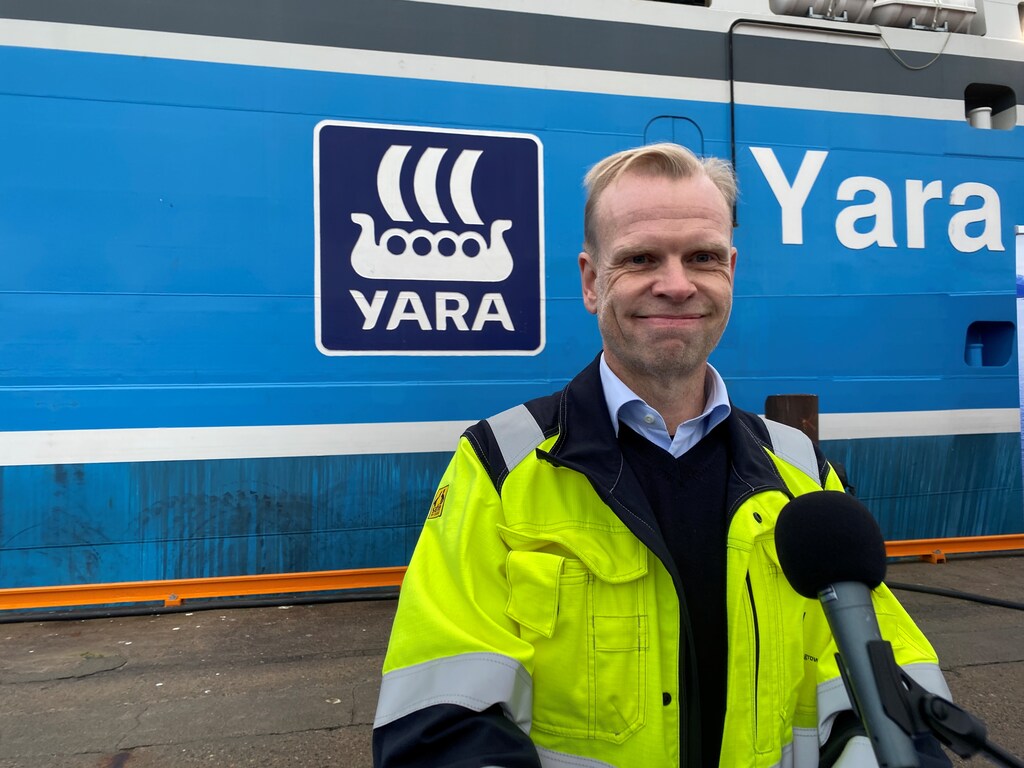
The closure of the Strait of Hormuz put a squeeze on oil and pushed up energy prices - but it has also had a big impact on food. Svein Tore Holsether, head of fertilizer company Yara International tells us why.
This transcript has been generated using speech recognition software and may contain errors. Please check its accuracy against the audio.
Svein Tore Holsether, President & CEO, Yara International: Around half of the food produced in the world is a direct result of fertilizer or nutrition being applied in the field. Nitrogen fertilizer, urea, about 30% of the traded volume goes through the Strait of Hormuz.
Robin Pomeroy, host Radio Davos: Welcome to Radio Davos, the podcast from the World Economic Forum that looks at the biggest challenges and how we might solve them. This week, we think a lot about the impact of geopolitics on the flow of energy. But what about another important economic input - fertilizer?
Svein Tore Holsether: When you have disturbances in the supply chain, the flow of product, in one part of the world, it spills straight into the availability and affordability of food in other places in the world. And we saw that highlighted with the Strait of Hormuz. Because we might think of that as a regional conflict, but it has global implications, both because of energy going through the Strait of Hormuz, but it's also one of the most important shipping lanes for fertilizer.
Robin Pomeroy: Svein Holsether, CEO of multinational fertilizer company Yara International, also tells us about his sector’s responsibility to help reduce greenhouse gas emissions from the farming and food sector.
Svein Tore Holsether: While we've be able to increase production, we also have to take into account that we have increased emissions as well. Now we need to do both. We need to further improve productivity. We need to produce more food for a growing population. At the same time, we need to bring down emissions as well, that's an incredibly complex thing to do.
Robin Pomeroy: Follow Radio Davos wherever you get podcasts, or visit wef.ch/podcasts where you will also find our sister programmes, Meet the Leader and Agenda Dialogues.
I’m Robin Pomeroy at the World Economic Forum, and digging at how geopolitics impacts fertilizer and food…
Svein Tore Holsether: It's a fragile system and it's not resilient enough to deal with shocks like this.
Robin Pomeroy: This is Radio Davos.
Geopolitical shocks have economic impacts - and usually the most evident one is on the price of energy - something that can have all kinds of knock-on impacts across the economy across the world.
But there's another material which is also very important for the economy but is less visible to most of us, and that's what we’ll be hearing about in this episode.
Svein Tore Holsether is CEO of Yara International, a major producer of fertilizer - on which huge amounts of the world’s food production relies.
Svein was in our New York office recently so my colleague Linda Lacina took the opportunity to try to understand more about the issue. This conversation ranges from the impact of the Strait of Hormuz closure to climate change and the climate COP.
Here’s Linda’s interview with Svein Holsether.
Svein Tore Holsether: I'm Svein Holsether, I'm the CEO of Yara International.
Yara is a company that is 121 years old. We were founded in 1905, solving one of the biggest challenges that humanity faced at the time, and that was hunger. And our founder came up with the innovation that was able to extract nitrogen from the air and created the fertiliser company that we are today, and that operates in 60 countries across the world. We sell our products to 140 countries and purpose-driven organisation to responsibly feed the world and protect the planet.
Linda Lacina: The Hormuz crisis reminded everyone around the world how important fertiliser is, but can you sort of lay out the impact that a crisis like that has on farming and food prices around the word, maybe for those who aren't fully familiar?
Svein Tore Holsether: The food system, as we know it today, has done a tremendous job over the last decades to feed a growing population. Hundreds of millions of people, billions have been brought out of famine.
And it's because of growing food where it makes the most sense, tremendous flows of products across the world has enabled that system to feed a growing populations. At the same time, That is also a weakness, right?
When you have disturbances in the supply chain, the flow of product in one part of the world, it spills straight into the availability and affordability of food in other places in the world.
And we saw that highlighted with the Strait of Hormuz. Because we might think of that as a regional conflict, but it has global implications. Both because of energy going through the Strait of Hormuz is also one of the most important shipping lanes for fertiliser, nitrogen fertiliser, urea. About 30% of the traded volume goes through the Strait of Hormuz. And when that is interrupted or delayed, that has an impact on farmers across the world.
So it just highlights that it's a fragile system and it's not resilient enough to deal with shocks like this.
Linda Lacina: Oil companies and exporting countries have all kinds of different ways that they're looking to diversify, pipelines to the Red Sea. But what can a fertiliser company do? How did you guys mobilise? How did your react?
Svein Tore Holsether: Well, at Yara, we're a battle-tested company, to put it mildly, with what we've been through in the last six years in particular, it's been some sort of state of emergency for six years straight now, starting with COVID and how that impacted the ability to move products across borders and get to the fields of the farmers.
We saw it on Russia's invasion of Ukraine and how that impacted both farmers in Ukraine, but also food costs and availability in other parts of the world. And now with the Strait of Hormuz.
So for us as a company, we've learned from this and we built more resilience into our operating model. How do we run our plants more flexibly? How do we shift between different kinds of raw materials to be able to source for more parts of the world to deal with the disruptions?
But I think the key that we can do as a company is really focusing on farmers, the fields of the farmers, how do you create resiliency? How do you make agronomic advice available to farmers? How did we get the most out of every kilo of nutrient or fertiliser that we produce so that we can maximise the yields of the of the farmers? How can you think about the entire food value chain, the food system? How to create a more resilient one, more able to deal with shocks like this?
Linda Lacina: When it comes to that resilience, whether it's for farmers or even the plants or other things like that, what's something that you guys do now, just as a matter of course, that you just didn't need to have in place six years ago? What's like a tangible thing that can kind of help people understand sort of how you guys mobilise?
Svein Tore Holsether: One obvious one is how we think about sourcing because we've gone from decades of more and more global trade and more and more rules-based trade as well. And as a result of that, companies were able to lower their cost of production.
But we didn't to a great extent take into account that. Maybe this will change. Maybe there will be a new reality. Maybe you won't be able to get access to the same raw materials as you did before.
So it's about diversifying the sourcing of raw materials. Also, redesigning our plants to be able flex much more than they did, because to produce fertiliser, you need large amounts of energy and when we see how energy cost has fluctuated, we need to be able to deal with that so that we reduce production when the energy prices are really high and then the opposite when they're lower. So to flex that production much more.
And this is something that we've done all the way to the shop floor, engaging our operators, the ones that know the processes the most and then invest in these ideas to create that resilience in how we produce the product.
And then it's also flexing between our plants using the global network that we have when we are operating in 60 countries across the world. That also in itself is part of the resilience. It's how we ship our products and then how we work with farmers, how we make technology available and also the fact that we have 121 years of agronomic competence. That's also very useful in these challenges that farmers are meeting today.
Linda Lacina: You talk about diversifying sources. What does that look like in practise?
Svein Tore Holsether: Well, fertiliser is nutrition for the plants, or think about it as the food for the plant. And they need several nutrients. Just like us human beings, you need a balanced diet. So you need these nutrients in order to grow.
Some of them are available in large quantities, but not all of them. And they needed to be shipped across the world. Some of the are located in areas of conflict or involved in conflict or need to be transported through areas of conflict. And if there's anything we've been learning from the last few years that there's great unpredictability in that and then you need to have the sources available in other parts of the world. But also for a company like us it's not like we can just switch from one source to the other. The characteristics are different. So how do you run these in your plants as well? So you need to build that robustness into the operating process as well.
And that's how we work together with our people on the shop floor operating the plants to help them also to deal with rapid switching of raw materials in order to be able to make our finished products, which is a multi-nutrient product that we bring to the field of the farmer.
Linda Lacina: A lot of consumer countries are diversifying away, of course, from oil, using renewables, but is there a similar fertiliser transition as there is an energy transition? Is there something like that that's also happening in this sector?
Svein Tore Holsether: Yes and no, because fundamentally when it comes to fertiliser and how do you diversify, well, it's food for the plants, right? So if you stop feeding the plants they will not grow. So it's not like you can just discontinue the use of fertiliser. It's responsible for around half of the food produced in the world is a direct result of fertiliser or nutrition being applied in the field of the farmers.
But it is possible to be more precise on how you apply fertiliser, more targeted, putting the right nutrients into the field. It's also about the farming techniques in order to get the maximum benefit of the fertiliser.
And that's where we come in with the expertise that have from decades of field trials, using sensor technology.
Just a few weeks ago, I was in the field of one farmer that uses our sensor on top of the tractor is called an end sensor. That sensor reads the field in front of the tractor to see, okay, so how much nutrient is needed? And then that's connected to the spreader of fertiliser behind the tractor. And that has multiple benefits. It's reducing the consumption of fertiliser. That's one obvious benefit. But it's also creating a more level field of crop for the farmers. So fertilise less where you don't need as much fertiliser, more where it's needed, and then you get much more consistency and more precise nutrient use.
So that's the main contribution that we can do, utilising technology to support the farmer, but also creating resilience through that.
Linda Lacina: What are the next choke points, in your mind? Like what are you sort of planning for to make sure that you guys can kind of remain resilient? Can you take us through the maybe vulnerabilities that might be happening in the future and what's important to watch?
Svein Tore Holsether: When it comes to choke points and new things that could happen. Let's deal with the ones that we're already facing and it's multiple challenges right now.
One is geopolitics, its energy cost, and let's keep in mind why do we consume food in the first place as humans, right? It is to get energy and it takes energy to produce food. So, what starts as an energy cost issue goes straight into the food system.
And then we have climate change.
I've been with a lot of farmers over the last few months now and I've seen directly how extreme weather is implicating their ability to produce crops. Whether it's drought or flood or first drought and then flood, which is also the case many, many, places. Heat stress, all of this is impacting the ability to do farming.
And it seems like what happened once a century is becoming an annual event. So it is for many the new normal with volatility, how to deal with that is also a challenge.
But at the same time, we shouldn't only focus on all the challenges, but also the opportunities in this. And that's how we should think about putting the farmers at the centre of this, because the food system is also responsible for a lot of the emissions. I think about 30% of global emissions come from the food system, and the farmers are the ones that are hardest hit, or one of the occupations hardest hit by climate change.
So how do we work with the farmers to help them to transition through this? And I think key to that is profitability. Many farmers are struggling right now with lack of profitability. And unless they're profitable, they will not be able to reinvest. And if the farmers are not profitable, fertiliser producers will, I mean, we're in the same value chain, right? So we will not prosper unless farmers are prospering.
And then we need more food and we need to look after emissions as well. But it is possible to both reduce emissions and to grow more food, but it requires a very targeted approach.
Linda Lacina: You mentioned programmes you guys put into place and the importance of making sure that farmers are profitable. Can you give an example of some of the ways that Yara is helping these farmers stay profitable and maybe whether you're advising them or, you know, other sort of resources that you're making available? What sort of things are maybe especially helpful with the Hormuz crisis?
Svein Tore Holsether: Well, and we made a lot of our tools available for the farmers as well, and that is to put the right nutrients in order to get maximum benefit per kilo or also per dollar that you use for fertiliser into the field.
Also making our agronomic competence available for, you know, what fertiliser do you use for which crop? How do you translate that into the highest profit possible for farmers as well? How do deal with heat stress, for instance?
And I was late last year in the south of Spain that has been especially hard hit with heat and also to some extent drought as well. And where our agronomists in the field of the farmers, they work with them on bio-stimulants that are helping to put the right products and the right biologicals into the ground in order to help the crops to deal with the impact of heat stress so that rather than, you know, for some farmers not getting any yields at all or very low yields, they are able to deal with the heat stress and grow crops under conditions where it would normally be very challenging.
And that's where we're making some of our biggest investments right now, is to scale up more bio-stimulants to help farmers deal with these extreme conditions.
Linda Lacina: Is there like a before and after like is there what kind of can you make the the impact of that tangible for us so we understand the benefits that happen?
Svein Tore Holsether: I could spend a full podcast just talking about the impact.
But one that made a particular impact on me was in Kenya, in the countryside outside Nairobi. I was together with my colleagues that had supported a farm on getting the right nutrients into the field to create a more healthy soil.
When you have a healthy soil, you get so many other things for free. If you have a healthier soil, it's more nutritious, it's better at handling water, and it's more resistant to extreme weather.
So what had happened in that area was at first they had drought and then heavy rain. Several farms in the same area, and the ones that didn't have healthy soil, it's not that they didn't get, or that they got less yield, the whole crop was gone. The field was black. It had been washed away.
While the farmer that had healthy soil still had a crop and was able to grow it. And that is because of the focus on healthy soil.
That is an extreme example, but that is the reality out there. If you get healthy soil, if we're able to contribute with your agronomic competence and the products that we have, that we can make a huge difference on the ability to grow food, but also to withstand extreme weather conditions that are. I think we have to expect, it's the new normal. .
Linda Lacina: You mentioned that, hey, you guys have been through battle tested, especially across the last six years. But even in the last year with the Strait of Hormuz, was there like an emotional moment that really kind of drove home to you that like, gosh, you know, we've already had issues with food insecurity and famine all around the world, and this is a new challenge, What was maybe an emotional reaction or a surprise that you had this particular year?
Svein Tore Holsether: Well, it's always difficult to meet farmers that are struggling. All businesses and all business owners feel pain when the business is not profitable.
But I think it's particularly difficult for farmers because they run a business, but very often it's also a family legacy, right? It's inheriting the farm from the parents and then the responsibility to bring it to the next generation, to their children. And if you feel that you're not able to do that, you're facing bankruptcy, you are not able to continue that tradition and to hand it over to your children, that's really, really difficult.
And I can see it and I've been in so many houses sitting around the kitchen table with farmers and see that kind of desperation and how tough that is. That makes a big impact on me.
And these discussions have been more frequent in the last few years because it is tough right now.
And then right now, as we're sitting here in the fall of 2026, I'm also deeply impacted by what I've seen before, but also what I hear from my colleagues in Ukraine.
I was there last year in the fields of the farmers. And I see these farmers are risking their life for producing food for the country, but also for exporting to other parts of the world. Farmers have been killed while doing that work. There are mines in their fields. They're risking their lives to go out there to produce food.
This year, they have, against all odds, been able to produce a higher crop yield than last year. Only now to be faced with attacks on infrastructure, on inventories, vessels, so that they're struggling now to sell their crops and to get the revenue. And some of them are wondering whether it's worthwhile bringing in the harvest at all after risking their life to grow that.
And that has huge implications for many Ukrainian farmers now that risk losing significant money, maybe some are losing their livelihoods as well as a result of it. And it has global implications on the availability of food. That makes a huge impact on me.
Linda Lacina: With all of this, and again, you mentioned you guys are battle-tested, you've got this long history, but still worry has its uses. What keeps you up at night?
Svein Tore Holsether: There are of course many things that we need to to deal with, but I'm very fortunate to lead a company that has a very clear purpose. Every single colleague in our company know what our purpose is. That is a very strong force to drive performance throughout our entire organisation because we all know how important what we do is for food production but at the same time also looking after and emissions back to our purpose to responsibly feed the world and protect the planet.
That purpose everyone knows. I don't have to worry about our organisation's ability to do whatever we can to deal with this.
But we're also living in very exciting times right now. And then I'm thinking about the fourth agricultural revolution.
We were an important driver of the third agricultural revolution driven by better inputs to help farm productivity. We are now in the fourth agricultural revolution that is driven by technology, but now that is being accelerated significantly because of artificial intelligence and the power of these models in order to drive productivity and to really accelerate this agricultural revolution.
And that's something that we're spending a lot of time on and that I think is a huge opportunity for a company like ours. The more science and the more data that goes into policy making and decision making in farming, I would say the better it is for our company.
Linda Lacina: For folks who aren't maybe familiar with the fourth agricultural revolution, can you take us through the different stages? So they have a better sense of kind of where we've been and where we're going
Svein Tore Holsether: We've been able to drive a lot of productivity through better seeds, better and more targeted fertiliser, the use of all kinds of products in order to drive farmer productivity.
But while we've be able to increase production, we also have to take into account that have increased emissions as well.
Now we need to do both. We need to further improve productivity. We need to produce more food for a growing population. At the same time, we need to bring down emissions as well.
That's an incredibly complex thing to do and no one can do this alone. No company, no university, no government, no farmer can do that alone. But together we can do it, but how do we solve that? Then we need help from technology. And in order to solve complex processes, we've all been amazed by what AI is able to do right now. Let's get more of the great minds now that are working on solving some of the biggest problems in the world to focus on the food system as well so that we utilise that technology to get a better understanding of how is weather patterns impacting food production? Why is soil health important? How is that connected with growing, not only bigger crops, but more nutritious crops that helps humans get a better and more healthy diet? How is connected to water consumption, loss of biodiversity, nature, land use, all of this?
To be able to combine all of that, we need very powerful models that I believe AI will help us to accelerate. So that's why I'm saying that the fourth agricultural revolution is right now really being accelerated.
Linda Lacina: What is the difference? What's the difference between the third and the fourth Industrial Revolution in terms of technologies?
Svein Tore Holsether: The great thing with technology is scale, speed, and availability.
You know, in the past, to be able to have access to agronomic expertise, you needed to have an agronomist employed at your farm. So you had to be fairly large scale in order to have that kind of expertise. Well, today there is technology available through the use of a smartphone, you can get access to significant agronomic competence that you can utilise at farm levels.
So it's about the expertise, but also scale and reach of that.
And then areas like sensor technology, for instance, satellite imagery. I mean, who would have thought just a few years ago that you can actually use images from a satellite above Earth taking pictures of a field, of a farm field, and then be able to give recommendation on what nutrients you should put in that field. Today you can do that and you can that at scale and that's enabled by technology.
That is what this fourth agricultural revolution is about. It's about utilising the inputs at the most optimal way for the farmer.
Linda Lacina: What are some other, like, really interesting, very exciting technologies that maybe Yara is putting into place that may really surprise people about what's possible, what these technologies are sort of enabling? What are other ones that can take us through?
Svein Tore Holsether: In order to utilise this technology, it has to be profitable for the farmer as well.
And I was together with a farmer in China last year, and she really ran this as a business. I think her background actually was as an auditor, trained in finance and then learned agronomy after it.
And it's really cool to see when you sort of combine financial expertise with agronomic expertise how we were able to support her. She was growing melons and through the use of the right fertiliser or crop nutrition, she was able to increase the size of her crop, also the sweetness of the melons. It's about the taste as well. And then on top of it, by doing this in the right order, she was to have her melons ready to the market. Couple of weeks before her competing farmers. And I think we all know if you're able to bring the crop a little bit earlier, the price point is also higher.
So all these things you can do when you utilise crop nutrition in the right way. So it's not just about growing larger crops, it's about the quality of what you do as well. But at the end of the day, it needs to be profitable. And that's what we saw when we talked to her and saw the return on investment for her, that it is possible to reduce emissions, create a better product and also have profitability.
Linda Lacina: How have you changed as a leader, maybe even just in the last six years, how have you change, what's something you do now that would not have occurred to you maybe even before the pandemic?
Svein Tore Holsether: Well, for us, actually, the pandemic and for me and how I think about leadership really changed as a result of the pandemic because it changed the way we could operate.
We have operations in 60 countries, we sell to 140 countries, and that's something that we've built over more than 100 years, right? In order to support that and to drive that at a global scale, we needed to have a lot of people travelling across the world every day to work with our colleagues to make that possible. Well, what happened in the pandemic is that we couldn't travel, right? Seems like a distant memory right now, but it's only a little bit more than six years ago that had to come to a halt.
I remember the first few days of the pandemic, because I know how important our product is. Half of the world is getting food because of fertilisers, so if we don't deliver on our purpose as a company that has huge consequences on food production and food availability, and that carries a huge responsibility to be able to produce and move that product.
And the immediate response that would be extreme control from the headquarter in order to compensate for the lack of travelling. That was the instinct. We did the opposite.
We were sitting in Oslo discussing this. What do we do now? And then we said, well, we have a very clear purpose. All our colleagues throughout the world know what the purpose of Yara is. They are closest to dealing with the challenges that we're faced with. Let's empower them instead.
So what we said was, we trust you, you know what to do. So one, look after the safety of yourself and your colleagues and contractors at our sites. Follow rules and regulations, of course. And three, make sure that you produce as much as you can and get it out to the farmers.
And then we reduced our reporting to a minimum and said, you focus, do what you need to do in order to deliver on the three priorities. And then, we will let you do that.
And of course, that's quite uncomfortable for the first few days when you don't know exactly what is happening out there and you don't get all the reports every day because people are busy making sure we can produce.
But then, fast forward a few weeks and we start to get the numbers in. And it's quite extraordinary to see how our organisation stepped up to meet these challenges.
Linda Lacina: What's one thing that you want leaders to be prioritising, maybe something that you think, gosh, that this has to be top of mind, this issue has to tackled. What's something that leaders should be keeping top of minds?
Svein Tore Holsether: For the upcoming COP, food availability, food affordability needs to really take the centre stage here.
And I know there are many competing priorities, but with all the shocks that we're facing right now, whether it's on geopolitics, climate change, disruptions to supply chains, all of it ends up impacting the fields of the farmers and how we produce food and how transport food and It's suffered a lot from this.
And I seen that the food is getting a more and more significant position. But I think what we've been through now in 2026 is another reminder that food needs to be at the centre stage, how we work with farmers, how do we create policy to ensure resilience, but also profitability for farmers across the world. And if we get profitability, we get resilience. As well.
Linda Lacina: Why do you think it gets overlooked? Why do you think that this happens that we have to remind people?
Svein Tore Holsether: I'm asking myself the question, why isn't food getting more attention? It's so essential, everyone can relate to food. And when we see how the food system is being impacted by what is happening across the world, why is it not getting more attention?
I think part of it is that it's extremely fragmented, complex supply chains. The realities are very different depending on where in the world you are. But at the same time, we are all living on one planet. What happens in one part of the world, and we've seen that very clearly now with the Strait of Hormuz as a clear example that what happened there is having an impact. Whether you're a farmer, we're sitting in New York City right now, so whether you're in Brazil or Vietnam, it doesn't matter, you are impacted by what happens in the Strait of Hormuz.
So I hope that COP really gives the attention on agriculture and farming that it both deserves and frankly that all of us need.
Robin Pomeroy: Svein Holsether was speaking to Linda Lacina.
Starting in December, Radio Davos will be bringing you special episodes on some of the big issues likely to be central at the World Economic Forum’s Annual Meeting in Davos in January. Please follow Radio Davos wherever you get podcasts so you don’t miss any of those episodes.
This episode of Radio Davos was presented by me, Robin Pomeroy. Editing was by me and Taz Kelleher.
Radio Davos will be back next week, but for now thanks to you for listening and goodbye.