What nature can teach us about leadership in a fractured world
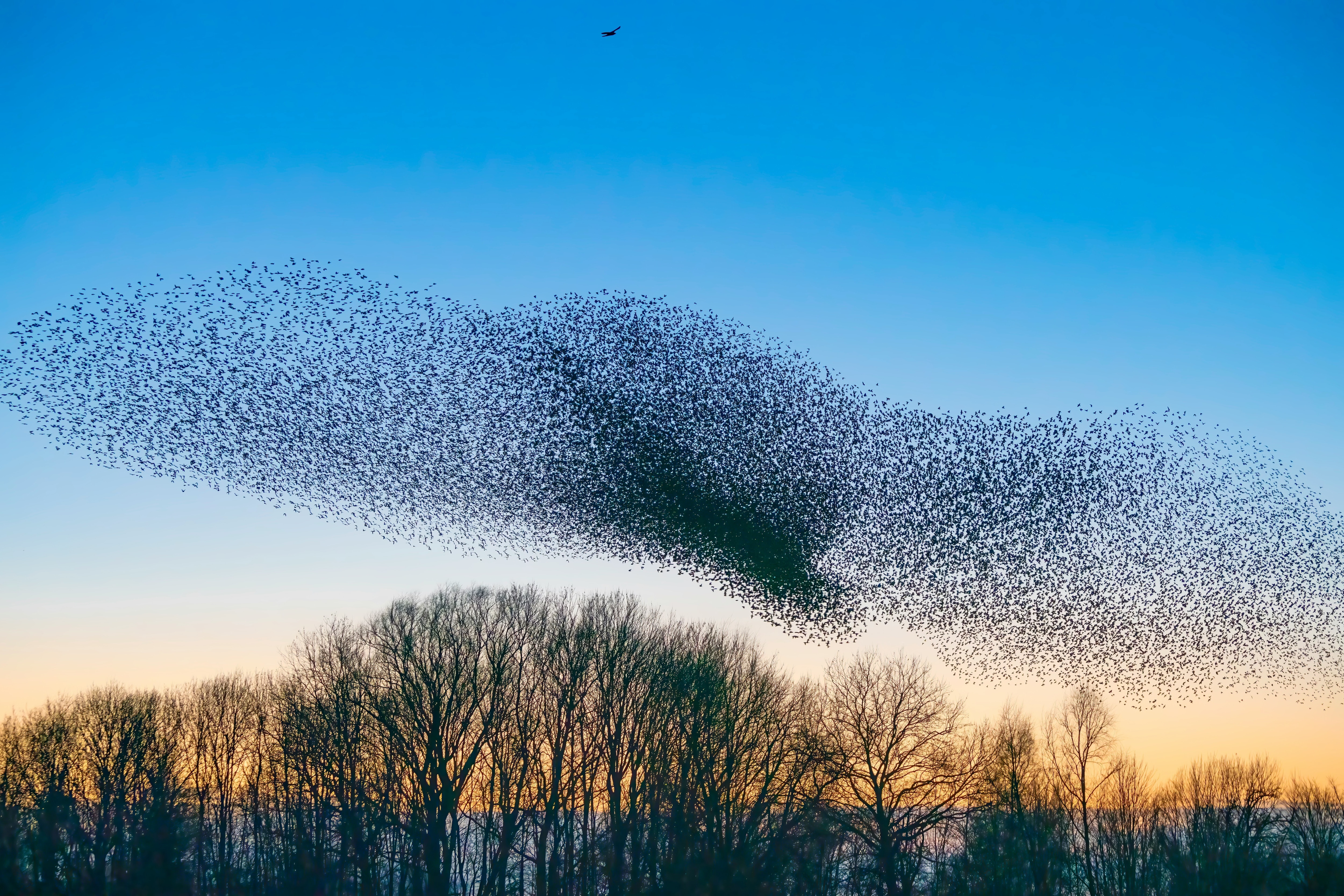
A starling murmuration is just one example of how nature can provide inspiration for leadership. Image: Getty Images
- Nature-based solutions are often seen as a way to tackle climate change. But what if we also saw nature as a strategy for leadership?
- With 3.8 billion years of experience in adapting to uncertainty, nature living systems show how to thrive under significant constraints.
- The Forum of Young Global Leaders, in collaboration with Accenture, worked to define how nature’s most enduring patterns could inform how leaders navigate complexity, build resilience and strengthen cooperation across systems.
As the world faces unprecedented nature and biodiversity loss, nature is often seen as a crisis to solve.
Yet while our planet’s power is recognized in its ability to offer nature-based solutions for climate change, we often overlook its value to guide how we approach our lives, lead our teams and seek to drive impact.
When seen this way, nature is a strategy, not a crisis.
Nature as a time-tested system for resilience
For decades, leaders have turned to strategy, technology and organizational design to navigate disruption. However, the most time-tested system for resilience is nature.
With 3.8 billion years of experience in adapting to uncertainty, living systems show how to thrive under constraints through distributed intelligence, diversity, collaboration and dynamic reorganization.
Today’s leaders can therefore look to nature for inspiration on how to deal with overlapping disruptions such as climate instability and geopolitical conflict.
Biomimicry, for example, has already inspired breakthrough design such as the humpback whale flipper bumps improving wind turbine efficiency. But the natural world’s potential extends far beyond science and engineering – it can also inspire how we lead.
After all, humans are part of nature too. Yet research suggests that human connection to nature has declined by more than 60% in 200 years, driven by rising urbanization, diminishing local biodiversity and a decline in spending time in nature.
Reconnecting with nature and observing how it organizes, adapts and regenerates, can offer leaders a fresh lens for strengthening organizations and creating a ripple of sustainable impact.
Nature-based leadership offers opportunities for a new way of working
Nature-based leadership invites us to reconnect with nature as a strategy for leadership. Through shared research and dialogue, the Forum of Young Global Leaders, in collaboration with Accenture, worked to define how nature’s most enduring patterns could inform how leaders navigate complexity, build resilience, and strengthen cooperation across systems.
This concept is not new. Currently there is excellent research and many approaches that nature-based leadership draws upon. For example, The Biomimicry Institute highlights that life organizes through interdependence, feedback loops and self‑organization, and mechanisms which help systems respond to change while maintaining coherence.
Meanwhile, Ken Thompson’s Bioteams theory applies this to team building and organizational design, exploring how high‑performing natural systems teach us how groups thrive through distributed decision‑making, fluid communication and self‑organization around shared purpose.
Such work and other research in the field has informed the development of the nature‑based leadership frameworks. The first is a set of principles of nature that guide leadership actions. The second is a set of nature-based leadership roles which enable leaders to understand and develop their own leadership styles.
Core principles of nature that can guide leaders
In exploring how natural systems enable resilience and collaboration, we identified seven principles that can guide leaders to operate more like interconnected ecosystems. They are:
- Flow with change: River meandering changes course over time, responding to obstacles and sediment. This dynamic process enables the river to keep moving forward despite disruptions.
- Weave the web: Underground fungal networks connect trees and plants, transferring nutrients, signals and support across entire forests. When one tree is stressed, others share resources to stabilize the ecosystem.
- Activate the collective: Thousands of starlings sweep across the sky in coordinated patterns without a central leader as defence against predators.
- Embrace competition: When ants search for food, each explores different routes and leaves pheromone trails. The most efficient paths naturally strengthen as more ants use them, while weaker paths fade away.
- Thrive in constraints: Mangroves thrive in salty, oxygen-poor coastal soils. Instead of overextending their energy to grow like inland trees, they’ve evolved aerial roots.
- Honour natural rhythms: Wildflowers bloom only when conditions are right. They use rest periods to store energy, ensuring that when they do bloom, they do so fully and brilliantly.
- Seed and scale: When a tree falls and creates a clearing in the forest, pioneer species like grasses and shrubs colonize the small opening. If successful, these species gradually expand.
These patterns illustrate how information flows, decisions emerge and ecosystems maintain balance through adaptability and shared intelligence.
7 leadership roles inspired by nature
Beyond principles, nature thrives through the complementary roles of distinct species within an ecosystem. Translating this insight into leadership, we examined key ecosystem functions and identified seven nature‑based leadership roles:
- Pollinators spread ideas, connect people, and ensure cross-fertilization of knowledge so that innovation and collaboration can thrive.
- Renewers break down what no longer serves us, recycle wisdom and resources, and create fertile ground for new growth.
- Cultivators generate and nurture the energy that fuels growth, creating the fertile foundations for others to thrive.
- Enablers reshape environments to unlock potential, creating conditions where others can succeed and flourish.
- Connectors link people, ideas, and resources, building bridges across boundaries to strengthen resilience and collaboration.
- Pioneers step into the unknown with courage and creativity, forging new paths and enabling transformation.
- Stabilizers bring balance and resilience, providing steady presence and adaptive strength that sustains long-term health.
Each role supports the health and resilience of the entire system, from connecting ideas, to renewing energy, to stabilizing teams during uncertainty.
When tested with Young Global Leaders, these roles came to life in meaningful ways. Pollinators spread ideas, Enablers refine emerging concepts, Connectors bridge perspectives and link people.
This diversity of roles mirrored the interdependence found in nature and underscored the value of differentiated strengths within teams.
Applying nature-based leadership to improve resilience
Lessons from nature can help leaders build resilience across three levels:
- Individuals adopting roles that mirror how life thrives
- Teams functioning like adaptive living systems
- Systems grounded in pluralism and connection
Applying these principles is not a theoretical exercise. The nature‑based leadership frameworks have been tested and refined through a series of workshops, with Young Global Leaders, translating concepts from nature into real leadership contexts and decisions, while consistently reinforcing shared patterns around resilience, interdependence and adaptive capacity.
Taken together, these insights show that applying nature-inspired principles helps leaders cultivate collaboration and regenerative strength, enabling environments that self organize and respond intelligently to disruption.
Mandë Holford, Harvard Professor, Co-director of Rockefeller University’s Hurford Science Diplomacy Initiative and Young Global Leader alum, explains: “Nature-based leadership gave our early career scientists a different perspective on how to have impact as a lab head, a postdoctoral fellow, or as a trainee, by highlighting the interconnected ecosystem-like aspects needed to build and maintain curiosity-driven labs that are nimble to new technology and ideas, while maintaining a solid foundation of knowledge.”
Meanwhile, Danae Kyriakopoulou, Co-Head of the Bank of England’s Climate Hub and Young Global Leader, observes: “We found the nature‑based leadership materials offered a powerful way to re‑frame how we collaborate as a team.
“The lens of ecosystems and complementary roles helped us better appreciate where each of us naturally contributes – and where stronger connections can unlock greater collective impact. It was a good reminder that resilience and innovation come from diversity, interdependence and shared purpose.”
Nature-based leadership shifts how we understand resilience
Looking ahead, nature-based leadership is not about adopting a new framework, but about shifting how we understand resilience. Nature does not rely on control or optimization alone; it builds strength through interdependence, adaptability and continuous learning across the system.
Across this work, one idea has been consistent: no single role sustains an ecosystem on its own. Whether acting as a Pollinator, Connector, Stabilizer or Pioneer, each leader contributes differently to the health and well-being of the whole. Resilience emerges not from any one approach, but from how these roles interact, reinforce one another and evolve.
For leaders, the question is not how to apply these ideas perfectly, but how to work with them in context, recognizing both their own role and how it connects to others. Amid growing complexity, the leaders who thrive will not be those who try to simplify it away, but those who learn to operate within it. Nature offers a model for doing exactly that.
Don't miss any update on this topic
Create a free account and access your personalized content collection with our latest publications and analyses.
License and Republishing
World Economic Forum articles may be republished in accordance with the Creative Commons Attribution-NonCommercial-NoDerivatives 4.0 International Public License, and in accordance with our Terms of Use.
The views expressed in this article are those of the author alone and not the World Economic Forum.
Stay up to date:
Nature-Based Solutions
Related topics:


Forum Stories newsletter
Bringing you weekly curated insights and analysis on the global issues that matter.


