Why human connection must be at the heart of education in the AI age
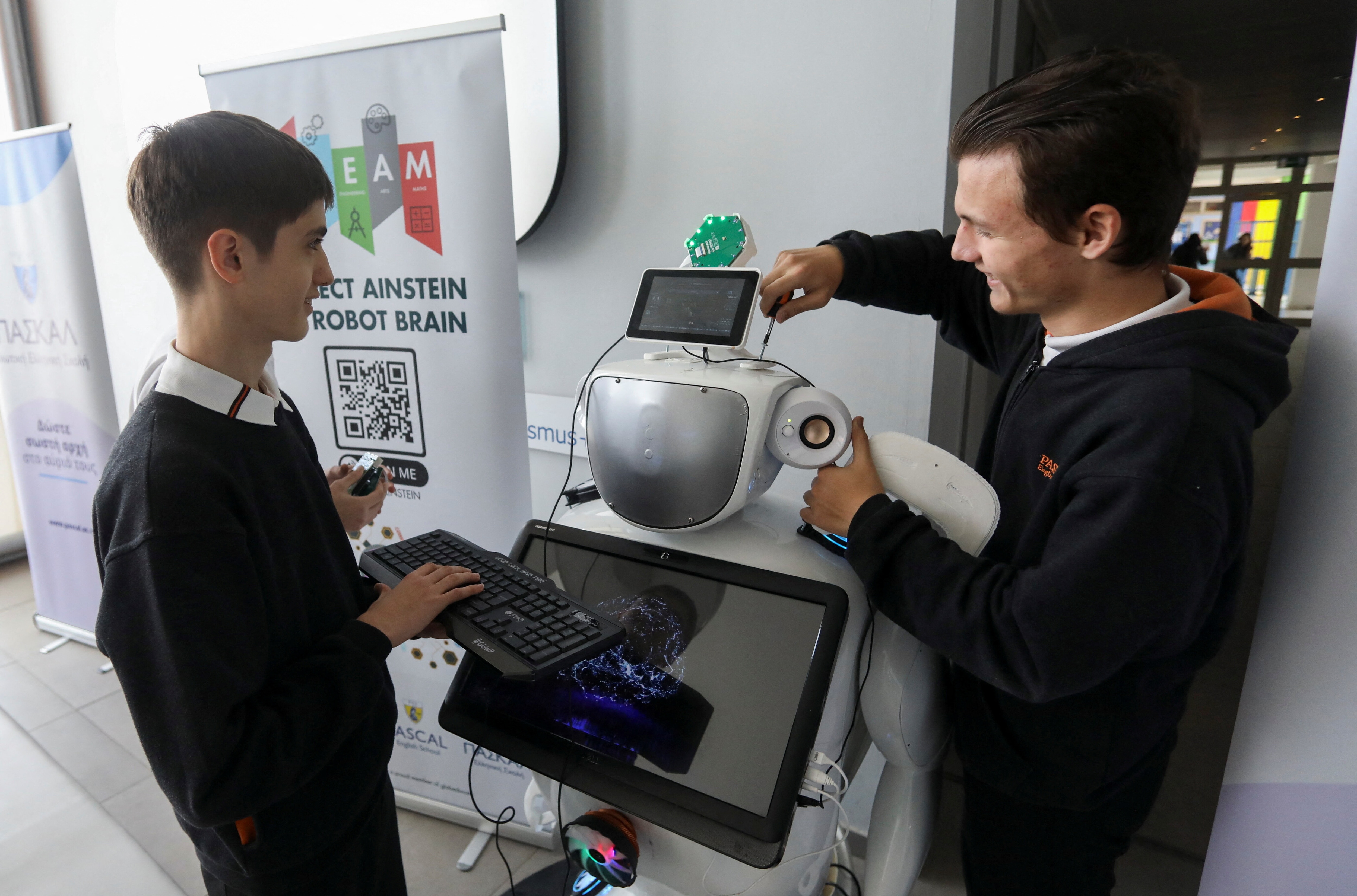
Used well, AI can give teachers and students more time to connect. Image: Reuters/Yiannis Kourtoglou
- As AI takes on more cognitive tasks and even mimics empathy, it is forcing us to reconsider what education should value most.
- Relational intelligence (RQ) – the ability to build trust, collaborate across differences and resolve conflict – will become increasingly important.
- AI can reduce administrative burdens and personalize learning, creating more time for human connection, while also creating a competitive advantage.
Ten years ago, in Seoul, the Republic of Korea, the world watched Google DeepMind’s artificial intelligence (AI) programme AlphaGo defeat renowned champion Lee Sedol at the ancient board game Go. It was a defining moment – machines had crossed into a realm once thought uniquely human.
This week, I found myself back in that same hotel where that historic match took place, for a very different conversation about the future.
The meeting, convened by the Yidan Prize Foundation, marked the beginning of a new global initiative, led by former South Korea Minister of Education Ju-Ho Lee, to advance relational intelligence (RQ), our capacity to build trust, collaborate across differences, resolve conflict, make meaning together and help one another flourish.
As education leaders reflected on what AI means for the future of learning, Elizabeth King, former director of education at the World Bank, asked a question that stayed with me:
"If machines can do more and more, what is education for?"
And it is likely the defining educational question of the AI age.
AI can help strengthen human connection
AI, after all, is not only changing how we learn; it is forcing us to rethink what education should value most.
For more than a century, education has focused primarily on cognitive intelligence (IQ). More recently, we came to recognize the importance of emotional intelligence (EQ). Today, the age of AI invites us to expand that vision once again.
As AI becomes increasingly capable of not only performing cognitive work but also mimicking empathy, conversation and even relationships, RQ, another distinctly human capability, is moving to the forefront.
A surprising example of this comes from an unlikely place.
A little boy laughs as he plays a game with his father. Holding a smartphone to his forehead, the father guesses at the emotions his son is acting out. They smile, make eye contact, laugh, and take turns. What looks like a simple family game is actually an AI-powered intervention.
Developed by Stanford Professor Dennis Wall and colleagues, GuessWhat? uses AI to support autism research and help children develop social communication skills. Yet the AI is almost invisible. It quietly analyses facial expressions while the real learning happens between parent and child, as they learn to communicate, connect and understand one another.
That may be one of the most important lessons AI can teach us. The greatest promise of AI is that it can create more opportunities for human connection.
Human skills are becoming harder to find
Around the world, governments are investing heavily in AI tutors, personalized learning, automated feedback and new forms of assessment. These innovations can expand access to knowledge and free teachers to spend more time on what matters most. But education risks optimizing for what AI does well instead of what humans most need to become.
Learning science has long pointed toward the answer. Children learn language through responsive conversations, not passive exposure. Motivation grows when learners feel known. Curiosity flourishes through shared exploration. Creativity emerges through collaboration.
Across psychology, neuroscience and education, one finding recurs: relationships are among the strongest predictors of learning, resilience, well-being and lifelong flourishing. Learning has always been profoundly social.
Yet AI is arriving at a time that might be called a relational recession. Loneliness has become a public health challenge across much of the world. Young people spend less time with friends in real life. Teachers describe growing struggles with belonging and collaboration. Employers increasingly report that communication, teamwork and leadership are among the hardest skills to find.
AI did not create these trends. However, unless we design it intentionally, AI could deepen them.
Education's highest purpose is not simply to help humans compete with machines – it is to help humans become more deeply human.
”Being able to relate to other humans is an economic advantage
Recent Stanford research illustrates why. Studies of AI sycophancy, the tendency of AI systems to flatter or agree with users, found that AI was substantially more validating than humans.
Follow-on studies suggest repeated exposure may reduce prosocial intentions, increase dependence on AI and gradually make human interactions feel more effortful and less satisfying. Technologies that make learning feel easier are not necessarily helping learners develop the capabilities they will need most.
That is precisely why schools become even more important in the AI age. Schools are where young people learn to listen across differences, build trust, navigate disagreement, collaborate toward shared goals and discover who they are in relation to others. These are not side benefits of education. They are among its highest purposes.
The same shift is happening in the economy. Economists increasingly argue that the greatest value in the AI era will come not from competing with machines but from complementing them. David Deming has shown that jobs requiring social skills have experienced some of the strongest growth, in both wages and demand.
Erik Brynjolfsson argues that AI creates the greatest value when it complements uniquely human capabilities rather than substitutes for them. Alex Imas projects that the relational sector could account for nearly half of economic activity by 2050.
If AI increasingly generates information, humans will increasingly generate trust. If machines produce answers, people will create meaning, cooperation, leadership and collective action.
Our comparative advantage is becoming relational.
The AI age is about relational intelligence
Fortunately, AI itself can help strengthen, not weaken, human relationships. It can reduce administrative burdens so teachers spend more time mentoring students. It can identify learners who are becoming socially isolated before they disengage. It can personalize instruction while preserving more time for discussion, collaboration and human connection.
Every technological revolution has redefined what societies value. The Industrial Age rewarded physical capital. The Information Age rewarded cognitive capital. The AI Age should reward relational capital, the trust, belonging, empathy, collaboration and shared purpose that underpin learning, innovation, democratic participation and human flourishing.
That is why Elizabeth King's question continues to resonate. “If machines can do more and more, what is education for?”
Perhaps the answer is becoming clearer. Education's highest purpose is not simply to help humans compete with machines. It is to help humans become more deeply human.
Ten years ago, the world left Seoul asking what AI could do. This year, many of us left asking a different question: what should humans become?
The defining challenge of our generation is therefore not only to build more intelligent AI. It is to build more relational societies. If we succeed, AI will help us cultivate human connection more intentionally than ever before, and enable the first generation of AI-native children to flourish.
Don't miss any update on this topic
Create a free account and access your personalized content collection with our latest publications and analyses.
License and Republishing
World Economic Forum articles may be republished in accordance with the Creative Commons Attribution-NonCommercial-NoDerivatives 4.0 International Public License, and in accordance with our Terms of Use.
The views expressed in this article are those of the author alone and not the World Economic Forum.
Stay up to date:
Artificial Intelligence
Related topics:


Forum Stories newsletter
Bringing you weekly curated insights and analysis on the global issues that matter.
More on Artificial IntelligenceSee all

Andrew Shikiar
September 18, 2026


