How to teach kids in the age of AI, from the head of a leading LA school
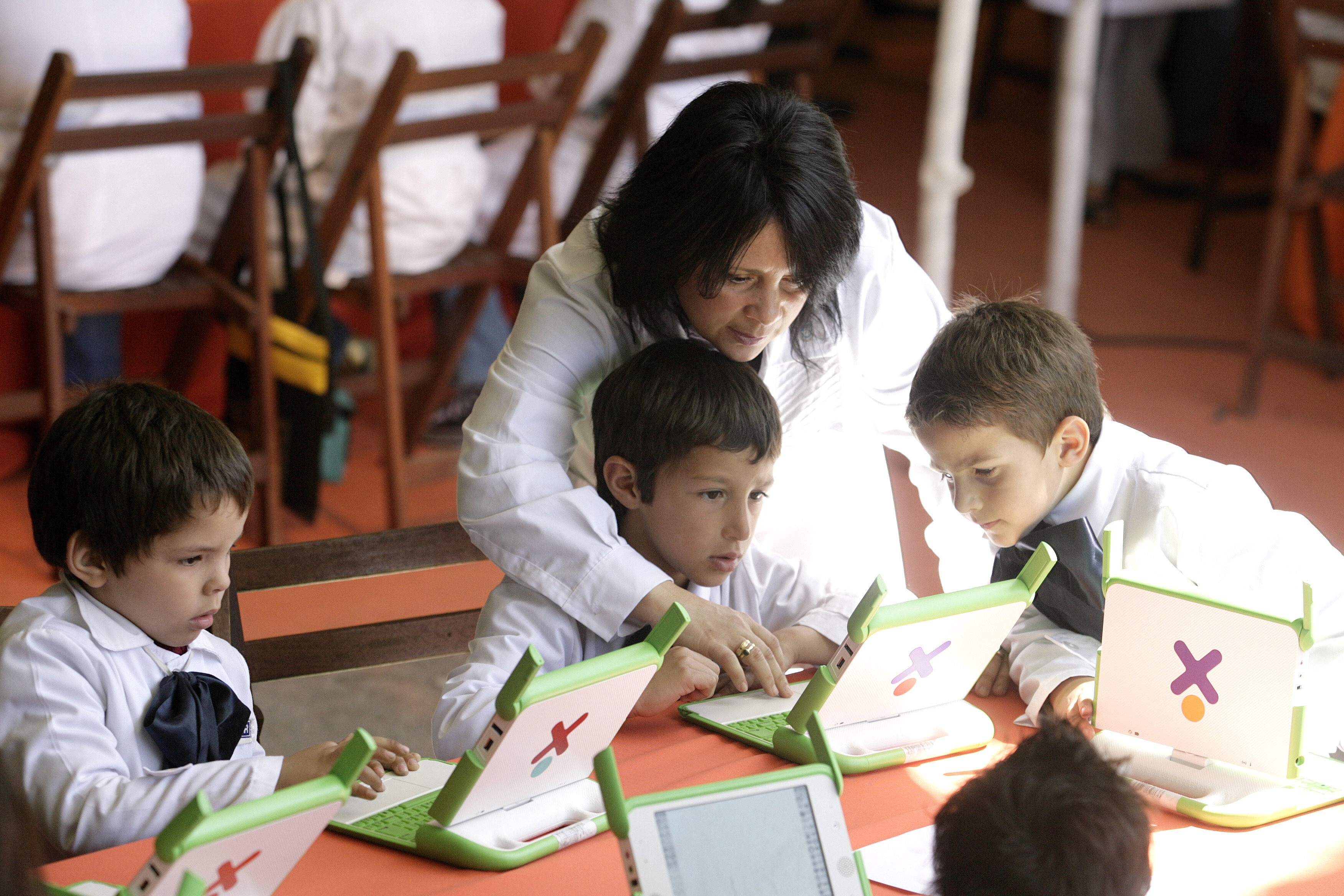
AI is here to stay in children's education, whether at school or home – how we teach them must accept and build upon that. Image: REUTERS/Andres Stapff (URUGUAY POLITICS EDUCATION)
- Conrad Hughes, head of a top international school in Los Angeles, and former head of a similar school in Geneva, shares how to help students learn in the age of AI.
- Falling PISA scores in reading, maths and science have been linked to chatbot use, raising concerns about cognitive offloading.
- Cognitively demanding pedagogies – handwritten notes, reading from the page, oral exams and debate – keep students thinking for themselves.
Through the 1990s and 2000s a technological tidal wave swept over classrooms, culminating today in the emergence of AI as a major disruptor of the education space. Now, opinions about what to teach have come full circle. Cognitively demanding pedagogies (or CDPs), classroom practices that ensure students are thinking for themselves, are emerging as a key strategy.
For decades we have been complaining, and perhaps not unreasonably, about the fact that educational models are too backward-looking, traditional and slow to adapt to the realities of a fast-changing world. Competencies and skills for the future have been at the heart of most serious educational discussions for years now. The World Economic Forum's skills for the future forecasts have evoked digital literacies such as data protection, AI and big data, and technological skills.
The ability to flourish with technology has always been predominant and will be even more so in a technology-saturated future. However, a recent ream of studies, such as those by MIT on the impact on brain activity when using large language models (LLMs) to assist in essay writing, and the sharp decline in PISA reading, mathematics and scientific reasoning scores published by the OECD have focused on the deleterious effects of cognitive offloading and an over-reliance on technology in the classroom. "Hasty reading" (when children read quickly but inaccurately) is skyrocketing
Three guiding principles for teaching in the AI era
All this has led us back to some fairly simple, powerful principles:
Reading, writing, manual problem solving, mental problem solving, project-based learning and in-class assessments are crucial. They ensure that students are thinking for themselves, exercising the all-important subcomponents of fluid intelligence (working memory, pattern recognition and processing speed) and not getting AI to do the work for them.
Debate, oral examinations, vivas and discussion-based learning have become increasingly necessary in today's classrooms. Through these, students nurture on-your-feet thinking skills and interpersonal competencies. Without them, we will struggle to communicate well with each other, given that so much happens online and there is a clear de-skilling of face-to-face interaction outside of those social gatherings where it might happen, like the classroom.
The integration of technology in the classroom, including AI, needs to be intentional and not de facto. Each time we look at technology in our pedagogy, we need to consider the benefits and potential drawbacks, and have an explicit, educational vision for what we are using the technology for in the learning experience in question and what some of the potential problems might be. AI tutors, for example, need to be vetted and curated by an education expert, and assignments allowing access to the internet must be created with the assumption that students will use AI.
Going back to basics to move forward
What is interesting is that much of this is a return to basics: pen and paper, working through problems without the help of technology, oral communication and the reading of books. Twenty years ago, arguably, these would have been seen as archaic, whereas today they are seen as necessary for the future.
At the same time, we should be teaching students about the design of algorithms, the social and emotional hooks used in social media, the environmental effects of artificial intelligence and how to think to prompt (as opposed to prompting to think). Stronger data and technology literacy alongside ethical, creative and critical STEM learning should continue to flourish in classrooms. It’s not about turning away from tech, but about complementing it with the learning necessary to make sure we are not surrendering to it mindlessly.
The least interesting approach to this paradigm shift, or perhaps paradigm return, is to ban and prohibit: no more AI in schools, no more phones, low tech. This in itself will not do anything, for it is not what we don’t do that counts, it’s what we do. The time has come to forge a clear vision for the type of pedagogy, learning and assessment needed.
The role of cognitively demanding pedagogies
CDPs are classroom practices, home learning and homework strategies, assessments, and tasks that ensure students are thinking for themselves, enhancing their long-term and working memory. In a world where the standards of criticality and cognitive acumen are dropping, it is essential that teachers and leaders embrace this vision and be intentional about their approach to technology.
The main vehicles for CDPs are, perhaps not surprisingly, numeracy and literacy: the age-old foundation that makes up the spinal cord of a formal education. Notes should be handwritten, books read off a page (and students tested for comprehension), mental arithmetic should be enhanced by having students solve mathematical problems with no technology, memory should be tested frequently. Discussions should be extended, triangulating complex ideas and pushing students to extend their working memories as they hold on to several thoughts while processing others and responding to the ideas of those around them.
Parents should be reading books and reading to their children at night until a relatively advanced age (at least age 11) and they should engage with their children in discussions that push vocabulary and syntactical arrangements.
If we focus on these things, in a CDP approach, the use of screens and AI will be less important and, those using them will probably be more discerning. The question will be less about keeping students away from technology (which is not a solution), but more about preparing them to use it well.
Don't miss any update on this topic
Create a free account and access your personalized content collection with our latest publications and analyses.
License and Republishing
World Economic Forum articles may be republished in accordance with the Creative Commons Attribution-NonCommercial-NoDerivatives 4.0 International Public License, and in accordance with our Terms of Use.
The views expressed in this article are those of the author alone and not the World Economic Forum.
Stay up to date:
Artificial Intelligence


Forum Stories newsletter
Bringing you weekly curated insights and analysis on the global issues that matter.
More on Artificial IntelligenceSee all

Johan Falk and Owen Gaffney
September 29, 2026


