
Data from the Open for Business City Ratings, covering 149 cities across three continents, shows that inclusion gives cities a competitive advantage.
Inclusive cities consistently outperform in human capital, innovation and entrepreneurship.
For urban leaders navigating economic uncertainty and technological disruption, the path forward requires integrating inclusion as a core economic development strategy.
In today's interconnected world, cities stand as the cornerstone of global economic growth, generating over 60% of global GDP. As the World Economic Forum’s May 2025 Chief Economists Outlook signals rising economic volatility, cities face a critical question: how can they build resilience in an era of ongoing disruption?
One answer lies in a powerful, but often overlooked driver of economic resilience: inclusion.
Inclusion as a competitive advantage
Recent data from the Open for Business City Ratings, covering 149 cities across three continents, shows that inclusion isn't just a social good, it's a competitive advantage.
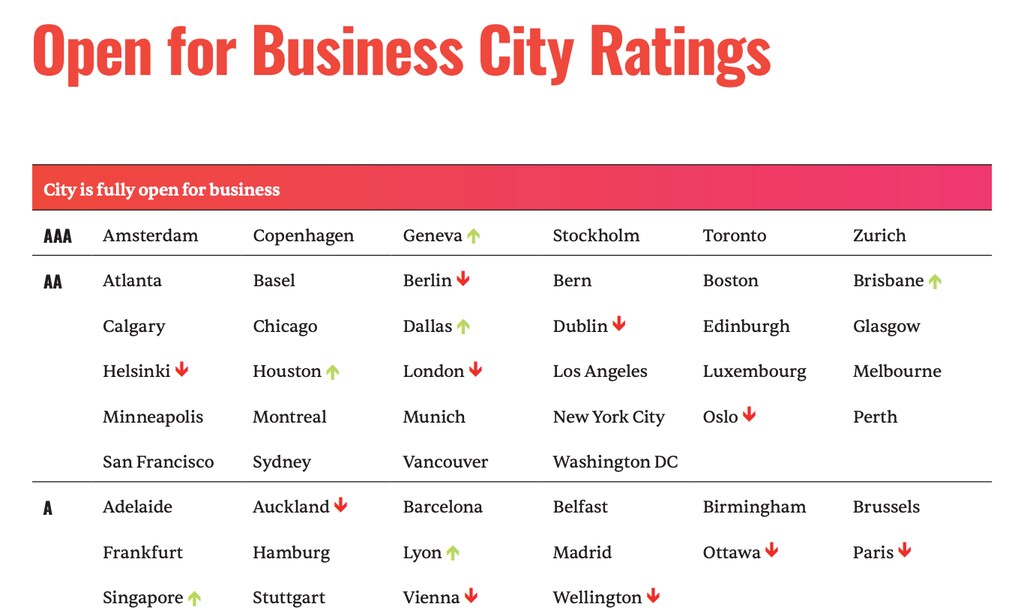
Inclusive cities consistently outperform in human capital, innovation and entrepreneurship.
• Human capital drives competitive edge: Cities ranking in the top quartile for LGBTQ+ inclusion demonstrate human capital performance four times stronger than the bottom quartile. They excel in quality of living, university student attraction, educational attainment and concentration of top-tier institutions.
• Innovation and entrepreneurship thrive in inclusive environments: Inclusive cities score two times higher on innovation metrics and 2.5 times higher on entrepreneurship, creating dynamic ecosystems where diverse perspectives fuel breakthrough thinking and business formation.
• Inclusion as a workforce strategy: With 170 million new jobs expected by 2030, alongside the disruption of 22% of current roles and the evolution of 39% of key skills, cities that embrace LGBTQ+ inclusion are better positioned to attract and retain the diverse talent needed to navigate transformation.
Turning technological disruption into opportunity
To safeguard these benefits, leaders need to anticipate new dynamics affecting underrepresented groups.
AI is reshaping the economic landscape and risks creating new divergence in labour market outcomes. While women, for example, are underrepresented across STEM roles, representation drops further in STEM leadership, a pattern that risks being exacerbated by the advent of GenAI. The 'drop-to-the-top' for women in STEM roles is steep, starting with just under 30% representation in entry-level STEM jobs, which shrinks to 12% in the C-suite, suggesting much female talent is lost along the pipeline. The rapid adoption of GenAI is reinforcing existing role segregation: currently, 33.7% of women are in jobs that are being disrupted, while 25.5% of men are. At the same time, only 20.5% of women are in jobs that are being augmented, while this figure is 24.1% for men.
Exclusion of and bias against LGBTQI individuals compound economic losses resulting from an AI transformation that draws on only part of the talent pool.
The twenty-first century is when everything changes. The fourth industrial revolution, combining robotics, digitalization, artificial intelligence and social media, represents a truly revolutionary moment. Yet technology in isolation means little; economic success depends fundamentally on the people who use it.
—Paul Donovan, Chief Economist, UBS
Paul Donovan, Chief Economist, UBS
This insight becomes particularly relevant as cities grapple with AI's dual nature, promising significant GDP growth while potentially displacing jobs or downgrading social status. In this context, maximizing human potential becomes critical.
The mantra for economic success in any company, city, or country is: right person, right job, right time. Inclusive environments don't just expand talent pools numerically; they enhance performance qualitatively.
—Paul Donovan, Chief Economist, UBS
Paul Donovan, Chief Economist, UBS
How is the World Economic Forum promoting equity in the workplace?
The Future of Jobs Report 2023 found that 75% of companies surveyed expect to adopt AI, big data and cloud technologies in the next five years.
The Centre for the New Economy and Society provides a platform for leaders to share insights on the adoption and efficacy of new technologies, and the readiness of the workforce to use them. Our work includes developing insights and dialogue on growth, jobs, skills, equity and risks.
Learn more about our impact:
Gender parity: Since 2006, we have annually measured the state and evolution of gender parity in 101 economies, supporting decision-makers to identify the most effective policies to close gender gaps. In Chile, we helped establish gender parity accelerators and benefitted 728,000 women – reducing the gender gap by 37% in the participating companies.
Reskilling Revolution: With our partners, we are helping the global workforce future-proof their careers, working with over 350 organizations to provide 1 billion people with better education, skills and economic opportunities by 2030.
Disability inclusion: Working with the Valuable500, we are collaborating with the largest global network of CEOs committed to closing the disability inclusion gap. Members are making progress by increasing the adoption of digital accessibility best practices and including disability in diversity, equity and inclusion strategies.
Racial justice: We are collaborating with a global coalition of 55 organizations in 13 industries who are committed to building equitable and just workplaces for professionals from under-represented racial and ethnic identities.
Want to know more about our centre’s impact or get involved? Contact us.
The virtuous spiral and its risks
The Open for Business City Ratings 2025 data reveals a mutually reinforcing dynamic: inclusive cities attract diverse talent and foster innovation, enhancing economic performance. This improved standing enables further investments in inclusive policies, creating a positive feedback loop that compounds competitive advantages over time.
However, this virtuous spiral risks creating divergences. As inclusive cities outperform economically, less inclusive areas may experience relative decline, potentially making inclusion even more difficult to achieve. The gap between inclusive and non-inclusive urban areas threatens to become self-reinforcing, with economic success concentrating in cities that embrace diversity.
This divergence can carry particular risks during periods of structural change. The LGBTQ+ community, having made recent progress towards equality, could for example become a target when others feel threatened by change. As Donovan warns, this dynamic could make inclusion more difficult precisely when it's most economically beneficial.
Strategic imperatives for urban leaders
With 17% of Gen Z adults identifying as LGBTQ+, cities ignoring inclusion risk losing entire generational cohorts of workers, consumers and innovators. Recent surveys show job seekers increasingly choose organizations where they can be authentic, while younger professionals view LGBTQ+ inclusion as an indicator of broader social values and quality of life.
For urban leaders navigating economic uncertainty and technological disruption, the path forward requires integrating inclusion as a core economic development strategy. This means moving beyond viewing diversity as a social objective to recognizing it as a strategic economic driver essential for long-term prosperity.
Anyone who has crouched in the closet at work knows how exhausting it can be to hide who you really are. It is difficult to perform at your best in the workplace if you are spending energy performing the role of 'straight person.
—Paul Donovan, Chief Economist, UBS
Paul Donovan, Chief Economist, UBS
As our economies face unprecedented challenges, from trade tensions and technological displacement to skills shortages and competitive pressures, cities cannot afford to waste human potential. The data is clear: inclusive cities don't just build better societies; they build more resilient, innovative and prosperous economies.