
More than 60 countries have published bioeconomy strategies, but far fewer can show what their policies have changed. Brazil’s experience with biofuels illustrates why governments need to design policies around measurable outcomes, not only investment, implementation or production capacity.
A government can point to a strategy, a grant programme or a new production facility. But none of these, on its own, proves that policy is working.
The real test is whether public action is creating measurable change: bringing products to market, strengthening value chains, reducing emissions, improving livelihoods or making new technologies accessible.
This question is becoming increasingly important as countries invest in the bioeconomy — the production of materials, fuels, food, medicines and other goods using biological resources and processes. More than 60 countries have now published strategies to develop the sector, according to the Bioeconomy Policy Index. Yet many governments still struggle to demonstrate what these strategies have achieved.
Brazil offers a useful example. In August 2026, the country temporarily increased the mandatory share of anhydrous ethanol blended into gasoline from 30% to 32%. The government said the measure would support domestic production and reduce gasoline imports by around 900 million litres a year, according to the Brazilian Ministry of Mines and Energy.
This is an example of policy helping to create demand. But knowing that a policy has been introduced — or that a market transaction has taken place — is not the same as knowing what wider outcomes it has produced.
The gap between policy activity and policy impact
The Bioeconomy Policy Index, developed by the World Economic Forum with Capgemini Invent, examines 935 policy instruments across seven selected geographies. It looks beyond whether governments have introduced policies, asking what those policies are designed to change, where they operate in the value chain and what evidence exists of their outcomes.
The findings point to a significant gap between policy activity and measurable impact. Evidence of a measurable outcome was available for only 128 of the 935 instruments assessed. Independently verified findings were available for no more than 8%.
This does not mean that the remaining policies have failed. Missing evidence is not proof of failure. It does, however, mean that governments often cannot yet show what their policies have changed. That is more than a reporting weakness. It is a policy-design challenge.
Without a clear baseline, measurable objectives and a plan for evaluation, it becomes difficult to distinguish between a policy that has generated real impact and one that has simply generated activity.
Policy is supporting supply more than demand
The Index finds that 62.5% of the policy instruments assessed operate primarily on the supply side. They support research, infrastructure, skills, production capacity and other capabilities needed to develop the bioeconomy. These interventions are essential. But supply alone does not guarantee adoption.
Only around 2% of the instruments assessed focus explicitly on market creation — for example, by supporting first buyers, creating offtake commitments or establishing price signals for new bio-based products.
This imbalance helps explain why promising technologies can remain stuck between technical validation and commercial deployment. A company may develop a viable bio-based product but struggle to find a buyer. A production facility may be ready to operate but face uncertainty around demand, regulation or pricing.
The next phase of bioeconomy policy therefore needs to focus not only on producing more innovation, but also on creating the conditions for innovation to be adopted.
What Brazil can teach us about measurement
The Index finds that Brazil has one of the strongest agricultural orientations among the geographies studied. Of the 91 Brazilian instruments assessed, 24.2% focus on agricultural biotechnology, 26.4% on industrial biotechnology and 29.7% are cross-cutting. This reflects the structure of Brazil’s bioeconomy, where agricultural production provides the basis for industrial activity, including biofuels.
Brazil’s biodiesel programme also shows why measuring implementation is not the same as measuring impact. Introduced in 2004, the National Programme for the Production and Use of Biodiesel included the Social Biofuel Seal, which provides fiscal and commercial incentives for producers that source from family farms. The Brazilian Ministry of Agrarian Development describes the scheme as a way to include family farming in the biodiesel value chain.
Government evaluations have pointed to rising income among participating families. Yet an independent academic assessment of the wider programme between 2004 and 2018 found that its expected improvements in rural living conditions did not materialize to the extent originally intended.
Both findings can be true. A policy may achieve one of its intended outcomes while falling short on another. Without clearly defined indicators, these distinctions are difficult to see.
The same principle applies to environmental outcomes. Brazil’s RenovaBio programme has helped establish a market for decarbonization credits and encouraged investment in renewable fuels. However, a 2026 audit by Brazil’s Federal Court of Accounts found that the indicator used to measure results was not sufficient to demonstrate whether the programme’s environmental and climate objectives were being achieved.
Counting transactions is not the same as measuring change.
Designing policies for evidence from the start
Governments do not need to wait for a new international framework to improve the way they measure bioeconomy policy. They can begin by asking four questions before introducing a new instrument:
What outcome is the policy intended to achieve?
What is the baseline against which change will be measured?
What will the result be compared with?
Who will verify the evidence?
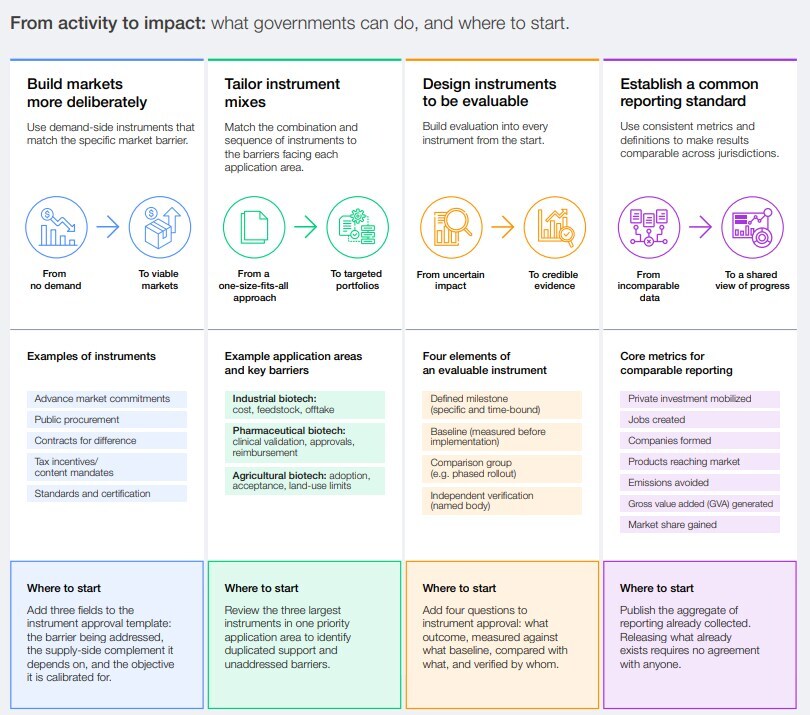
The answers will differ across sectors. Success may mean emissions avoided, farmers included, jobs created, investment mobilized or products brought to market. The principle is consistent: policies should be designed not only to support activity, but also to make progress visible.
The bioeconomy is too important to be judged by the number of strategies published, programmes launched or facilities built. Its long-term legitimacy will depend on whether governments can show how policy is improving lives, strengthening economies and supporting environmental goals.
Brazil’s experience demonstrates what is possible when policy, infrastructure and industry develop together. The next challenge is to ensure that bioeconomy policies are designed to make their contribution measurable and to direct support towards the markets and value chains that can turn biological innovation into real-world impact.