Climate resilience is increasingly critical to business competitiveness and long-term value creation. A World Economic Forum and KPMG playbook reveals how chief financial officers can integrate resilience into financial planning and capital allocation.
Climate resilience is becoming a core economic and business priority. As extreme weather events intensify, physical climate risks are increasingly translating into real economic consequences, affecting business operations, physical assets, supply chains and the critical infrastructure on which economies depend.
These pressures are unfolding in an increasingly complex operating environment. Businesses are navigating climate disruption alongside geopolitical uncertainty, vulnerable supply chains and growing pressure on critical infrastructure.
Without adequate adaptation, the world's largest companies could face up to $1.2 trillion in annual costs from physical climate risks by the 2050s.
Businesses must now meet the challenge to understand their exposure to climate risks and translate that understanding into investment decisions.
Finance leaders have a critical role to play here by embedding resilience into business strategy, financial planning and capital allocation to protect enterprise value and strengthen long-term competitiveness.
Resilience is not only about avoiding losses. Investments in climate resilience can improve operational efficiency, extend asset life, strengthen supply-chain reliability and enable businesses to maintain services when competitors face disruption.
This shift, from treating resilience as a defensive cost to a driver of value creation, has important implications for corporate strategy and capital allocation.
As climate-driven uncertainty grows, resilience is becoming a foundation of competitiveness. Discussions on adaptation finance are moving from whether resilience matters to how capital can reach it at scale.
The supply of adaptation finance is growing, supported by new frameworks and the call at the 2025 United Nations Climate Change Conference (COP30) to triple adaptation finance by 2035. Whatever the negotiations deliver, capital can only flow to proposals that exist. COP31 in Antalya ended without agreement on its overarching decision.
A proposed target of at least $120 billion a year in adaptation finance for developing countries was also dropped, leaving no agreed figure or baseline. That leaves important questions about public finance unresolved but it doesn't change the business case for resilience.
Physical climate risks are already hitting operations, assets and supply chains and earlier commitments, including that tripling goal, still stand. If anything, the outcome puts more weight on companies – businesses can't wait for multilateral consensus before investing to protect their cash flows and competitiveness.
Recognizing this challenge, the World Economic Forum, in collaboration with KPMG, launched The Chief Financial Officer Playbook for Resilience Capital: From Climate Risk to Value Creation at COP31.
It draws on insights from more than 40 finance leaders and experts and provides practical guidance to help businesses move from understanding climate risks to financing resilience.
Why climate resilience is a CFO concern
Despite growing awareness of physical climate risks, corporate investment in resilience remains insufficient.
Climate-risk information frequently sits within sustainability or risk functions, disconnected from financial planning.
Even when potential impacts are understood, resilience investments struggle against projects promising immediate returns, particularly when short appraisal horizons overlook longer-term benefits.
This makes resilience fundamentally a chief financial officer (CFO) concern.
CFOs are also uniquely positioned to bridge this gap by connecting physical climate risks with cash flows, asset values, risk appetite and capital allocation.
Their responsibility is not to predict the climate with certainty but to ensure resilience is assessed with the same financial discipline applied to other material business risks.
4 actions CFOs can take to unlock resilience investment
The new playbook introduces the “Resilience Capital Ladder,” a practical four-stage framework designed to help companies turn recognized climate risks into funded investments.
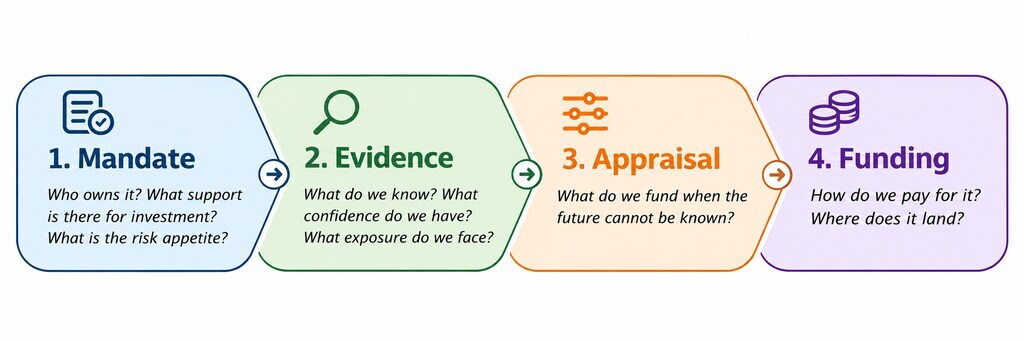
1. Establish a clear mandate and accountability
Resilience investment begins with governance.
CFOs should ensure that physical climate risk has a clear owner within finance, with responsibility for translating assessments into financial consequences and investment decisions.
Equally important is establishing board-approved risk appetite that explicitly considers physical climate risks.
With clear risk tolerance, companies can evaluate investments on financial returns and whether they reduce exposure to acceptable levels.
This creates a stronger foundation for prioritizing resilience within corporate strategy.
2. Translate climate risks into financial evidence
Many organizations already assess their exposure to climate hazards. However, information developed for disclosure is not always sufficient to inform investment decisions.
CFOs need evidence connecting physical risks to specific assets, operations, suppliers and financial performance.
For example, rather than simply identifying a facility as exposed to extreme heat, finance teams should understand how rising temperatures affect productivity, operating costs, equipment performance and future cash flows.
This requires closer collaboration between finance, sustainability, risk and operational teams, using consistent assumptions and methodologies.
Importantly, organizations should not wait for perfect forecasts. Businesses routinely make investment decisions amid uncertainty about interest rates, markets and geopolitics. Climate resilience should be approached with similar discipline.
3. Build a business case that captures the full value of resilience
Resilience investments often struggle because they are evaluated using financial criteria designed primarily for revenue-generating projects.
Short appraisal horizons can exclude future climate impacts, while conventional financial analysis may overlook benefits such as business continuity, insurance availability and strategic flexibility.
Rather than relying solely on adjusted discount rates or shadow pricing, CFOs should improve assumptions about the timing and financial consequences of climate impacts.
These are the three approaches to building a stronger business case:
Operating returns: Investments that reduce costs or improve productivity, such as cooling upgrades, water efficiency or predictive maintenance.
Business continuity: Measures that protect revenue, critical operations and customer commitments during disruptions.
Risk appetite: Investments required to bring exposure within board-approved risk thresholds.
Timing also matters. Integrating resilience into planned infrastructure upgrades, asset design and investment cycles is often more cost-effective than retrofitting assets after disruption.
4. Mobilize existing budgets before seeking new financing
Financing resilience does not always require new financial instruments.
Many adaptation measures can be funded through existing operating budgets, planned capital expenditure or risk-management allocations.
Low-cost operational changes can generate immediate benefits, while larger investments can be incorporated into scheduled upgrades or infrastructure renewal.
Where risks extend beyond company boundaries, including shared infrastructure and supply chains, collaborative financing may be necessary.
Insurers also have an important role in identifying risk, assessing adaptation measures and potentially recognizing resilience improvements in coverage and underwriting decisions. For many companies, staying insurable matters more than the premium itself, because lenders and investors increasingly rely on it.
The key is matching each investment to the most appropriate funding mechanism rather than waiting for dedicated resilience finance products to emerge.
From climate ambition to capital allocation
Companies do not need perfect climate forecasts, entirely new financial instruments or separate investment processes to begin building resilience. They need to integrate physical climate risk into the financial decisions they already make.
Here are three immediate actions for CFOs:
Assign ownership of climate-risk information within finance.
Review whether board-approved risk appetite addresses physical climate risks.
Identify resilience opportunities within existing capital plans.
Ultimately, the companies that succeed will be those that move beyond measuring climate exposure to making informed investment decisions.
For CFOs, resilience is no longer simply about preparing for an uncertain future. It is about protecting cash flows, strengthening competitiveness and creating lasting enterprise value today.