Japan is transforming its bamboo forests from underused natural resources into low-carbon solutions
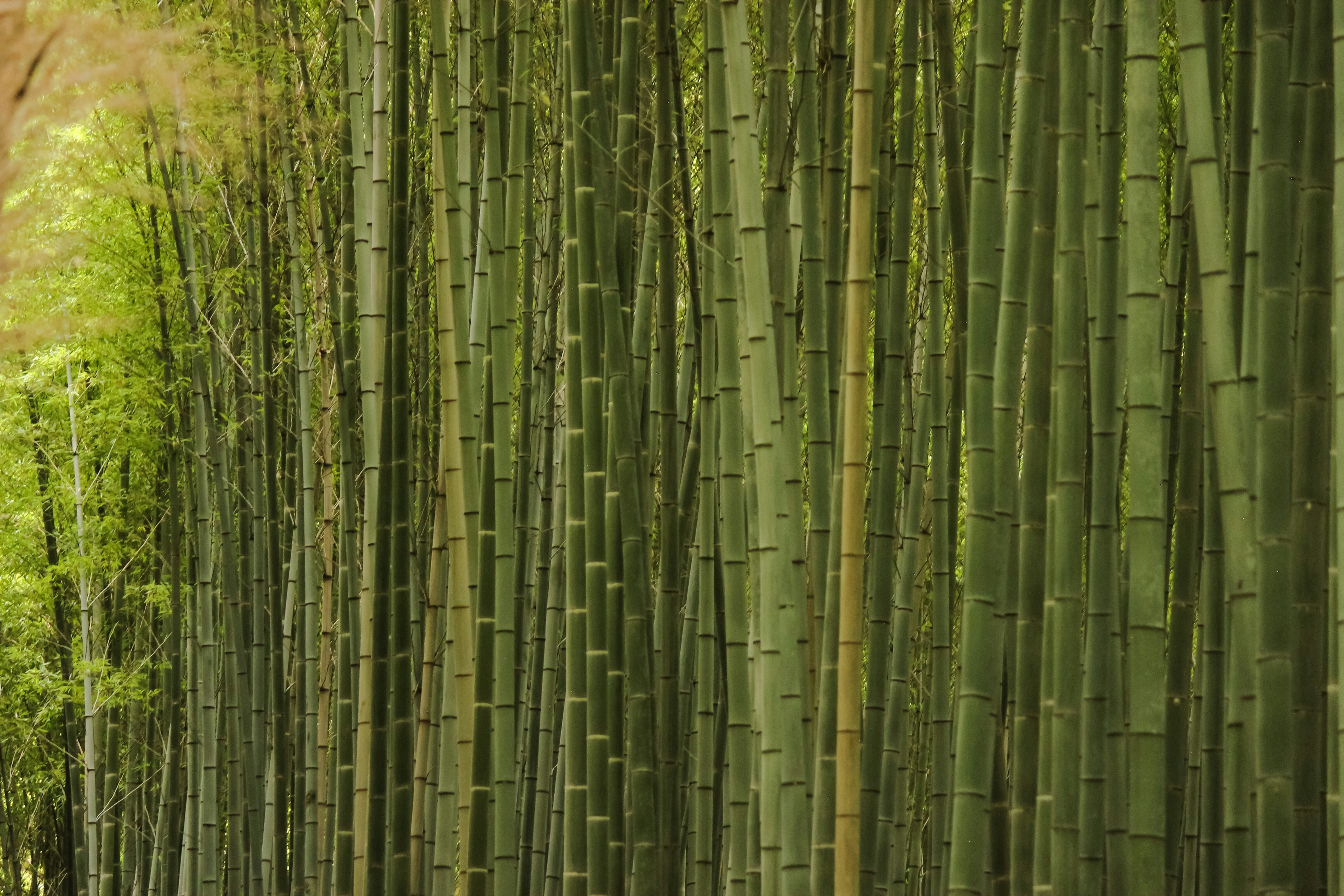
Bamboo has become an underutilised natural resource in Japan, but new initiatives are trying to change that. Image: Unsplash/AndrésDallimonti
- Bamboo has traditionally been widely used for everyday goods and construction materials in Japan.
- But even as the country’s bamboo forests have continued to grow – often at a significant rate – the use of domestically-grown bamboo has fallen.
- Governments and other organizations have recently discovered its potential as a material that could help support a more sustainable society.
Fast-growing, strong and easy to process, bamboo has long been used in Japan for a wide range of purposes, including household goods, construction, landscaping materials and food. Bamboo forests have provided valuable resources, but they have also been an integral part of Japan’s traditional landscapes.
The use of domestically grown bamboo has declined with the spread of new materials, however, including plastics, as well as changes in housing styles and growing imports of inexpensive bamboo shoots.
At the same time, the area covered by bamboo forests is expanding. According to Japan's Forestry Agency, bamboo forests grew from 147,000 hectares in 1986 to 175,000 hectares in 2022. This is more than twice the land area of New York City.
One factor behind this expansion is the growing number of unmanaged bamboo forests. This has been driven in part by ageing among the people who have traditionally maintained them, as well as the depopulation of rural areas. Bamboo grows rapidly and, without proper management, spreads easily into surrounding areas. A survey of bamboo forests in a village in Nagano Prefecture found that the area expanded 13.54-fold – from 0.26 hectares in 1977, when the settlement was still inhabited, to 3.52 hectares in 2014, after it became uninhabited.
While bamboo forests can provide a valuable source of materials, unmanaged forests can also create environmental challenges, including increasing the risk of landslides and threatening biodiversity.
Against this backdrop, efforts are spreading across Japan to develop new uses for bamboo, with the aim of combining the sustainable use of this natural resource with the responsible management of bamboo forests.
Keeping cool with bamboo paving materials
As global warming intensifies, bamboo-based paving materials can be used to create cooler paving materials with circular economy benefits.
Developed by Nippon Kanryu Industry, a company based in Fukuoka Prefecture, Kaguya Road (named for a fairy tale about a baby found inside a bamboo stalk by an elderly couple) is a paving material made entirely from natural materials. It combines bamboo fibres with magnesium oxide, decomposed granite and mountain sand, as well as water-retaining materials made from volcanic ash.
While the surface temperature of conventional asphalt can approach 60°C in the middle of summer, experiments have shown that Kaguya Road can keep surface temperatures approximately 15°C lower. The bamboo fibres can also be used as a binding material in soil that helps to reduce both the use of herbicides and the need for weeding.
Bamboo harvested from unmanaged forests in different regions can be incorporated into this material, with applications extending beyond roads to cultural facilities where the use of asphalt is restricted.
Its ability to reduce surface temperatures and its circular properties is attracting attention from other countries, and the company plans to double production in 2027.
Feeding livestock while decarbonizing
In Miyazaki Prefecture, Yamato Frontier cuts down unmanaged bamboo forests free of charge and uses the harvested bamboo to produce “sasa silage”, a product that can be used as livestock feed and fertilizer.
Made by crushing bamboo and mixing it with molasses, sasa silage is rich in lactic acid bacteria and can help improve livestock gut health, as well as soil conditions. Specific reported benefits include increases in milk and meat production, higher yields of vegetables and rice, and improvements in meat quality. Livestock farmers that have replaced some conventional feed with sasa silage say it improves digestion and nutrient absorption, allowing animals to be raised with less feed.
Japan’s feed self-sufficiency rate for livestock is only around 20%, leaving the country to rely heavily on imports. Replacing a portion of conventional feed with sasa silage could contribute to better bamboo forest management, lower feed costs and cut the carbon footprint associated with imports.
Yamato Frontier has signed comprehensive partnership agreements with 15 municipalities, primarily in Miyazaki, and is developing its business in collaboration with local communities.
Supporting new uses for bamboo
Across Japan, local governments with unmanaged bamboo forests are also taking steps to promote the use of bamboo as a way of addressing regional challenges.
Kochi Prefecture held a seminar earlier this year about different bamboo applications, while Oita Prefecture provides financial support for cutting bamboo to restore forests, as well as for the construction of simple access roads. In Kobe, the city government is working with universities and civic organizations on demonstration projects exploring the potential of bamboo-based solutions to control weeds.
Further collaboration among local governments, businesses, universities and civil organizations could help transform bamboo from a regional challenge into a valuable national resource again.
From underused natural resources to sustainable solutions
More than 90% of business leaders recognize that international cooperation on materials use is extremely important for long-term economic success, according to the World Economic Forum white paper, The Future of Materials Systems.
Rather than viewing natural resources simply as something to be managed, it is important to explore how they can be used as circular resources to create new markets. With bamboo, Japan is already transforming underused natural resources into new sources of value while addressing environmental challenges, stimulating regional economies and driving innovation.
Other countries could take a similar approach, using natural resources to conserve local environments, develop low-carbon industries and build more resilient local communities.
Don't miss any update on this topic
Create a free account and access your personalized content collection with our latest publications and analyses.
License and Republishing
World Economic Forum articles may be republished in accordance with the Creative Commons Attribution-NonCommercial-NoDerivatives 4.0 International Public License, and in accordance with our Terms of Use.
The views expressed in this article are those of the author alone and not the World Economic Forum.
Stay up to date:
Forests
Related topics:


Forum Stories newsletter
Bringing you weekly curated insights and analysis on the global issues that matter.
More on Climate Action and Waste Reduction See all

Liz Dennett
September 14, 2026


