Developing countries’ external debt has hit a new record, so has the number of places paying more just to service old IMF loans than they’re tapping in fresh funds. What causes the cost of borrowing to climb distressingly high? The ways in which a small group of rich countries manage their economies can have a big impact on everyone else.
The economy, we’re told, is now so freighted with massive numbers that it has a desensitizing effect.
One more figure that recently contributed to the numbing: Anthropic’s record $81 billion haul from giving the public its first “pure play” chance to buy into the AI boom. And only days before that, yet another financial record had been set – though this one mostly flew under the radar.
$9.4 trillion. It’s the amount of external debt now owed by developing countries. This particular number is not just bigger than ever, it’s increasing at its fastest rate in years.
The machinery behind a red-hot stock offering is clear enough: optimism about future prospects pushes a sale price higher. The levers working against many heavily indebted economies can be less apparent. In general, though, they tend to get sucked into the wake of what’s happening elsewhere.
When the initial spread of COVID-19 spooked stock market investors and made relatively stolid investments like American, British, and European bonds more attractive, the compensation expected in exchange for buying those bonds fell – their “yield.” That in turn lowered the cost of borrowing from the International Monetary Fund for many of the most troubled economies.
By 2022, though, spiraling inflation in the small group of well-endowed countries issuing marquee bonds made them a less-sure bet. Yields rose. The cost of borrowing from the IMF rose in tandem. Later, more trouble on the horizon – a tariff blitz here, a new conflict in the Middle East there. Things that can re-aggravate inflation. Yields rose, and borrowing from the IMF once again got more costly. A sizeable number of the world’s countries have watched from the sidelines as their debt loads swell.
More than 80 nations are paying off loans from the IMF. One of them is Ukraine.
At the time it was invaded by Russia in early 2022, Ukraine was being charged a basic rate of 0.2% on its IMF balance. A few weeks later, the US Federal Reserve and other major central banks kicked off what was described as a historic rate hike blast meant to check inflation. By the following year, bond yields across the rich world were climbing higher.
To troubleshoot the world’s financial plumbing, the IMF uses a basket of currencies from the US, the UK, Europe, China, and Japan, lumped together as “the SDR” (Special Drawing Rights). As long as that’s the case, when yields on bonds issued by those places increase – particularly American bonds – it can increase the cost of IMF borrowing for a big swathe of the planet.
Sometimes it’s a sense that higher interest rates are imminent that can increase bond yields. Or if the countries issuing the bonds “incur greater deficits year after year,” EY Chief Economist Gregory Daco said during a recent Radio Davos interview. Some of the richest nations have also struggled to balance their books lately, it should be noted, even if they’re not tapping credit lines with the IMF.
A year into Russia’s invasion, Ukraine was paying a basic rate on its IMF debt that had increased to 3.5%. It rose to 4.2% later in 2023, then dipped below 3%. It has since ticked back up to 3.2%. The country owes the equivalent of about $14 billion in total.
Of course, money always has a price. Floating rates are exactly that. But then there are surcharges, the type of thing that can be applied for an excessive level of borrowing. Ukraine was assessed a “level-based” IMF surcharge earlier this month equal to about $32 million, not long after its embattled economy failed to produce any steel, a key export, for an entire week – something that hadn’t happened in a century.
The surcharges are behavioural nudges designed to keep the IMF’s financial machinery operating, but they’ve been panned for pinching countries at their most vulnerable. Meanwhile IMF prescriptions for debtors on everything from spending to central banking can be like letting a personal trainer move in with you. Sometimes it gets uncomfortable.
The IMF has provided emergency war-time financing for Ukraine, and helped to channel support from donor countries. And for its poorest members, it can make “concessional” loans with low or no interest rates. But the pervasive role that it and other lenders play in distressed economies has been picked apart for decades.
History is full of white guys from the West making decisions that impact everyone else, and the origin story of the IMF is no exception. It was primarily the brainchild of two of them: the UK’s John Maynard Keynes, who was about as famous as economists get at the time, and Harry Dexter White (really), a little-known American economist who got his PhD at 38 and was recruited into government service from a small college in Wisconsin.
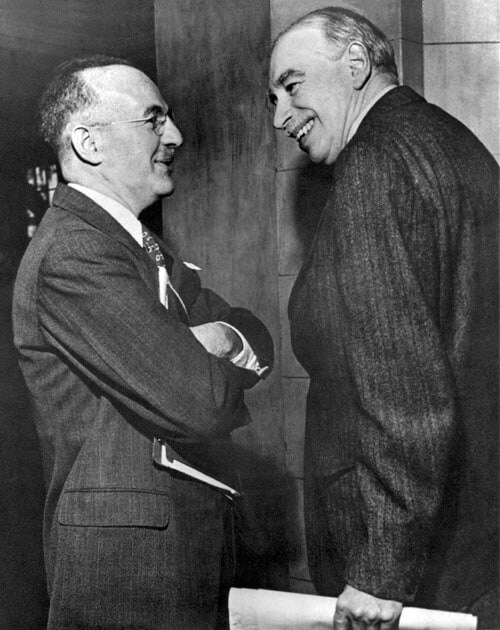
As World War II still raged, the pair haggled over the details of what would become the IMF at a Bretton Woods conference where “almost everyone seemed to be operating at various stages of inebriation,” according to a Keynes biographer.
Keynes had envisioned an international apparatus able to “prevent predatory trade arrangements and financial crises.” What he got was aspiration wedged into hard political and financial realities.
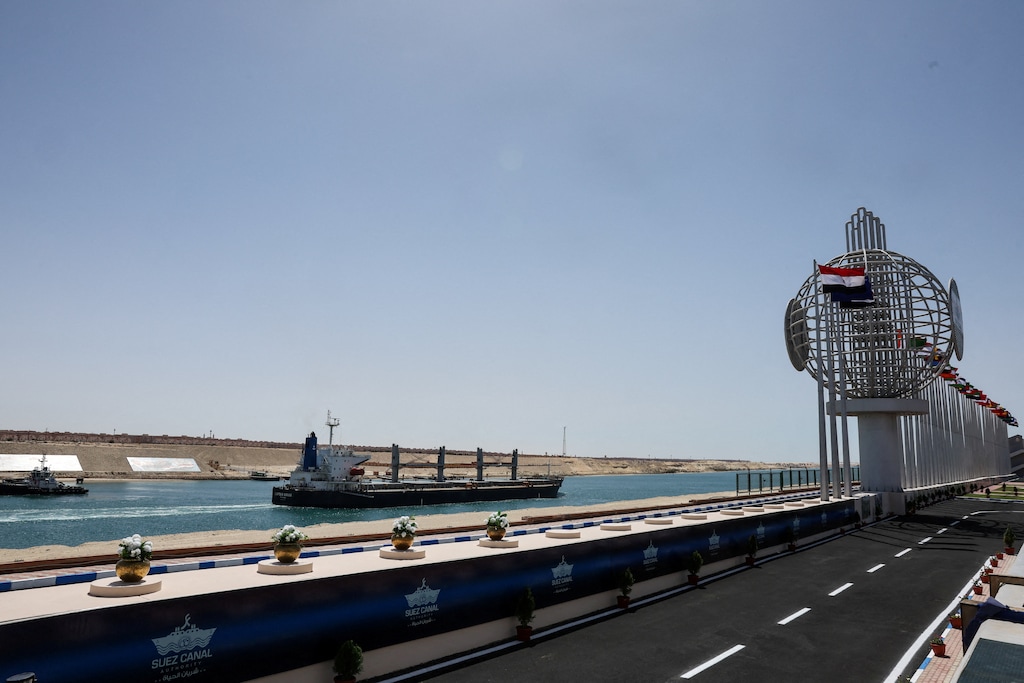
Those realities are constantly shifting. A strange new pneumonia spreads from one country, and others react in ways that end up increasing inflation and bond yields. Or they render a similar financial effect by indirectly throttling a vital trade corridor for food and energy in the Middle East – and soon bystanders like Egypt and Argentina are paying more to service their considerable debt.
Egypt took a more standard path to its financial situation than Ukraine, involving troubling deficits and bouts of inflation. Its external debt has quadrupled in recent years, and its outstanding balance with the IMF is the equivalent of $10 billion. It has cited IMF-mandated reforms as helpful, but just a 0.3% increase in the basic rate applied to its balance could tack on about $30 million in annual debt servicing.
Last year Argentina took its 23rd loan from the IMF since the 1950s, and it has the biggest outstanding balance: equivalent to $56 billion. The country paid $1.4 billion in basic interest plus a standard margin on its IMF debt in just the first 10 months of 2026; another payment equal to slightly more than $500 million was scheduled for earlier this month.
Argentina has a “much sounder picture” these days, the IMF says. Other places do not.
Efforts are underway to encourage lenders to ease off the most debt-distressed nations. The number of countries paying more in principal, interest and charges to the IMF than they’re receiving in new loans hit a historic high this year, according to a report published by the Rockefeller Foundation. That can limit funds available domestically for essentials like infrastructure and health services.
The global debt situation is painfully lopsided. It also lays bare the ties that bind rich and not-so-rich places, even as buzzwords like “fragmentation” and “decoupling” proliferate. Governments in every wealth category are more skint than they’ve been in a long time, though. Most are looking to AI to generate the meaningful productivity gains that can push an economy forward.
Anthropic and other AI-related stocks have had a rough ride since its initial public offering. And when it issues its first debt as a public company, Anthropic's bonds may have a “junk” rating, due to its ambitious plans to shell out $900 billion in the next couple of years on computing power.
That rating would raise its borrowing costs, putting Anthropic in a similar position to many distressed economies. It can be tough to get a decent loan when your future looks expensive and complicated.