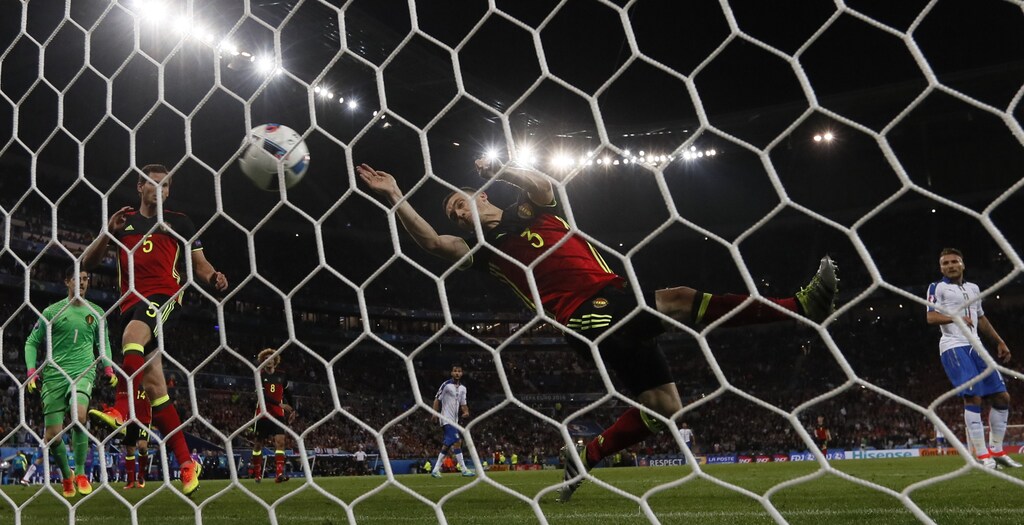
Euro 2016 has kicked off in France, with a newly-expanded tournament pitting 24 countries against one another for the trophy. A month of competition sees Europe’s top footballing nations battle it out on the pitch, but which country is doing best off it?
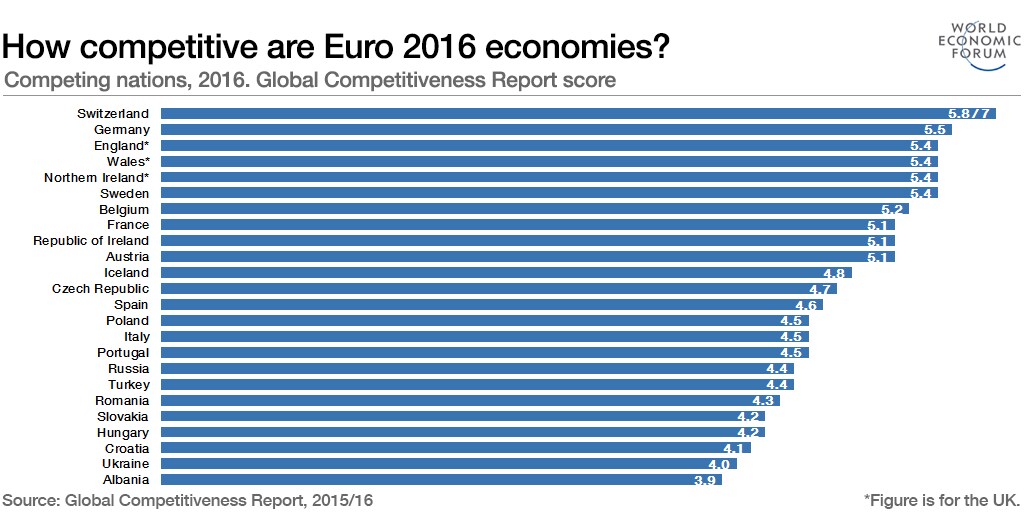
With mixed growth rates, and continued uncertainty over the recovery in Europe, the World Economic Forum’s Global Competitiveness Report provides an insight into productivity and prosperity across the continent. Using the latest report’s data, this chart outlines Euro 2016’s top scorers.
Euro 2016’s most competitive economies
Switzerland tops both the Euro and global ranking, scoring 5.8 out of a possible 7. The report’s authors highlight the world-class research and high spending on R&D, as well as business sophistication and a highly efficient labour market as key factors. It is the seventh year in a row that Switzerland has topped the ranking.
Europe’s biggest economy, Germany, comes second, with a score of 5.5. The report attributes much of Germany’s success to more complex areas of competitiveness: “Businesses are highly sophisticated, exerting a high degree of control of international distribution and employing latest technologies in the production process.”
Europe’s economic challenges in 2016
Challenges continue in economies across Europe. Slow growth in the Eurozone, a continent battling with the refugee crisis and the uncertainty of the UK’s referendum, have created a difficult environment.
As governments and policymakers try to bring stability, politically and economically, football fans have turned their attention to events on the pitch. However, this year could also be a defining year for the competing nations’ economies. Can captains and managers communicate a clear strategy to their players? Or are we set for a spate of own-goals and goal-keeping howlers?
Have you read?
This is how Europe's borders have changed over 1,000 years
Footballers vs CEOs: Who earns more?
These are the most valuable squads taking part in Euro 2016