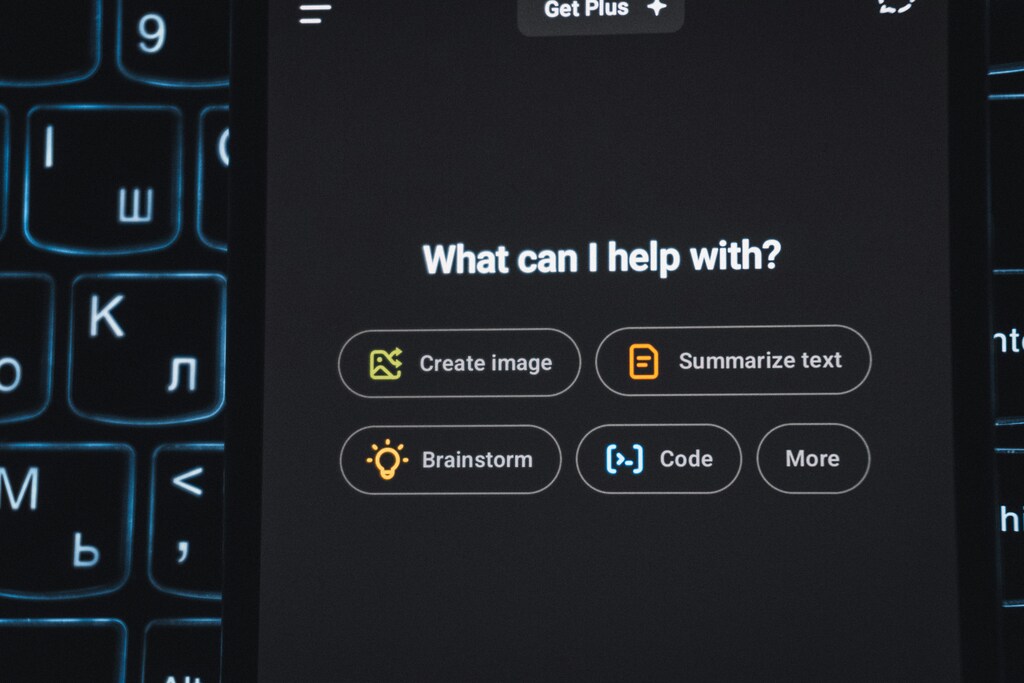
As large language models make cognitive offloading effortless, we risk delegating the mental struggle essential for learning and brain health.
In 2018 I began writing a science-fiction novel, The Antiheroes, set in a post-apocalyptic world that had surrendered its largest decisions to an artificial intelligence it had learned to trust. I never finished that manuscript. My published novel, Project Unison, imagines a different surrender, that of a woman who keeps her memory outside her head. Working with large language models – also called LLMs – makes me feel a bit like those main protagonists, aided by technology that has crept into the innermost workings of our minds: memory and decision-making. The question I ask myself is what such an aid gives back: does it return your memory trace so that you can think with it, augmenting you, or does it think in your place, preventing you from learning?
The answer to that question depends less on the machine than on the effort we keep hold of, and effort is precisely what a bounded mind is tempted to hand away. While machines never tire, we hold roughly four items in mind at once, and six hours of demanding cognitive work pushes the prefrontal brain towards low-effort choices. I propose we consider the brain we hope to grow old with when deciding what to hand over.
What is at stake is our brain capital, an asset calculated by adding the value of skills minus brain health costs (including mental disorders such as depression, addiction and burnout). To grow it over a lifetime, we must maintain skillful, learnable and healthy brains. Everyday-use LLMs may be a partner or an obstacle in this quest. For example, a study of adult AI users linked frequent use to lower critical-thinking scores through cognitive offloading – the reliance on external tools to reduce mental effort. And a not-yet-peer-reviewed MIT preprint found that 83% of chatbot-assisted essay writers could not quote their own text minutes later, against 11% of unaided writers. While preliminary, these results hint that convenience, left unexamined, may prevent us from growing our own skills.
So, I distilled the evidence into four prescriptions for one question: Where should we allocate our mental energy in a workplace boosted by LLMs? A single thread runs through all of them. Put simply, we should delegate what only produces an output, and keep what also builds the person who makes it. The figure below summarizes this four-tiered test.
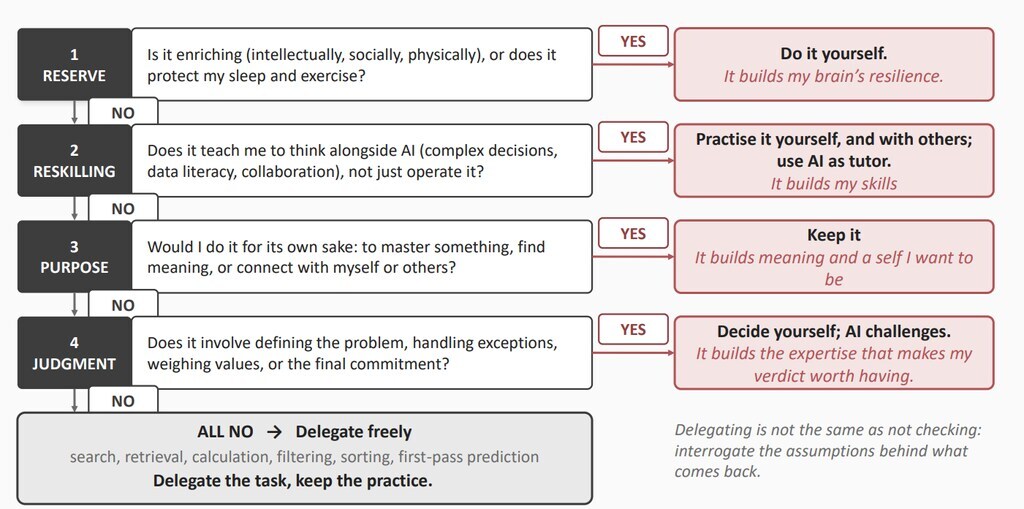
1. Reserve: Does it keep my brain resilient for decades?
Cognitive reserve, the brain’s adaptive capacity to maintain function despite ageing or pathology, is often imagined as an innate endowment, yet it behaves more like a balance built across a lifespan from deposits of intellectually, socially and physically enriching experience. In the Synapse Project, older adults who spent three months learning quilting or digital photography improved episodic memory more than those in undemanding activities, and their brains grew more efficient.
That is likely because plasticity is triggered by a prolonged mismatch between what the brain can do and what its environment demands. A dance class or a board game with your children also count because they stretch you and bind you to others, for a brain is kept healthy not only by rest but by being asked for slightly more than it finds easy, ideally in company. Sleep and aerobic exercise build the infrastructure for such stretching, while social participation, which is linked to lower dementia risk, is itself among the richest deposits.
2. Reskilling: Does it teach me to think alongside AI?
Skills, like reserve, are learnt rather than installed, yet that is where AI most seductively offers help. When high-school students practiced with GPT-4, their performance rose, yet once it was withdrawn they did 17% worse than peers who never had it. And when endoscopists returned to unassisted colonoscopies after repeated AI use, adenoma detection fell from 28.4% to 22.4%. No struggle, no mastery.
This is why organizational psychologists warn that learning to integrate AI into our careers is, in fact, identity work – and belief in one’s ability to adapt is built chiefly from mastery experiences.
That effort is also better when shared, since groups think best when members read one another and share the floor. Yet mastery needs a destination, and no prompt is able to picture the working self you wish to become. Imagining that future is a future thinking skill, and one more effort worth holding onto.
3. Purpose: Would I do it for its own sake?
We all know the importance of intrinsic motivation, yet motivation without effort is a daydream. Self-determination theory shows that to thrive, we need three things: competence, autonomy and human connection. A meta-analysis of 192 studies confirms that work supporting these needs fuels true, self-driven motivation. When we pursue something for its own sake, we find meaning.
Why does that meaning matter? Because those who find purpose report greater life satisfaction and have lower rates of depression and anxiety. For example, I write because I enjoy it, for the flow and the inner ordering of ideas that outsourcing would flatten. Whatever your art, I recommend this: choose it freely and let it shape you. While no art is mastered without effort, it weighs lightly when we love what we’re doing.
4. Judgement: Does it need my verdict?
Judgement is not a free-floating skill but the fruit of expertise: we can spot a flawed answer only in a field where we have struggled to find sound ones. If you delegate that struggle too early, the verdict you sign is a guess. Fluent, confident output shortens our search for contrary evidence, a pattern called automation bias, and AI users overestimated their own performance, consistently demonstrating low meta-cognitive accuracy.
Thus, even a usually reliable assistant may mislead when you don't verify the output, so before accepting its polished answer, ask what it assumed and what evidence would prove it wrong. Delegate search, retrieval, calculation, filtering, sorting and first-pass prediction; keep problem definition, exceptions, the decision you will sign, and choices whose consequences fall on your future self. If AI defines the problem and you merely approve, the decision was never yours.
What to hand over
If all four answers are no, delegate freely. My general rule is to keep the effort that builds: drudgery may as easily train a novice as waste an expert's time. Whether AI will hand any hours back is, however, far from settled, and perhaps a question for another article. Nonetheless, in the future I hope for, knowledge workers will spend their days on collaborative ideation, teaching, craft and caring for others. Such work is absorbing rather than easy, and that is why it builds society's brain capital: skills, cognitive reserve and a future self worth becoming are, so far as the evidence shows, neither built without effort nor kept without use.
In 2018 I imagined an AI built to serve rather than dominate. Now that it sits on my desk, and perhaps on yours, which will it become, through the choices we make one task at a time? Find your art, and cultivate it until it cultivates you.