Industrial workers have long been the face of automation-driven job losses, yet their expertise is vital to making AI work in physical operations. New research outlines three ways industrial leaders can turn workforce transformation into a competitive advantage.
Industrial workers have long been the face of automation-driven job displacement. Now, they sit on the frontline of a much broader transformation, with 22% of global roles expected to be disrupted due to tech advancements and macroeconomic shifts.
But as artificial intelligence becomes more prominent in factories and transport, their expertise could be one of the most valuable assets in making the next phase of industrial AI successful.
Manufacturing and transport depend on human involvement with physical equipment and complex operations, requiring a high degree of training, trust and safety that takes time to build. Workforce development that helps people and AI work together is critical to redesigning the operating models and workflows that keep companies competitive amid shifting supply chains and impending labour shortages.
Companies that act on this are already seeing the payoff. A new group of transport, logistics and defence companies is pulling ahead in AI by retraining staff from the factory floor to the boardroom. According to a report from the Oliver Wyman Forum and the University of California, Berkeley, 12% of transport, aviation and automotive CEOs say AI has already boosted revenue by more than 20%.
For the study, we interviewed more than 50 corporate and academic experts and found that these frontrunners build capability with every new AI deployment – turning fresh operational data and experience into better human-machine collaboration across complex, regulated industries.
How industrial leaders can make AI work for employees and businesses
Based on the findings of that research, here are three things transport and industrial leaders can do to make this shift work for both employees and businesses:
1. Make workforce redesign part of the C-suite AI strategy
Workforce redesign and talent strategies should be prioritized by the C-suite and boards at the outset. Leading companies anticipate which tasks will be performed by AI agents, robots or autonomous equipment, how those machines can collaborate with humans, and which human roles will become more valuable. For example, we anticipate that workers at mining sites will oversee an integrated system of drones and digital twins to assess a pit’s geology or equipment health. That foresight will let leaders in this field redesign roles and evolve talent models sooner – a critical advantage given that workforce development takes years in asset-heavy and safety-critical sectors.
Earning employee trust is equally critical – and starts with executives leading by example and engaging openly with their teams. At leading firms, senior leaders are visible and transparent about how roles will evolve and where staff can get involved. They use AI tools and communicate their value, while encouraging employees to build and shape AI tools around their own needs. Across all industries, only 5% of frontline staff say that their company’s AI vision is clear and communicated, compared with 35% of executives who believe their company has a well-communicated vision, according to a 2025 Oliver Wyman Forum survey.
2. Start AI upskilling with frontline workers
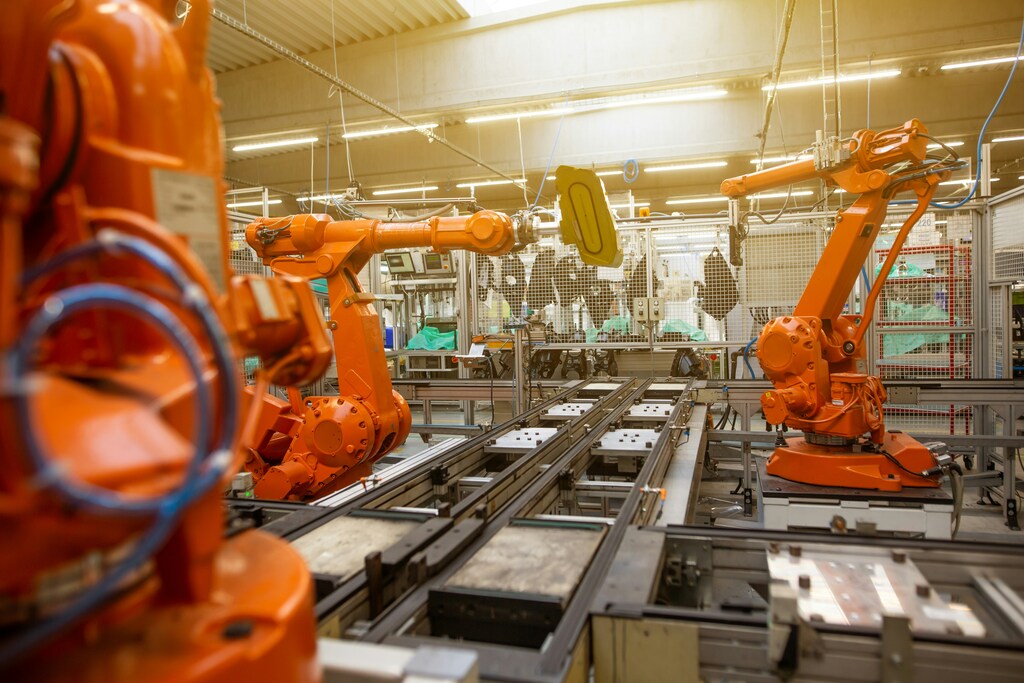
Unlike plugging-and-playing a chatbot, industrial AI must scale through new ways of working – like interacting with a physical robot – at the frontline of operations where humans and autonomous machines increasingly work together. Consider transport or logistics, where AI makes critical services more resilient to disruptions and improves dispatch, routing or maintenance – but only if drivers, dispatchers, coordinators, technicians and warehouse workers are using AI systems built around their needs.
These workers are used to established routines and informal workarounds, and our research has found that unless AI is built into their ways of working, adoption will stall. Leaders who engage with them directly on AI training can give workers a reason to embrace it.
That buy-in is critical for firms in this sector given a tightening labour market. In the United States, for example, nearly 1 million production-related job openings are projected each year through 2034 as workers retire or switch careers – even as greater adoption of automated machinery creates new maintenance roles that require upskilled staff.
With possible talent shortages in AI-critical areas like engineering and robotics, executives must be mindful of the talent pools beyond front-line workers as well. Only about a third of employees across all sectors are confident they are getting the skills they need, according to a five-year survey by the Oliver Wyman Forum across 20 countries. Yet those that do are more assured and engaged, with their job satisfaction holding steady between 88% and 90% since 2021, while the general population has swung between 68% and 71%.
3. Build the industrial talent ecosystem with governments and training institutions
Building an AI-ready workforce in industrial sectors cannot happen inside isolated company silos. More robotics or automated machinery may create, for example, a new class of installation and repair jobs that will ripple across value chains and training institutions. Business leaders must anticipate these future jobs and what skills they will require.
It’s a competitiveness and resilience challenge shared with governments too, given that transport and logistics employ millions and underpin economies and global supply chains. Industrial leaders should look beyond their internal workforce transformations to jointly develop talent pipelines with government training initiatives.
Several governments are already putting those foundations in place. Germany’s AI and robotics initiative, for example, will support rollout in industrial processes and include training for skilled workers, while South Korea’s AI manufacturing initiative includes education programmes for field workers adopting AI at manufacturing sites.
Preparing the industrial workforce for an AI-driven future
Industrial AI will reshape transport, logistics and manufacturing whether firms are prepared or not. But as adoption accelerates, a divide is emerging between companies that treat AI purely as a technology rollout and those that invest just as deliberately in their people.
Pulling ahead will depend on how well leaders draw on their workers’ expertise to redesign how humans and AI operate together. In asset-heavy, safety-critical sectors, technology alone will not secure a competitive edge; the workforce behind it will.