
As a growing number of countries nudge pension funds to invest at home, the harder question is who bears the cost if domestic assets fall short.
Pension funds are the ultimate sources of patient capital. They are bound by strict fiduciary duties to safeguard the retirement savings of their beneficiaries and by governance frameworks designed to protect the independence of investment decisions. Despite this, a new factor is emerging that could influence pension fund investment strategies, with potentially significant implications for the global economy.
Governments are increasingly encouraging pension funds to allocate a greater share of their capital to domestic investments. In the long term, this trend has the potential to impact the credibility of pension funds and further fragment the global financial system.
How pension funds usually invest
Across various major economies, home bias (the tendency for investors to allocate a disproportionate amount of their portfolio to assets within their home country) has been in decline: the Thinking Ahead Institute finds that domestic equity exposure in surveyed economies has fallen on average from 57.1% in 2004 to 34.1% in 2024. Most of this capital is flowing to the United States: European investors, for example, allocate about €300 billion annually to assets outside the EU, primarily in the US.
This trend makes sense. Bound by a fiduciary duty to their pensioners, pension fund managers seek to maximize risk-adjusted returns over the long run while maintaining diversified portfolios. As global markets have become increasingly integrated, many pension funds have looked abroad for diversification. US markets have typically attracted the most investment given their increasingly strong performance over time: the US makes up roughly 73% of the MSCI World Index as of Q3 2026, compared to only 35% in 1995.
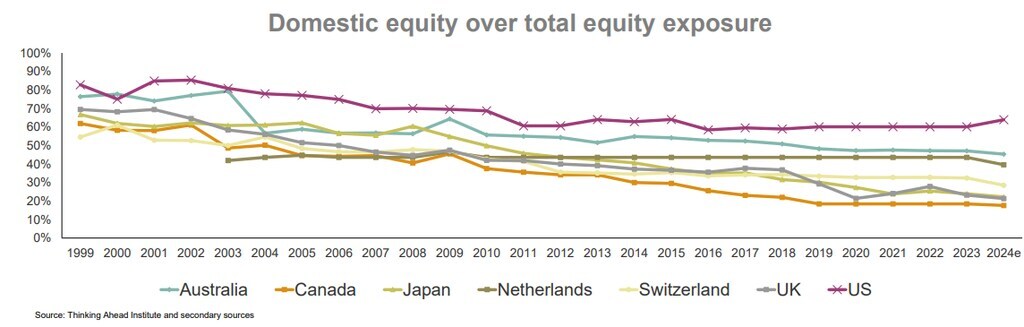
Governments pushing for pension home bias
In recent years, however, various governments of major economies around the world have been calling for pension funds to bring their capital back home.
In 2024, over 90 Canadian corporate executives signed an open letter calling on the government to find ways to incentivize more domestic investments among Canada’s largest pension funds, the "Maple Eight". This spurred the "Buy Canada" movement, which has seen the Ministry of Finance regularly meet with the Maple Eight to promote investable opportunities in Canada.
In 2025, the UK unveiled the Mansion House Accord, which saw 17 major workplace pension providers pledge at least 5% of their portfolios to invest in domestic assets, including infrastructure and property.
In July 2026, Japan's Ministry of Finance announced that it would pursue ways to increase Japan's Government Pension Investment Fund's (GPIF) investments in Japanese assets. For years, the GPIF has maintained a rigid balance of 25% allocation in each of domestic stocks, foreign stocks, domestic bonds and foreign bonds.
What this means for the global economy
While these policies broadly pursue multiple objectives, governments have emphasized different primary rationales for encouraging an increase in domestic investments.
On one hand, countries are pursuing economic stability and growth. In July, coincidentally to the Japanese Ministry of Finance's announcement, the yen hit a 40-year low against the dollar. A repatriation of Japanese pension fund capital could drive demand for both the yen and Japanese Government Bonds. Similarly, there are increasing concerns over concentration risks in US markets and the country’s fiscal health.
On the other hand, countries are pursuing economic security. In a 2024 speech launching the Future Made in Australia Act, Prime Minister Anthony Albanese highlighted the importance of Australia's superannuation system, a compulsory long-term retirement savings structure, to "build sovereign capability" in key areas including energy, infrastructure and innovation.
Of course, economies stand largely to benefit from increased investments at home. Investments in domestic industries can increase a sector's odds of becoming self-sustaining, lessening exposure to global supply chains and price fluctuations, all while deepening capital markets, increasing innovation and improving productivity. However, the extent of these benefits depends on whether pension capital generates additional productive investment or simply replaces funding that would otherwise have been provided by other investors. Furthermore, reshoring pension capital has the potential to reduce foreign exchange exposure from overseas investments, as well as exposure to geopolitical risks.
However, this is a balancing act: a push for domestic investments could undermine pension funds' fiduciary duty to deliver returns if domestic assets have an inferior risk-return profile. If pension investments become politically motivated, funds may have fewer opportunities to diversify globally, which could compromise long-term returns and lead ultimately to worse outcomes for pension holders. Excessive domestic investment could also increase concentration risk, particularly since pensioners’ contributions are often already tied to the performance of their domestic economy. Taken together, these could weaken individual financial resilience and put strain on countries’ retirement systems.
Furthermore, politically motivated pension investments could undermine pensioners’ confidence that their retirement savings are truly being managed in their best interest. Various Australian fund managers have argued that the government should not be dictating how pension funds allocate their assets.
On a global level, a political push for domestic investments could lead to further fragmentation of the global financial system if countries reduce cross-border investments and slow cross-border collaboration.
Justifying home investments
To justify repatriating capital, governments must work to create attractive domestic investments that benefit both pensioners and the broader economy. This could come through methods such as tax advantages, stable regulatory regimes to reduce risk, and simply creating more investable assets like infrastructure projects.
Promising examples do exist: the Scaleup Europe Fund, aimed at providing rising European companies with growth capital, has earned widespread buy-in from significant European financial institutions, anchored by the European Commission.
At its best, this policy push could strengthen local economies, industries and societies, protecting them amidst an increasingly fragmented global financial system that has seen alliances shift, and countries prioritize national objectives over global goals.
At its worst, geographically ring-fencing pension investments could accelerate this ongoing fragmentation, creating yet another venue for economic statecraft and threatening a key pillar in countries' retirement systems worldwide, all while potentially diminishing trust in pension funds among pensioners.
Whether this trend becomes a threat depends on governments' commitment to prudent policy, financial innovation and the financial outcomes of their citizenry.