AI could transform agriculture – if it gets the data it needs
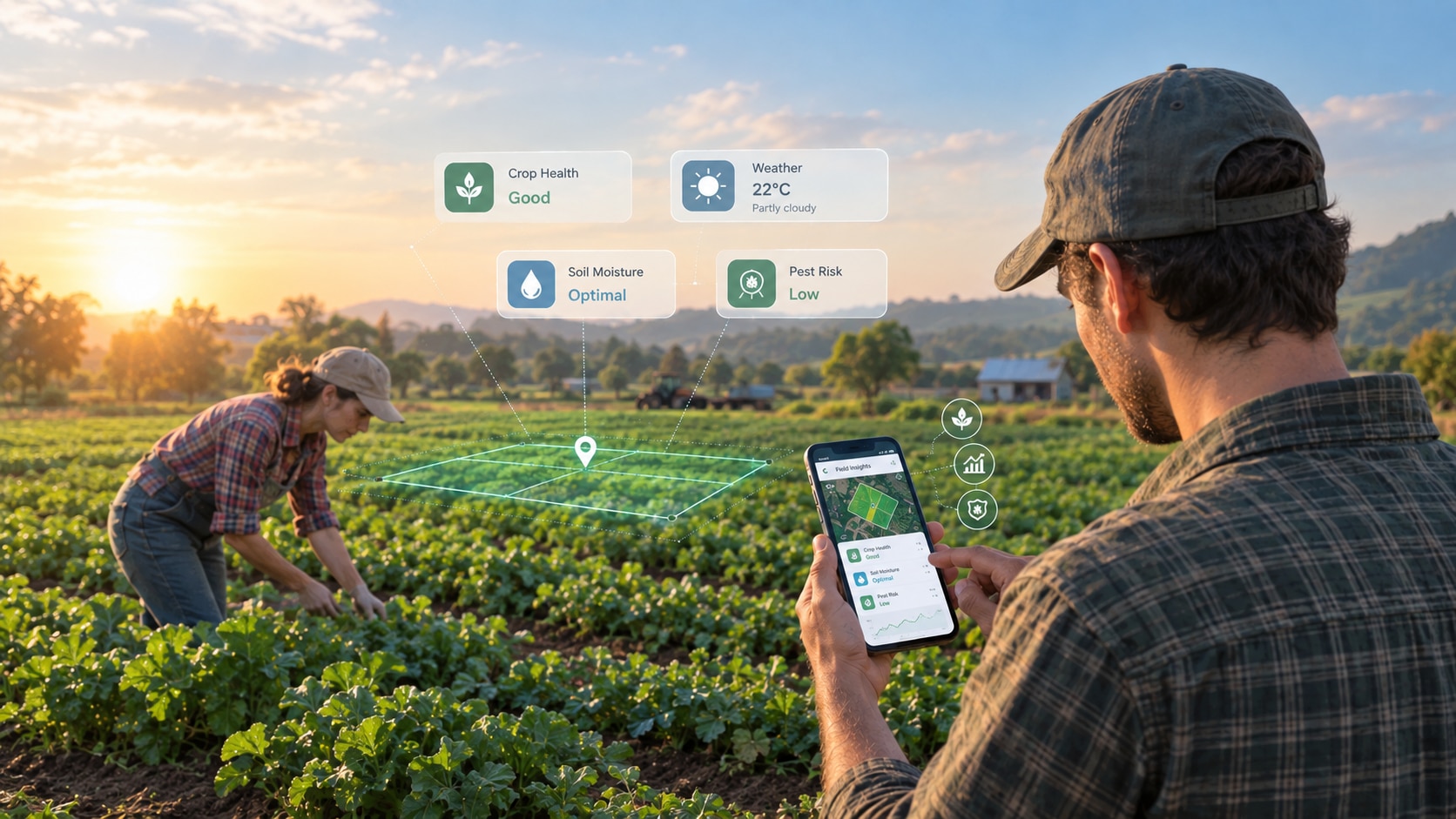
AI could make food systems more resilient – but only if the data gap is closed. Image: Cropin
- The world grows enough food to feed the global population of over 8 billion, yet 318 million people still face acute hunger.
- AI could transform agriculture and food systems, but the data gap on which it relies must first be closed.
- The challenge is no longer simply producing more food, but making food systems more visible, intelligent and sustainable.
We have split the atom, sequenced the genome, and connected over 6 billion people worldwide through the internet. Yet in 2026, 318 million people face acute hunger, more than twice the number recorded before the COVID-19 pandemic.
This is not a production failure; we grow enough food. It is an intelligence failure: an inability to see food systems clearly enough to manage them, costing $1 trillion in food waste globally. The most consequential gap in agriculture today is not seeds, fertilizer or capital – it is data.
A sustainability leader of one of the world’s largest consumer goods companies told me his business had committed millions to regenerative practices. However, “I don’t have the data to prove what I’m achieving.” Even a company with vast resources cannot measure its own progress.
That is not a technology problem, as the tools exist. Instead, it is a data problem and until we fix it, artificial intelligence (AI) in agriculture is an engine without fuel.
How AI can help transform agriculture and food systems
Fifteen years into building technology for farmers, I believe artificial intelligence (AI) can transform food systems, but only if we're honest about the sequence.
Here are six ways AI can be used to transform global food systems and how it is already happening, across continents and farmlands, at scale.
1. Build the data foundation
In most farming economies, usable data simply doesn't exist. Millions of smallholders keep records in notebooks, if at all. Yields are estimated by instinct, and farms are invisible to everyone downstream. Before AI can function, we need a unified digital layer deliberately built, linking soil, weather, crop health and input use.
Partnering with Mexico's national agricultural trust FIRA, we at agtech company Cropin digitized 400,000 smallholders, and overlaid 40 years of historical climatology, nowcasts and six-month forecasts, turning guesswork into a national data layer that lenders, input providers and government agencies could act on. Agri-stack, which acts as digital public infrastructure for agriculture, improved farmer outcomes and changed the national information architecture, highlighting the importance of data to running intelligence.
2. Turn food security into sovereign intelligence
AI at the government level can turn fragmented signals into a live picture a country can manage.
In Sri Lanka, paddy farmers hit by curfews, fertilizer ban, and economic collapse were ready to give up agriculture. With the Asian Disaster Preparedness Center (ADPC), Cropin delivered plot-level SMS advisories to more than 8,200 farmers, producing a 30% yield increase and a 23% drop in crop loss.
In Nigeria, a programme covering 45,000 hectares gave stakeholders visibility into crop health, acreage and estimated production months before harvest. A seasonal gamble turned calculated guarantee. That is sovereign intelligence: a government can see its own food system clearly enough to manage it.
3. Make agriculture climate-resilient, not just climate-aware
Climate disruption is a present operating condition, with disasters costing agriculture an average of $99 billion a year. Droughts, floods, unseasonal frost and shifting monsoons are no longer anomalies; they are structural features farmers must manage today.
With PepsiCo in India, we built 90% accurate weather prediction and 45-day yield forecasts, shifting decisions from reactive to anticipatory. Disease flagged 10 days early let growers target treatment instead of spraying blind. Across PepsiCo's farms, that meant a 25% yield lift and an 80% cut in disease threat. The value isn't the yield alone; it's safeguarding the supply chain.
4. Put AI in the hands of the smallholder
Some 600 million smallholders feed a third of the world, concentrated where climate stress and financial exclusion are worst. Yet agricultural AI conversation is dominated by tools built for large commercial farms. A food system with 600 million unprotected farmers at its base has a liability, not a foundation.
In Sri Lanka and Bangladesh, with ADPC, we delivered climate-smart advisories to 8,200+ smallholders facing fertilizer bans, flooding, and collapse at once. The farmer adoption rate was 90%, yields increased by 30% and crop loss was reduced by 23%.
5. Use AI to measure regenerative agriculture
Of 6,000 plant species, 9% account for 66% of global crop production. Intensive monoculture has depleted soils, and farming has driven the loss of 70% of biodiversity since 1970. Regenerative agriculture, with a $700 billion annual biodiversity funding gap, is the structural answer. But adoption has been blocked by a lack of proof of return and measurement; AI can solve both.
The FIRST Potato programme in Europe, backed by EIT Food, targets a 15% cut in pesticide use alongside a 5% yield gain, generating verifiable data that sustainability leaders need – a blueprint for a nature-positive supply chain.
6. Build supply chain certainty from the farm up
For companies that buy, process, and retail food, the conversation has shifted from innovation to survival. Global food waste across the supply chain is projected to touch $540 billion in 2026 alone. Retailers and distributors absorb immense losses here, driving massive margin leaks, and this uncertainty cannot be managed downstream: by the time it hits a shelf, it's too late.
For a major US food processor, we built systems predicting harvest windows at 75% crop maturity, precise enough to synchronize sourcing months ahead. For Walmart, we decoded historical yield patterns and modelled forward supply, turning procurement from a weather bet into a business decision. Companies that can guarantee supply consistency (a widening gap) have a structural advantage.
The future of agriculture depends on bridging the AI data gap
These six strategies are layers of one transformation, each dependent on the one below: data enables sovereign intelligence, which enables climate resilience, which enables smallholder inclusion, which underpins regenerative transition, which makes the food system sustainable.
Bridging the data gap in agriculture is not a technology story. It is a food security decision — one that governments can fund, development institutions can require and agribusinesses can build into procurement standards. The tools are ready; the question now is whether the people who control budgets treat the problem with the urgency the numbers demand.
Norman Borlaug, father of the Green Revolution, said: "We can't build world peace on empty stomachs and human misery." He solved the yield problem, yet millions are hungry. Today's problem is visibility, intelligence and sustainability, not production, which is what the intelligence revolution in agriculture is here to finish. Borlaug gave us abundance; now we have to earn it.
The future of food and agriculture needs to be built with intent. We are not just growing crops anymore. We are growing the intelligence to sustain humanity.
Don't miss any update on this topic
Create a free account and access your personalized content collection with our latest publications and analyses.
License and Republishing
World Economic Forum articles may be republished in accordance with the Creative Commons Attribution-NonCommercial-NoDerivatives 4.0 International Public License, and in accordance with our Terms of Use.
The views expressed in this article are those of the author alone and not the World Economic Forum.
Stay up to date:
Artificial Intelligence
Related topics:


Forum Stories newsletter
Bringing you weekly curated insights and analysis on the global issues that matter.
More on Food, Water and Clean AirSee all

Naoko Tochibayashi
September 15, 2026


