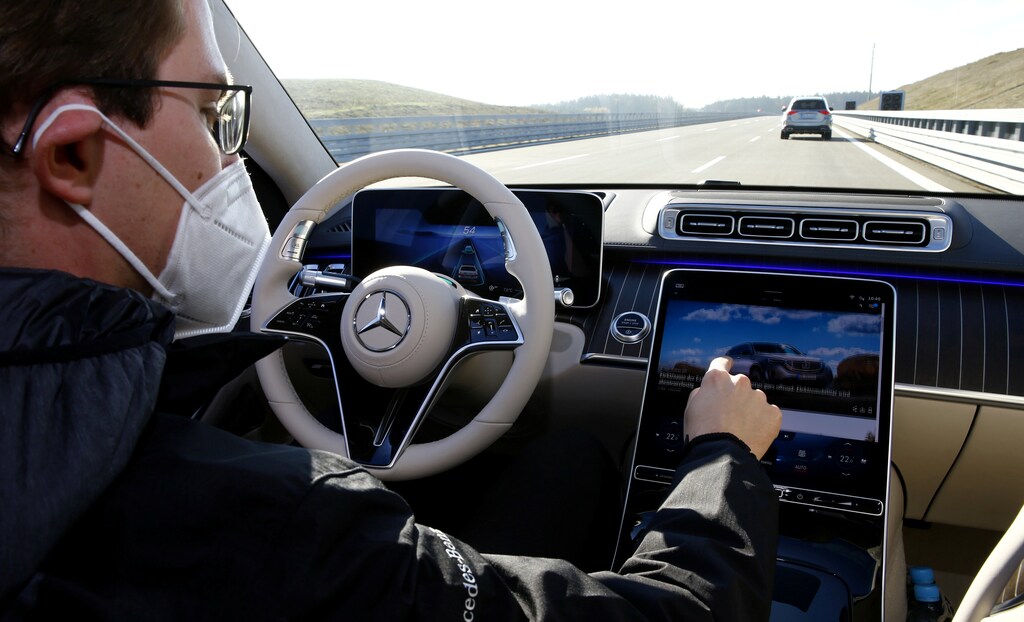
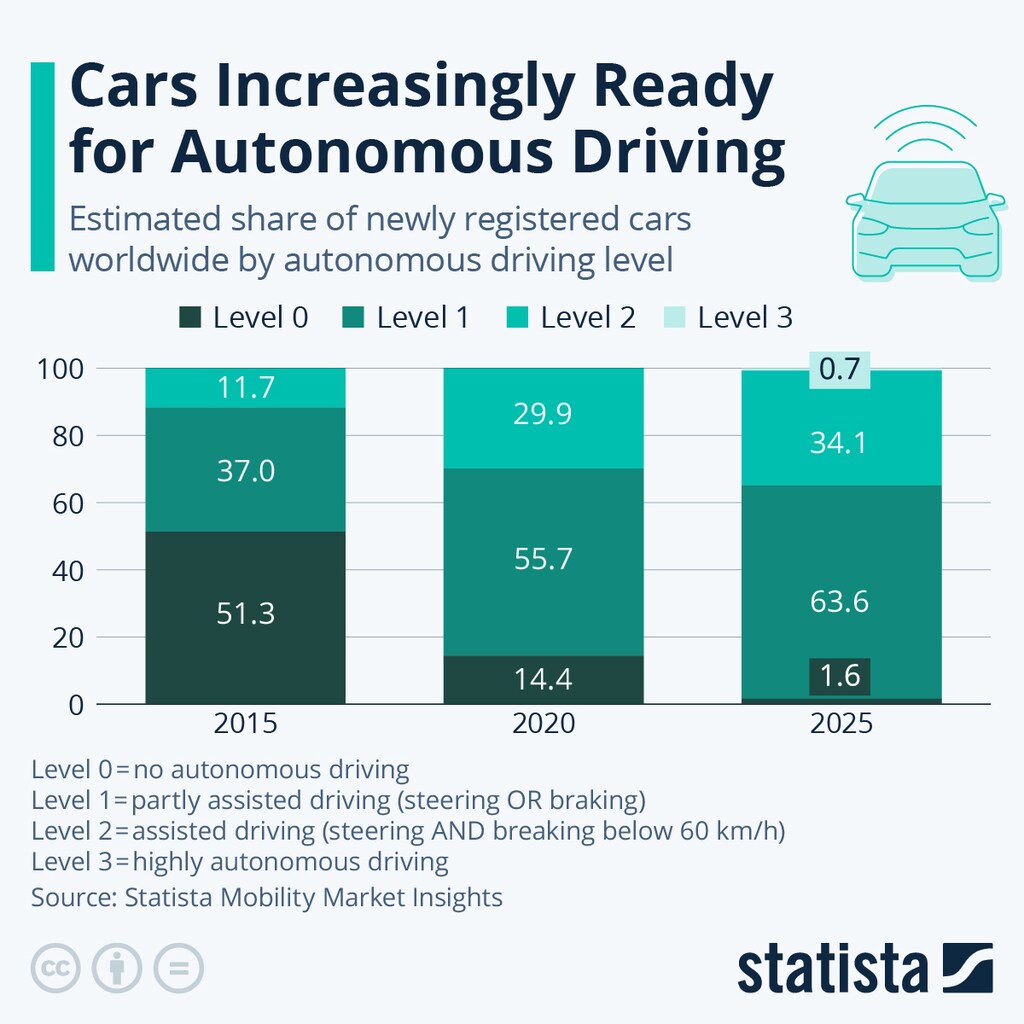
The transition to autonomous-ready cars has accelerated in recent years and will continue to do so, according to Statista's Mobility Market Insights.
There are six different automation levels for passenger cars in the classification, as this chart shows.
By 2025, 63.6% of registered passenger cars worldwide should be at level 1, partly assisted driving and steering, Statista predicts.
The share of newly registered passenger cars worldwide produced without provisions for assisted driving systems has become smaller and smaller in recent years. According to the Statista Mobility Market Insights, “regular” cars made up a minority of only 14.4 percent of newly registered cars around the globe in 2020. The transition to autonomous-ready cars has been a quick one: In 2015, cars without assistance systems were still in the majority at 51.4 percent of all newly registered ones.

There are six different automation levels for passenger cars in the classification SAE J3016 by standards developer SAE International, four of which are included in the chart. Autonomous driving ability is displayed as levels 0 to 5. In levels 1 and 2, the autonomous driving functions assist the drivers (so-called assisted mode). Automated driving provisions of of level 3 are now entering regular production, while level 4 is expected by 2025.
Level 3 is the lowest level of this automated mode. Vehicles whose systems meet level 3 requirements can drive independently to some degree, with the driver taking over the wheel again upon request and with advance notice. From level 4, vehicles can drive independently without the driver having to take over. In levels 1 and 2, the driver can be assisted by the autonomous driving systems, yet he or she can not turn attention away from the road. In level 1, either braking or steering can be assisted. In level 2, a combination of both is possible, equipping the car lane centering and adaptive cruise control capabilities.
How is the World Economic Forum promoting sustainable and inclusive mobility systems?
The World Economic Forum’s Platform for Shaping the Future of Mobility works across four industries: aerospace and drones; automotive and new mobility; aviation travel and tourism; and supply chain and transport. It aims to ensure that the future of mobility is safe, clean, and inclusive.
Through the Clean Skies for Tomorrow Coalition, more than 100 companies are working together to power global aviation with 10% sustainable aviation fuel by 2030.
In collaboration with UNICEF, the Forum developed a charter with leading shipping, airlines and logistics to support COVAX in delivering more than 1 billion COVID-19 vaccines to vulnerable communities worldwide.
The Road Freight Zero Project and P4G-Getting to Zero Coalition have led to outcomes demonstrating the rationale, costs and opportunities for accelerating the transition to zero emission freight.
The Medicine from the Sky initiative is using drones to deliver vaccines and medicine to remote areas in India, completing over 300 successful trials.
The Forum’s Target True Zero initiative is working to accelerate the deployment and scaling of zero emission aviation, leveraging electric and hydrogen flight technologies.
In collaboration with the City of Los Angeles, Federal Aviation Administration, and NASA, the Forum developed the Principles of the Urban Sky to help adopt Urban Air Mobility in cities worldwide.
The Forum led the development of the Space Sustainability Rating to incentivize and promote a more safe and sustainable approach to space mission management and debris mitigation in orbit.
The Circular Cars Initiative is informing the automotive circularity policy agenda, following the endorsement from European Commission and Zero Emission Vehicle Transition Council countries, and is now invited to support China’s policy roadmap.
The Moving India network is working with policymakers to advance electric vehicle manufacturing policies, ignite adoption of zero emission road freight vehicles, and finance the transition.
The Urban Mobility Scorecards initiative – led by the Forum’s Global New Mobility Coalition – is bringing together mobility operators and cities to benchmark the transition to sustainable urban mobility systems.
Contact us for more information on how to get involved.