Smart Factory Ecosystem: A digital boost for the chemicals industry in an era of turbulence

Digital and AI capabilities embed continuous value creation into chemicals manufacturing. Image: Getty Images/iStockphoto
Federico Torti
Head of Technology and Innovation, Advanced Manufacturing and Supply Chains, World Economic Forum- In a volatile manufacturing landscape, chemical manufacturers face distinctive operational, safety and sustainability pressures.
- Leading companies are moving beyond isolated digital use cases towards integrated, end-to-end transformation across operations and supply chains.
- The Smart Factory Ecosystem, built around six key building blocks, shows how this approach can transform legacy sites and shape new ones.
Chemical manufacturers face volatility, uneven demand and shifting trade regimes. Unlike many industries, they also operate long-lived, capital-intensive plants with complex batch and continuous processes under stringent safety and environmental requirements. These conditions have slowed digital and AI adoption, while global overcapacity and feedstock and energy pressures are making traditional models increasingly unsustainable.
That inertia is giving way to urgency. With 92% of manufacturers recognizing smart manufacturing as critical to competitiveness, leading manufacturers – including companies in the World Economic Forum's Global Lighthouse Network (GLN) – are moving beyond isolated use cases at individual sites or functions. They are building capability-led programmes connecting operations, R&D, supply chains, sustainability and people, increasingly end-to-end, to create integrated systems that continuously learn and scale value.
Through the Global Lighthouse Network, the World Economic Forum convenes advanced manufacturers to define and share operational excellence today. The Lighthouse Operating System (LOS) codifies this knowledge into a practical model. Developed with contributions from Lighthouses and industry partners, including Jubilant Ingrevia, it helps companies build the enablers for responsible transformation across sites and supply chains.
A sustainable digital transformation with strong foundations
Against this backdrop, Jubilant Ingrevia began a multi-year, staged digital journey by building strong foundations. Robust plant connectivity, cloud infrastructure and a centralized data lake enabled it to scale advanced analytics, AI/machine learning, internet of things and automation through its programme, Surge. Over three years, over 100 initiatives involving hundreds of employees generated around $14 million in value, accelerated R&D by over 20%, enhanced sustainability, safety and resilience, and fostered a digital-first culture that culminated in Global Lighthouse Network recognition. Building on this experience and the insights and proven practices codified through the Lighthouse OS, Jubilant's latest phase is its Smart Factory Ecosystem: an integrated approach to continuous enterprise-wide value creation.
Smart Factory Ecosystem: Key building blocks
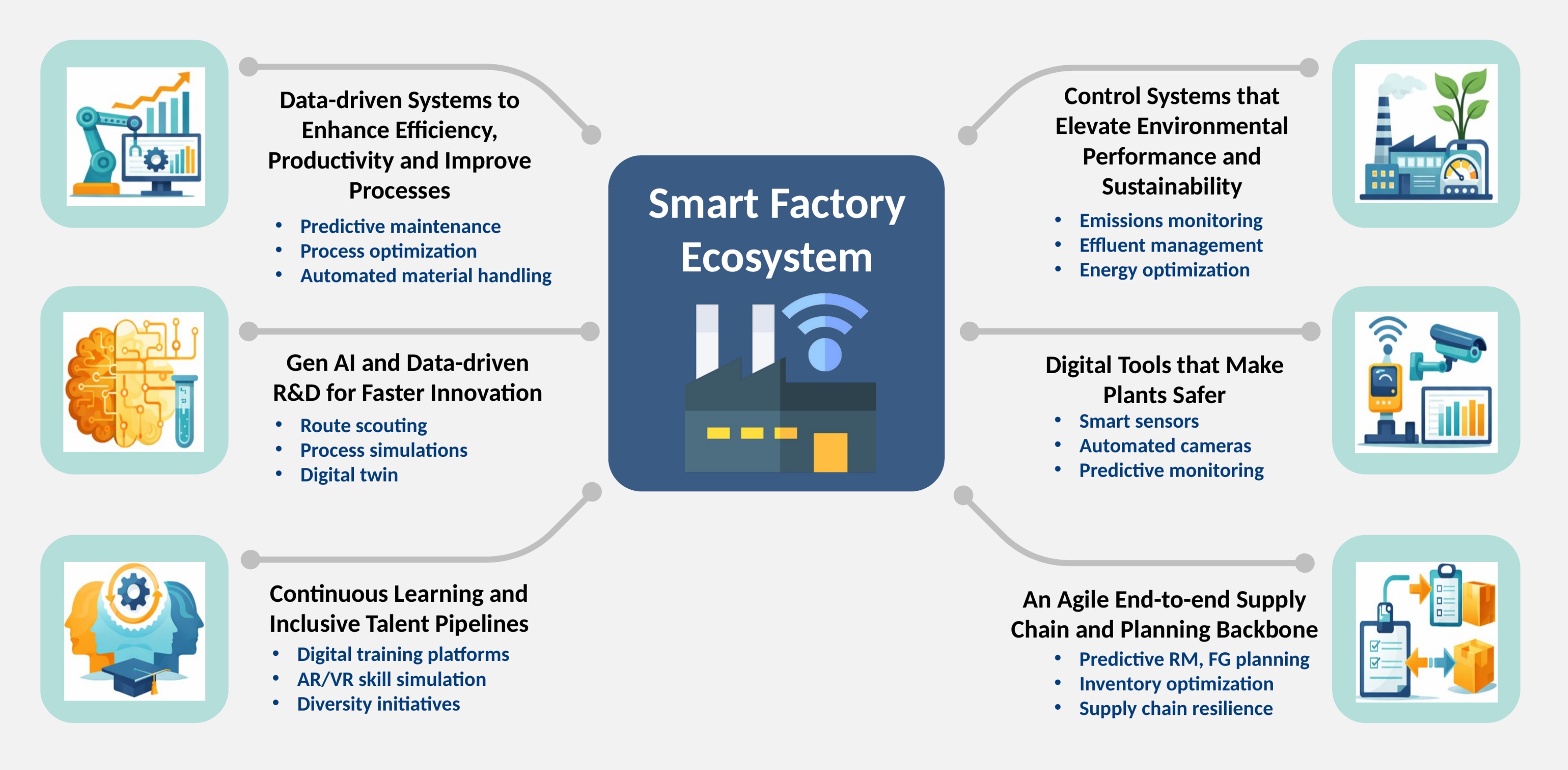
The Smart Factory Ecosystem is not just a collection of digital tools deployed at individual plants. It is the company's integrated digital architecture, creating continuous feedback loops between operations, R&D, supply chain, sustainability and people systems.
While every organization may be at a different stage of this journey, Jubilant's interpretation is to build the ecosystem deliberately, block by block:
- 1. Data-driven systems to enhance efficiency, productivity and improve processes. AI and automation maximize yields, improve energy efficiency and streamline material movement for higher productivity.
- 2. Control systems that elevate environmental performance and sustainability. Advanced monitoring reduces effluents and greenhouse gas emissions, aligning plants with sustainability goals.
- 3. Gen AI and data-driven R&D for faster innovation. Generative AI and simulations accelerate product development, enabling quicker commercialization and scale-up.
- 4. Digital tools that make plants safer. Smart sensors, automated cameras and predictive monitoring create safer, more reliable operating environments.
- 5. Continuous learning and inclusive talent pipelines. Digital training and diversity programmes build resilient workforces and foster inclusive excellence.
- 6. Agile end-to-end supply chain and planning backbone. Predictive models and real-time planning optimize raw material costs and maintain optimal inventory levels.
Embedding digital capabilities across legacy and new plants
Gajraula, one of the organization's largest and oldest manufacturing facilities, is an integrated site for specialty chemicals and intermediates with over 25 plants, seven multipurpose units and highly complex batch and continuous processes spanning kilogram to kiloton-scale production. This complexity presents a strong case for digital transformation across both brownfield and greenfield environments.
Over the last three years, the transformation spanning 10+ molecules, 30+ use cases and 50+ cross-functional members generated over $5 million in annualized value, while driving scalable adoption and continuous improvement. Beyond monetary benefits, significant reductions in steam and energy consumption, coupled with enhanced safety through sensors, interlocks and digital monitoring, have earned global sustainability and safety recognitions for the organization.
As the world's largest producer of a key molecule, manufactured at Gajraula, and the only scaled non-Chinese player globally with leadership across 35+ derivatives, maintaining this market position required continuous improvement at scale. This made digital and AI-led transformation of the legacy manufacturing plant a strategic imperative. The resulting interventions delivered significant economic and environmental impact, as highlighted below.
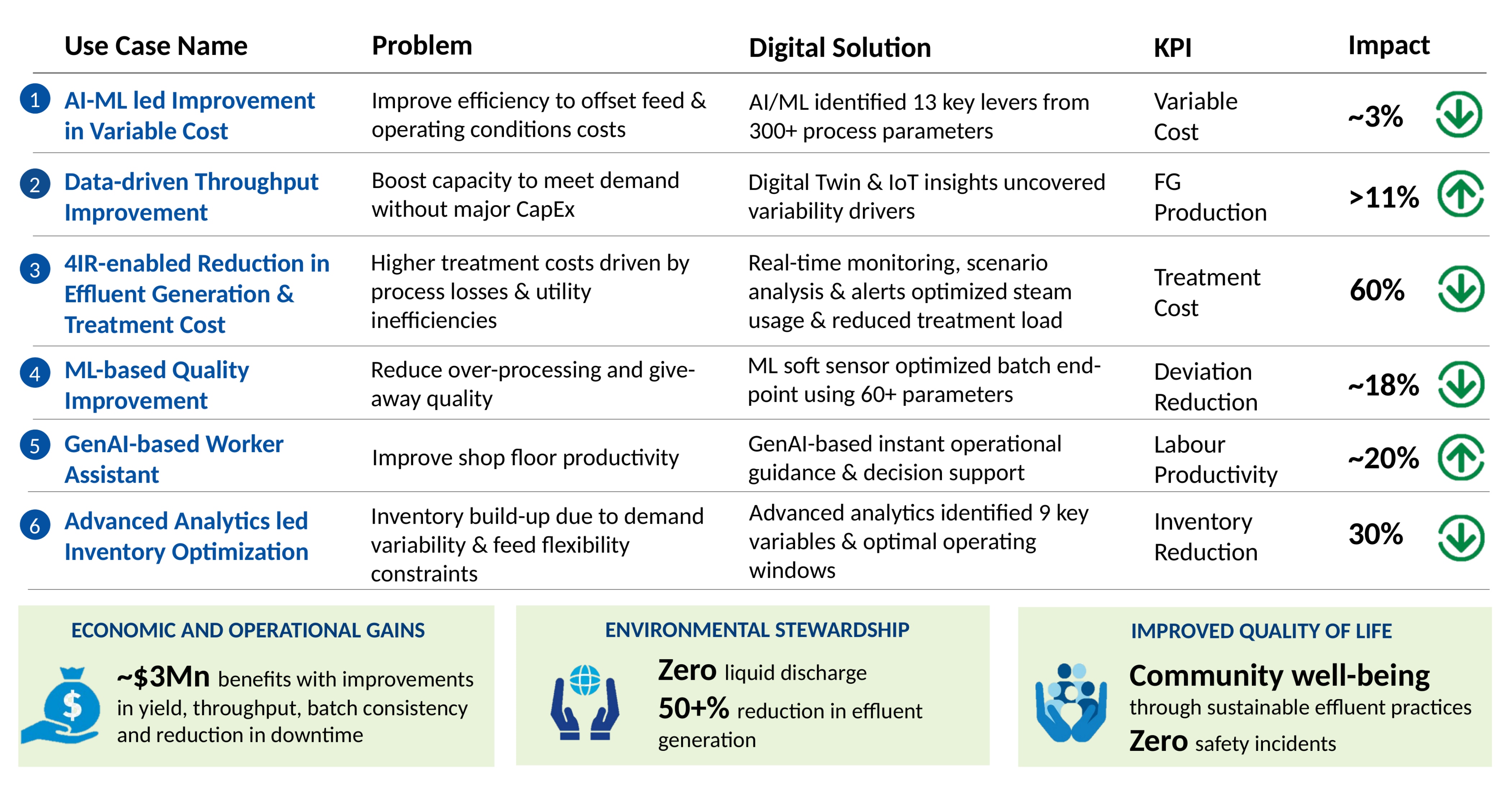
Use cases proven at Gajraula have been replicated across other plants and sites. The upcoming Multi-Purpose Plant (MPP8) is being designed as a smart factory from inception. From data-driven material handling, process analytical technologies, intelligent batch execution and predictive maintenance to AI-enabled workforce development, MPP8 is embedding adaptable, next-generation manufacturing capabilities into its design, operations and culture.
The new playbook for competitive advantage
The evidence is increasingly clear: integrated, end-to-end transformation programmes are becoming a source of competitive advantage across industries, especially in chemicals, where value depends on complex, interdependent operations. Companies embracing these capabilities are achieving 10-20% higher production output, 7-20% workforce productivity gains and up to 15% additional capacity without significant capital investment. Jubilant's Smart Factory Ecosystem is one expression of this frontier; many Global Lighthouse Network stories reflect the same end-to-end shift across sectors:
- Schneider Electric has combined real-time environmental monitoring with circular-economy practices and resource optimization to boost sustainability and operational performance.
- Engro Polymer & Chemicals has deployed advanced process control and digital twin technologies to enable agile, data-driven and resilient operations.
- Johnson & Johnson, through Project Agent Alpha, has harnessed generative AI to integrate multi-echelon inventory optimization and process mining, creating a synchronized supply chain.
Winning companies will no longer treat digital as a standalone initiative or a series of disconnected site projects. They will integrate operations, sustainability, innovation, supply chains and talent at enterprise scale, underpinned by trusted data, connected infrastructure, governance, leadership and continuous learning.
By sharing proven approaches, the Forum’s community can accelerate measurable gains in growth, resilience, innovation and talent. As volatility becomes the norm, holistic transformation at scale will distinguish tomorrow’s leaders.
Don't miss any update on this topic
Create a free account and access your personalized content collection with our latest publications and analyses.
License and Republishing
World Economic Forum articles may be republished in accordance with the Creative Commons Attribution-NonCommercial-NoDerivatives 4.0 International Public License, and in accordance with our Terms of Use.
The views expressed in this article are those of the author alone and not the World Economic Forum.
Stay up to date:
The Digital Economy
Related topics:


Forum Stories newsletter
Bringing you weekly curated insights and analysis on the global issues that matter.
More on Technological InnovationSee all

Allison Dadoun
September 24, 2026