What we can learn from Switzerland's approach to mobility
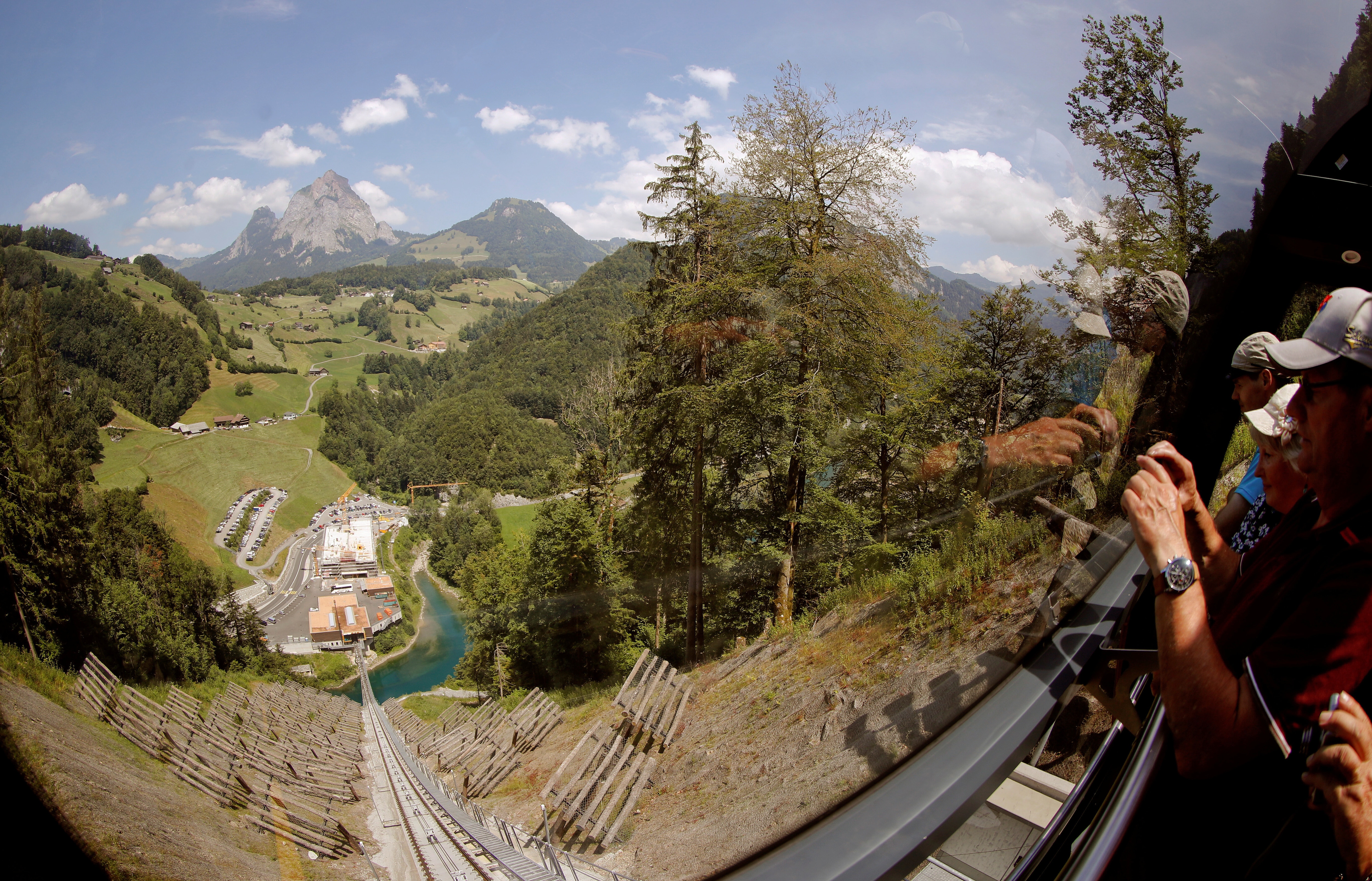
Public transport is part of everyday life in Switzerland. Image: REUTERS/Arnd Wiegmann
- Switzerland is often celebrated for its railways and engineering.
- But its greatest transport innovation may be how it treats constraint as a catalyst for innovation.
- So how did this country defined by mountains, limited land and ambitious climate goals become a living laboratory for mobility innovations?
Switzerland’s Stoosbahn is the steepest funicular in the world. Ascending 1,300 metres up a mountain to the car-free village of Stoos, at points it travels at a dizzying 110% gradient – a near-50-degree angle. Not that this affects its passengers who are kept upright at all times by spherical cabins that adapt perfectly to the incline.
This feat of engineering is just one example of Switzerland’s pioneering approach to public transport. The country is considered an international leader in mobility that turns challenges – such as 70% of its territory being mountainous – into innovation.
It has turned geographical constraints, societal factors and climate goals into a blueprint for mobility innovation that holds lessons for other nations seeking to make public transport more accessible and sustainable.
A history of mobility milestones
From trains and buses to boats and mountain railways, public transport is woven into the fabric of daily life in Switzerland and almost half of Swiss people have a season ticket to use it. To understand how the country arrived here, we need to look back.
If the Swiss didn’t quite move mountains to overcome the geographical challenges they faced, they did the next best thing. The country had Europe’s first mountain railway, which began operating in 1871.
Eleven years later, the 15-kilometre-long Gotthard tunnel opened, removing a significant obstacle between northern and southern Europe and transforming Switzerland from a mountainous barrier into a connector of trade.
Fast-forward to a decade ago, and the Gotthard Base Tunnel slashed travel times on this route even further. At 57.1km it is the longest and deepest rail tunnel in the world, and it allows trains to run almost twice as fast as the old tunnel.
It's not just about breaking records, though – it’s about tangible, sustained progress. Switzerland has continued to invest steadily in public transport, and sustainability is at the heart of many decisions.
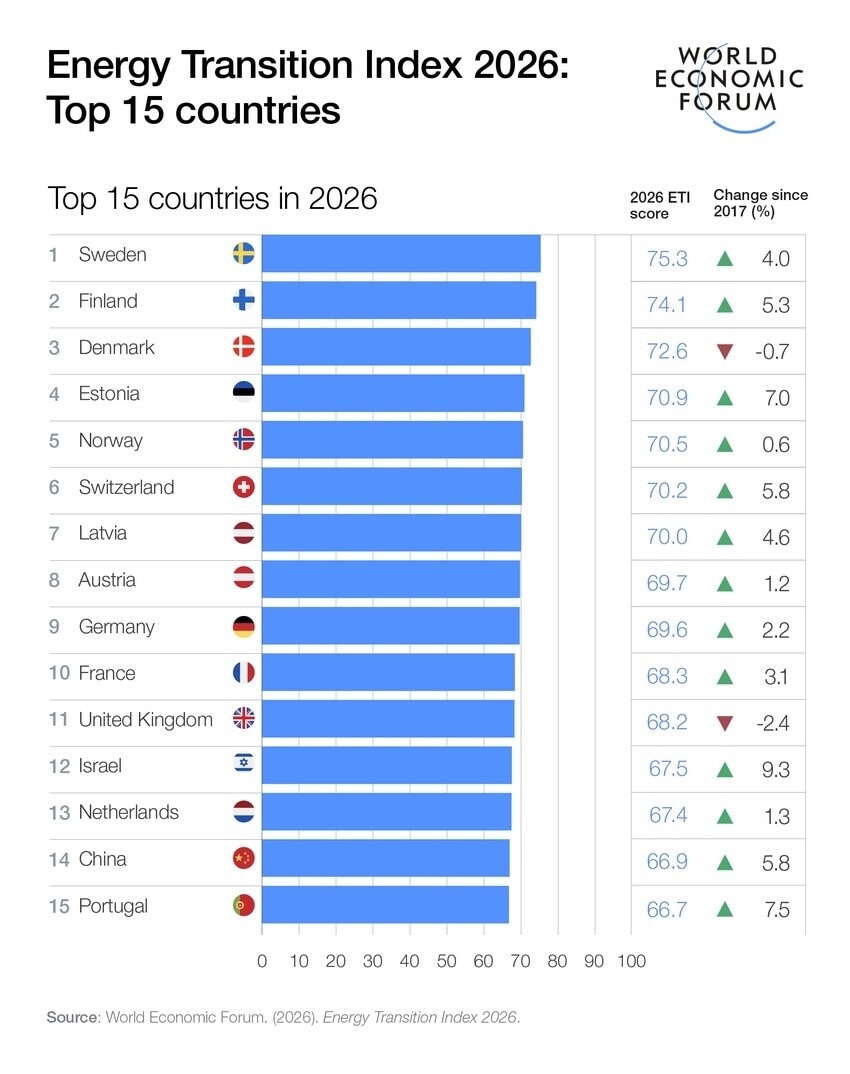
The country – a global top-10 leader on clean energy, according to the Forum’s latest Energy Transition Index – has committed to reducing its greenhouse gas emissions by at least 65% by 2035 compared to 1990 levels. This includes reducing emissions from the transport sector by 41% by the same year (excluding international aviation).
Sustainable transport innovation: from solar rail to fuels made from sunlight
Here too, Switzerland has pedigree. For example, coal shortages in the Second World War prompted large-scale electrification of the federal rail network (SBB), which continued apace after the conflict until the last SBB steam locomotive was retired in 1967. Today, the network is almost completely electrified and SBB trains run on 100% renewable energy.
The PostBus company, which has more than 800 bus routes across the country, is also turning journeys electric with the aim of going fossil-fuel free by 2035.
There are many other examples of sustainable transport innovation. In a country with a series of deep, sprawling lakes, boats are another key method of transport. On Lake Lucerne, the Lake Lucerne Navigation Company is preparing to run a historic steamship on a climate-neutral fuel made from sunlight.
Swiss start-up MobyFly – a World Economic Forum Technology Pioneer – meanwhile, has created a battery-powered hydrofoil boat that uses less energy than an electric bicycle – up to 70% less energy than current diesel ferries.
And the country boasts the world’s first ‘solar railway’. Installed last year near the village of Buttes in western Switzerland, start-up Sun-Ways has put solar panels in the space between train tracks that the company says could generate 2% of the country’s electricity if rolled out to the entire rail network.
Interconnectivity at the heart of everything
Innovation across many modes of transit has helped the Swiss build what is the world’s densest public transport network.
But what has really made Swiss mobility a success is how everything links together. It is also a highly interconnected network, with trains, buses, boats and mountain railways consolidated into a single timetable-coordinated system.
This integrated timetabling – called the taktfahrplan, or “clock-face timetable” – makes it possible to travel from a busy airport to a remote mountain village without worrying about multiple tickets or disjointed schedules.
All public transport operates at regular, reliable intervals and is perfectly coordinated – and it is possible to get almost anywhere using a single ticket and a single app to coordinate journeys. This means, for example, that you could travel in a cable car down from a remote mountain village to find your train to a major city already waiting for you.
This simple ticketing and more equitable access to public transport has helped build the social licence needed to get more people using public transport. As a result, the Swiss population travels the most kilometres by train per capita in Europe each year.
Switzerland also tops the table of countries with the highest average monthly revenue per public transport user.
Purpose over profit? A fundamental public service
The fixed timetable has been in use for more than 40 years, but the Swiss continue to invest in mobility, with sustainability, digitalization and efficiency at the heart of plans.
Challenges remain. Despite the ease and popularity of public transport, two thirds of all trips in Switzerland are still made by private car on roads that remain heavily subsidized. Motorists pay just a flat CHF40 "vignette" for up to 14 months of unlimited motorway use, a cost campaigners argue is disproportionately low compared with rising rail fares. And meeting growing demand while decarbonizing mobility is stretching the limits of many public transport systems.
Crucially, Swiss citizens vote directly on many of these infrastructure decisions and the funding mechanisms behind them. In November 2024, voters narrowly rejected a government plan to expand key motorway sections by 52.7%, citing cost and environmental concerns. As a result, ETH Zurich was commissioned to analyse and assess the expansion projects and prioritize roughly 500 planned road, rail and urban projects worth CHF 113 billion. The resulting "Transport 2045" blueprint, unveiled in 2026, scraps more than 30 motorway projects while committing roughly CHF 24 billion to rail expansion.
Despite these challenges, the Swiss model offers lessons for other countries looking to create more integrated and sustainable networks. Strong government backing is key to both innovation and public support. Viewing public transport as a fundamental public service – with more than 250 transport companies working together – ensures a network that considers purpose as well as profit, with benefits for both the economy and citizens' quality of life.
Bypassing siloed innovation to treat progress at a systems level that considers better timetabling, smarter vehicles and rolling stock and cleaner energy as vital to solving the same problem, Switzerland is quietly but consistently building the public transport network of the future.
How is the World Economic Forum promoting sustainable and inclusive mobility systems?
License and Republishing
World Economic Forum articles may be republished in accordance with the Creative Commons Attribution-NonCommercial-NoDerivatives 4.0 International Public License, and in accordance with our Terms of Use.
The views expressed in this article are those of the author alone and not the World Economic Forum.
Related topics:

Forum Stories newsletter
Bringing you weekly curated insights and analysis on the global issues that matter.
More on Built Environment and InfrastructureSee all

Lucas Gobatti
September 4, 2026


