To build an AI-ready workforce, look beyond traditional universities

From short-term coding bootcamps to applied degrees, community colleges deliver flexible, employer-aligned training for workers navigating technological shifts. Image: X/Unsplash
- Community colleges and polytechnics are crucial for building an inclusive, AI-ready global workforce.
- US initiatives like NAAIC show how public-private partnerships keep AI training current and scaled.
- Governments should fund these adaptive institutions as a core pillar of tech and economic policy.
Experts still debate the timeline and scale of AI’s labour market disruption, but there is growing recognition that governments must prepare. In a recent open letter, 16 Nobel laureates and more than 200 economists and AI researchers urged policy-makers to place AI’s economic impact more squarely at the centre of their priorities.
The most ambitious AI policy proposals are still taking shape, but one step is available now: shore up the public education and training institutions that can carry workers from today’s economy into tomorrow’s. This step will help ensure this latest wave of the industrial revolution strengthens the global middle class.
If upskilling and reskilling stop at secondary schools and traditional universities, these efforts will fall short. One of the most underappreciated tools for fostering AI literacy and talent is the open-access institution that sits between secondary school and university.
In North America, they’re called community or technical colleges. Elsewhere, they’re called polytechnics, further education colleges or junior colleges. Over 24 distinct institution types comprise this sector of postsecondary education globally, from Singapore to Switzerland. These institutions focus on employer needs, applied learning and regional access to jobs that require more than a secondary education but less than a university degree.
They deliver affordable, practical training through applied degrees, short-term credentials, apprenticeships, bootcamps and work-based learning. Because they serve everyone from recent graduates to working adults reskilling mid-career, and because they open a path to university, they are ideally suited to worker transitions in the AI era.
We already see this capacity in action across OECD nations, where an average of 42% of upper secondary students are enrolled in vocational programmes, and STEM is the most popular field in short-cycle tertiary education. Disadvantaged students enroll in vocational tracks at a higher rate than their advantaged peers, and women make up about 44% of vocational education graduates.
Investing in community college capacity for AI education
To manage AI’s labour market impact, governments worldwide must invest in the capacity of these institutions. America’s more than 1,000 community colleges already play a critical role in meeting AI workforce needs and supporting innovation-industrial policies meant to spark tech-based growth around emerging technologies.
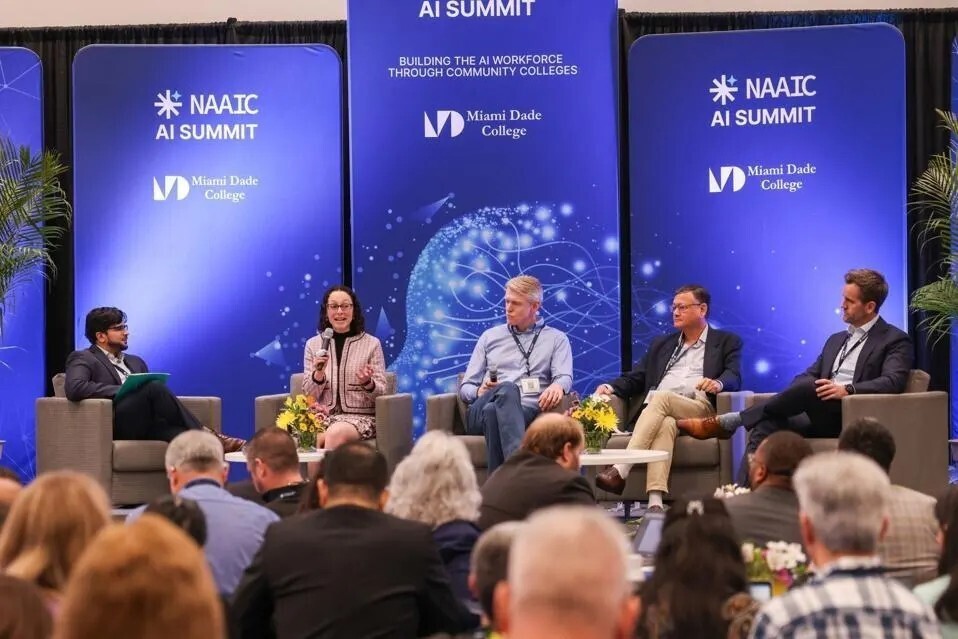
Through the National Science Foundation (NSF), the government is modernizing these colleges to expand AI literacy, education and upskilling. NSF-funded initiatives like the National Applied AI Consortium (NAAIC), led by Miami Dade College, Maricopa Community College District and Houston City College, offer other governments a good model to follow.
NAAIC is a community of practice run by and for community colleges, working closely with industry to build their capacity for AI education and workforce development. It aggregates AI curricula and learning materials, runs mentorship programmes among colleges and trains instructors to teach at the field’s frontier. So far, it has upskilled more than 2,000 faculty and staff across over 300 institutions in nearly every US state.
Google, Microsoft, OpenAI and Intel have all partnered with NAAIC, offering a suite of resources of their own. At the consortium’s annual conference in February, Intel’s Global Director and Head of Digital Readiness Programs, Anshul Sonak, credited NSF investments in initiatives like NAAIC. “NSF has done a good job in really building out industry partnerships with higher education around AI. This has been key.”
How governments can help
Policy-makers play a crucial role in helping community colleges build this capacity. In recent testimony before the US Congress, I outlined priorities for strengthening AI training that apply to institutions worldwide. These recommendations draw on research insights from initiatives like NAAIC and the Accelerator for Community Colleges in the Innovation Economy – a programme my team at New America launched alongside the National Science Foundation to prepare workers for emerging tech sectors.
They include modernizing data infrastructure so colleges can pair labour market information alongside improved models for industry feedback to track fast-changing jobs and skills; creating a sustainable process to keep instructors current in AI and other emerging fields; and scaling work-based learning like internships, co-ops and apprenticeships.
They also point to a need to upgrade physical facilities, partner with NGOs and social safety net providers, and improve regional coordination among secondary schools, universities, labour unions, industry associations and local government, which has been another key investment thrust for the NSF and US AI workforce strategy.
These capacity-building investments will pay off well beyond AI. Community college investments are key to the bioeconomy, quantum ecosystems, the clean energy transition and the global care economy.
Learning across borders
Colleges need not do this alone. With funding from Cognizant and the Cyril Taylor Charitable Foundation, the Association of Community College Trustees (ACCT), which represents more than 6,500 trustees across 1,000 colleges globally, has piloted a way for institutions worldwide to learn from one another.
In 2025, ACCT mapped the global landscape of community colleges. Today, its “Global Workforce Coalition” is connecting US community colleges and their international counterparts not only to expand study abroad opportunities but also to advance workforce development in partnership with industry. The coalition has already supported cohorts of community colleges from the United States, India and the United Kingdom to collaborate with industry in sectors like electric vehicle technology and sustainable construction.
The coalition is increasingly focused on incorporating AI across a range of programmes, from nursing to mechatronics. “International exchanges accelerate innovation by giving us access to ideas, partnerships and practices we wouldn’t have developed in isolation,” Amit B. Singh, President of Edmonds College, shared with me. “AI is transforming every economy, so learning from global peers helps us move faster and make better decisions.”
Technological progress alone will not always guarantee shared prosperity. Nations that invest in community colleges and their equivalents will hedge against the inequality risks posed by AI disruption, ensure that their middle classes can reap more of the rewards of the AI zeitgeist, and meet the talent needs of jobs today and tomorrow. Strengthening community college-style institutions should be seen as a core pillar of global tech policy.
Don't miss any update on this topic
Create a free account and access your personalized content collection with our latest publications and analyses.
License and Republishing
World Economic Forum articles may be republished in accordance with the Creative Commons Attribution-NonCommercial-NoDerivatives 4.0 International Public License, and in accordance with our Terms of Use.
The views expressed in this article are those of the author alone and not the World Economic Forum.
Stay up to date:
Education and Skills


Forum Stories newsletter
Bringing you weekly curated insights and analysis on the global issues that matter.
More on Artificial IntelligenceSee all

Ariel Kastner, Miriam Schive, Sannan Pervaiz and Jessica Margolis
October 2, 2026


