4 lessons from young people on the frontlines of the Nepal-Tibet floods
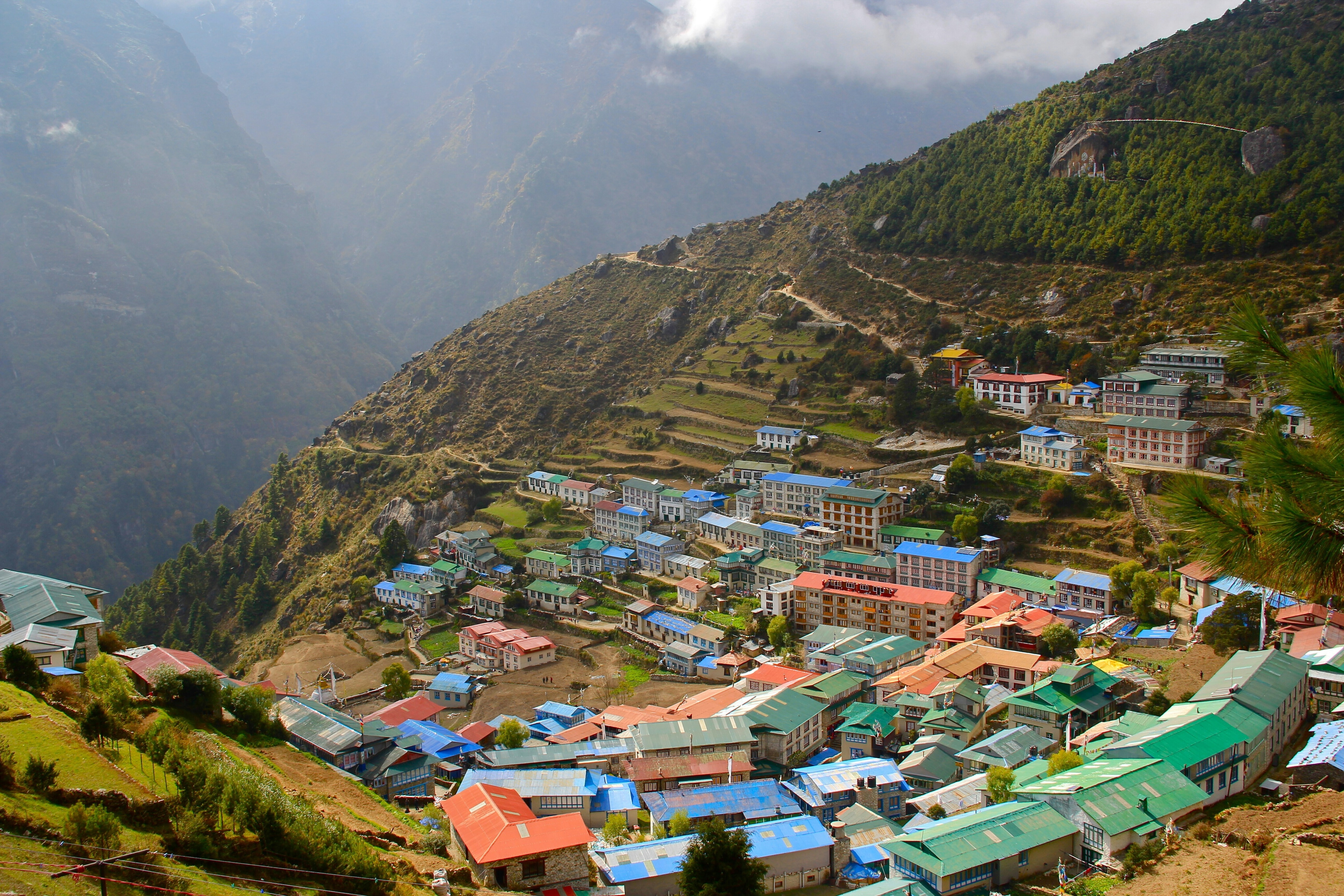
Namche Bazar, Namche, Nepal. As Nepal recovers from major flooding, forward-looking disaster response efforts could help build resilience for communities across the country. Image: Unsplash/KalleKortelainen
- Recent flooding in Nepal has led to over 1,300 deaths and the destruction of many homes and communities.
- This situation – and others around the world – show the increasingly urgent need for communities to be able to anticipate extreme weather events.
- Young responders in Nepal's flood-hit valleys are working to close disaster response gaps, affecting climate resilience policy in the process.
On 26 August 2026, an ice-and-rock avalanche blocked a tributary of the Bhotekoshi River on the Nepal-China border. When the natural dam gave way, the flood crossed into Nepal within minutes, devastating the districts of Rasuwa, Nuwakot and Dhading over the next 10 hours. By early September, the confirmed death toll had passed 1,300, with more than 5,000 people still missing.
When I worked alongside the relief operations in the Kathmandu Valley, it became evident that this disaster is not merely a localized humanitarian tragedy. It is a severe test of how prepared the global community is for a warmer, volatile climate.
Disaster response lessons
For policymakers and world leaders, four profound lessons from the youth-led response to this disaster show how climate resilience can be built before disaster strikes.
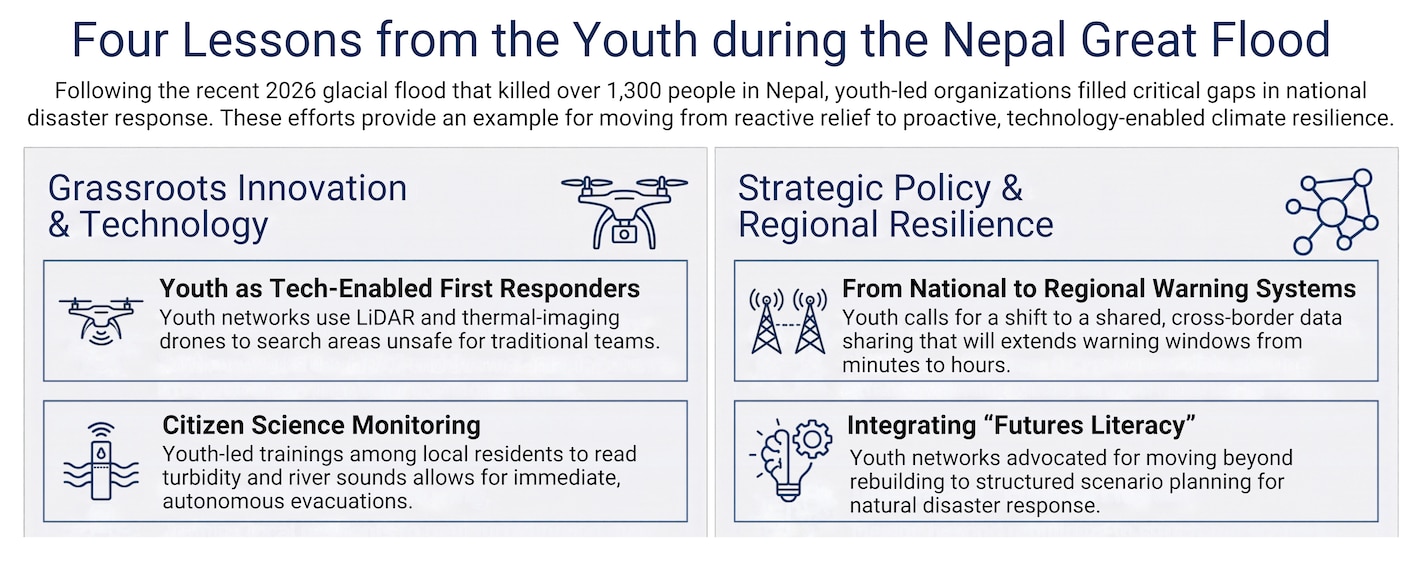
1. Young people can be trained, technology-enabled first responders
While the army and police cleared mud from Nepal’s collapsed hydropower tunnels, a separate response was already under way. Young volunteers organized clean water distribution, food supply chains and other support across displacement camps.
Young people from Nepal's Drone Association and surveyance innovation hub Geovation Nepal worked together using LiDAR (light detection and ranging – remote sensing technology that uses laser light). This helped them measure debris depth and they also used thermal-imaging drones to search hillsides, caves and flooded tunnels that rescue teams could not safely enter. Hami Nepal, a youth-led civic organisation, formed its own drone team alongside the police and army.
This reflects years of investment in youth-led disaster networks. The Global Shapers Community's Kathmandu Hub, active since 2012, raised over $500,000 to build a school and two health clinics after a 2015 earthquake. It now leads local resilience planning.
Young engineers and geomatics engineering students’ community also contributed to a Humanitarian OpenStreetMap Team (HOT) Tasking Manager, which coordinated a critical humanitarian mapping response.
Across Asia-Pacific, UNESCO's U-Inspire Alliance connects young engineers, scientists and technologists with disaster-risk-reduction work, including in Nepal.
These networks show youth should be treated as a technical resource in disaster planning, not just as volunteers once a crisis begins.
2. Early warnings should come from a shared regional system, not a national one
The flood originated entirely on the Tibetan side of the border, outside Nepal's monitoring network until it was already crossing. Nepal's nearest river gauge recorded the surge then stopped transmitting minutes later, likely destroyed by the flood itself. Even so, national authorities issued more than 600,000 SMS alerts to downstream residents within 10 minutes of receiving confirmation.
This shows the alert system works well once data reaches it. The deeper problem is that the data often does not reach because a hazard can originate beyond any single country's instruments. Cloudbursts and glacial lake outburst floods (GLOFs) do not respect national borders.
The International Centre for Integrated Mountain Development has long argued that Hindu Kush Himalaya early warnings need to be AI-driven and shared in real time among Nepal, China, India and Bhutan. This disaster illustrates the cost of that gap. Binding, cross-border data-sharing would extend the warning window from minutes to hours, saving many lives across all of these territories.
3. Citizen science can take monitoring where formal systems cannot reach
No national disaster agency can monitor every tributary across Nepal's mountainous terrain. But the Institute of Himalayan Risk Reduction has worked to close that gap through community-based, citizen-science monitoring. Its VICTORY project, developed with Smartphones for Water Nepal and the Asian Disaster Preparedness Center, trains residents of Nepal's flood-prone Bardiya and landslide-prone Dolakha municipalities to record the signals that often precede a hazard such as rising cloudiness in the water, unusual river sounds and shifting slopes.
This type of initiative should be scaled across the region so that the hyper-localized data can be collected from the region. Communities trained this way do not need to wait for an alert that may never arrive if networks are down. They can read the signs themselves and organize an evacuation on local knowledge alone.
In a basin where conditions can turn dangerous within an hour, this training can be the difference between a community that moves in time to avoid the worst of a natural disaster and one that does not.
4. Anticipation should become part of how communities plan for resilience
Most disaster response is, by necessity, backward-looking: bridges are rebuilt and shelters are replaced, with the cycle repeating after each new event.
UNESCO has spent over a decade developing an alternative called Futures Literacy. This initiative provides the capacity to imagine and prepare for multiple possible futures rather than simply reacting to the last crisis. In fact, the World Economic Forum has named futures literacy one of the core skills needed to navigate a period of rapid, compounding global change.
Applied to the Himalaya region, this means running structured scenario-planning exercises with local leaders now. This should cover covering faster glacier melt, more frequent GLOFs and the possible relocation of at-risk settlements.
Nepal needs to rebuild what the flood destroyed, but it also needs a generation of leaders, backed by international partners, that are able to anticipate what comes next and design for it in advance.
Closing the disaster response knowledge gap
Flooding of this kind is likely to recur across the Himalayas as glacial melt accelerates.
What is less certain is whether the region's warning systems, youth networks and planning frameworks will be ready. If not, each response will depend on how fast volunteers and communities can improvise.
Policymakers, international institutions and investors have an opportunity to close that gap now – before the next disaster, not after it.
Don't miss any update on this topic
Create a free account and access your personalized content collection with our latest publications and analyses.
License and Republishing
World Economic Forum articles may be republished in accordance with the Creative Commons Attribution-NonCommercial-NoDerivatives 4.0 International Public License, and in accordance with our Terms of Use.
The views expressed in this article are those of the author alone and not the World Economic Forum.
Stay up to date:
Humanitarian Action
Related topics:


Forum Stories newsletter
Bringing you weekly curated insights and analysis on the global issues that matter.
More on Climate Action and Waste Reduction See all

Parag Khanna and Eric White
September 24, 2026