12 startups scaling innovation to unlock low-carbon and circular systems
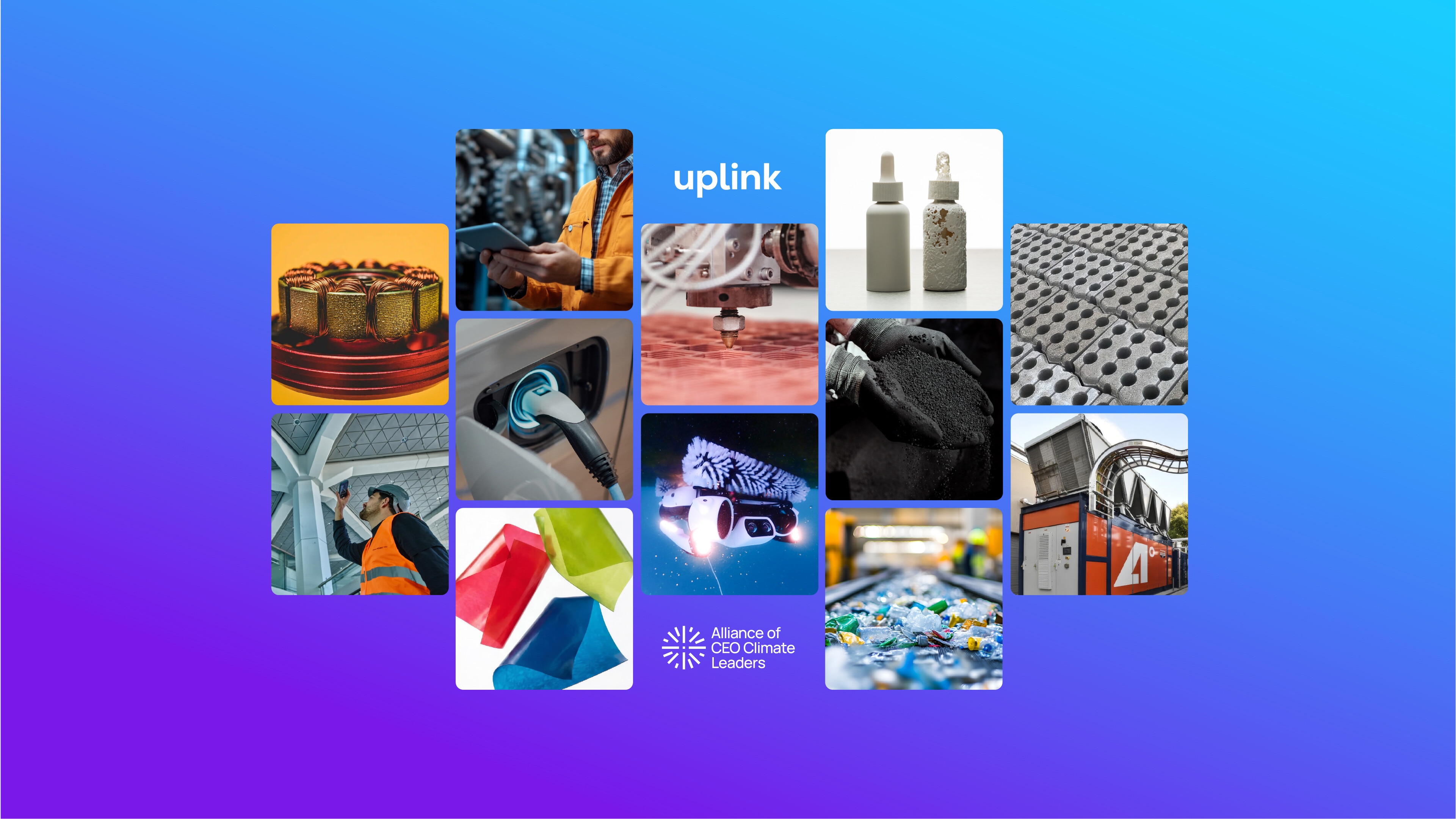
The UpLink Low-Carbon and Circular Systems Challenge winners provide innovative solutions that unlock decarbonization and circular transformation simultaneously. Image: WEF
- With inefficiency still baked into global economic systems, circular strategies remain a vital means of decarbonization.
- The UpLink Low-Carbon and Circular Systems Challenge aims to identify and scale innovative solutions that enable circular transformation across value chains.
- The 12 winners target areas from furniture to ship hulls, batteries to leather substitutes.
Imagine these scenarios: A robot that grooms ship hulls, saving 2.7 million litres of diesel. An AI material-tracking platform that reduces deconstruction costs by up to 30% and material costs by up to 20%. 3D-printed interior products made from a circular recycling process. What do they all have in common? Decarbonization and circularity – which are fundamentally deeply interconnected.
Circular strategies are a critical lever for upstream and downstream Scope 3 decarbonization, while also enhancing resource efficiency, resilience (including adaptation to supply disruptions), and long-term competitiveness and growth. The reduction of Scope 3 upstream and downstream emissions remains a key priority for businesses, including those of the Alliance of CEO Climate Leaders, where they account for around 87% of the alliance's aggregate emissions (approximately 5.05 gigatonnes).
While investment in the green economy now exceeds $5 trillion annually and many low-carbon technologies are scaling globally, emissions remain deeply embedded in complex, material-intensive value chains. Addressing them requires not only technological deployment, but also a stronger understanding of market dynamics, economics and regulatory conditions across geographies.
At the same time, global economic systems remain resource-intensive and inefficient, with most materials not cycled back into the economy. This drives environmental impact and economic loss. Circular approaches, such as reducing material use, extending product life cycles and increasing the use of secondary materials, offer an opportunity to improve resource productivity, lower emissions and strengthen supply chain resilience.
While a significant share of emissions can be reduced with existing and emerging technologies, adoption remains uneven. Advanced technologies, including AI, can accelerate this transition by enabling greater visibility, optimization and decision-making in complex systems.
The UpLink Low-Carbon and Circular Systems Challenge aims to identify and scale innovative solutions that unlock decarbonization and circular transformation simultaneously across value chains. In particular, the challenge was designed around three focus areas: intelligence, data and decision-making; low-carbon products, processes and operations; and circular products, materials and systems.
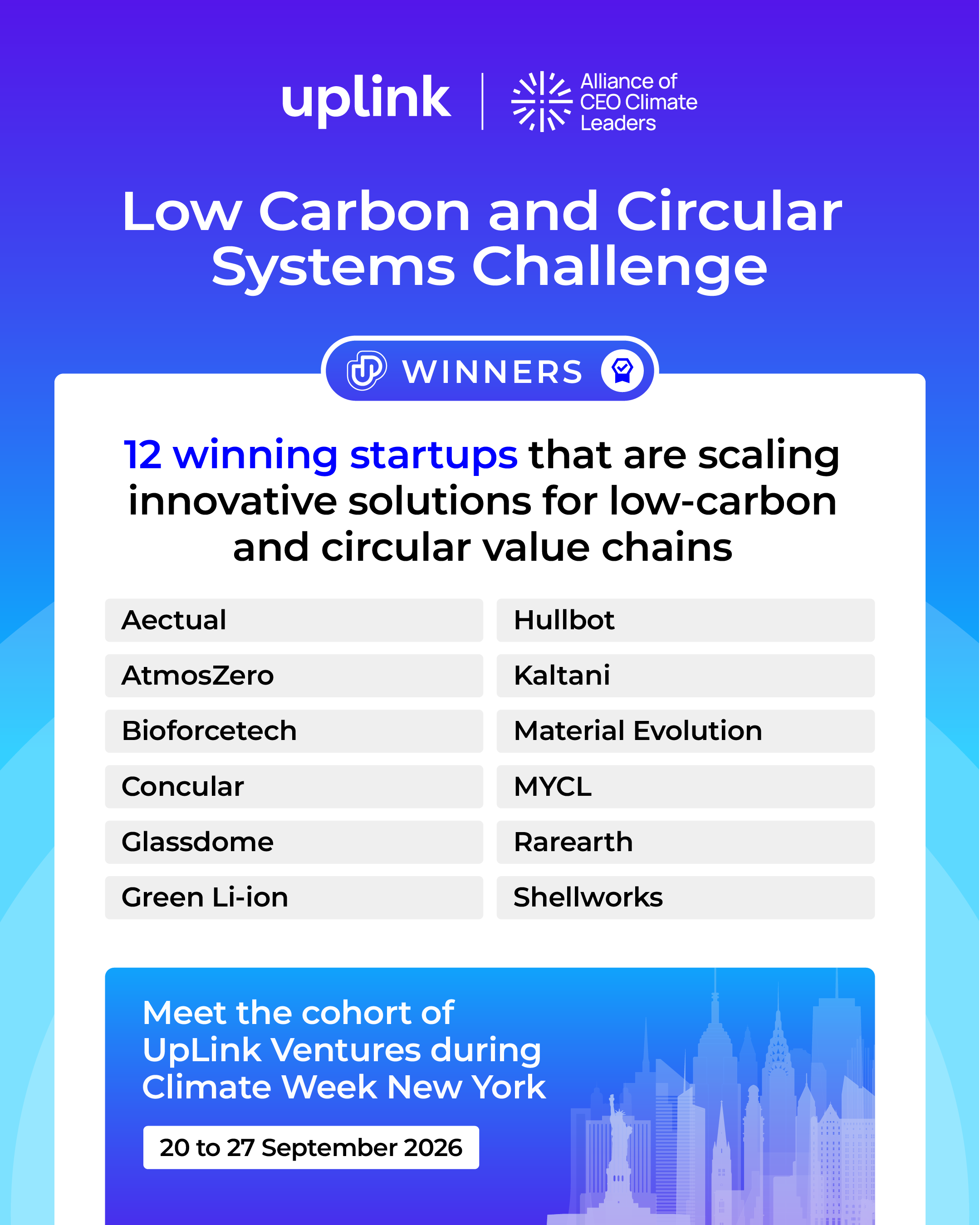
From 153 submissions, 12 winners stood out for their entrepreneurial solutions. Spanning Europe, North America, Asia-Pacific and Africa, 33% are female-led, more than double the roughly 15% global average for tech startups.
Here are all 12 of the Challenge winners, known as UpLink Ventures:
Intelligence, data and decision-making
1. Aectual
Directly advances material circularity and Scope-3 decarbonization in the built environment via made-to-measure interior finishes and furniture produced from recycled waste streams with a take-back, shredding and re-printing loop, via XL 3D printing using recycled waste materials.
2. Concular
Reduces deconstruction costs by up to 30% and material costs by up to 20% by using their platform that helps turn demolished building materials into reusable inventory through digital material tracking, smart AI matching and logistics hubs.
3. Glassdome
Provides an integrated carbon management platform that collects factory and enterprise data, and automates carbon calculations and reporting. The solution is already used by leading manufacturers, including LG Electronics, KGM (KG Mobility) and Samsung SDI.
Low-carbon products, processes and operations
4. AtmosZero
A modular industrial steam boiler uses patented heat pump technology to turn heat from air or water into clean steam, fitting into existing facilities with minimal disruption. Each factory-built 1MW unit is designed to scale easily and use a safer, low-impact refrigerant.
5. Hullbot
Designs, builds and deploys underwater robots for ship-hull grooming to reduce fuel use and emissions. The company serves the ferry and shipping markets, has seven contracted fleets, and reports cumulative reductions through August of 2.7 million litres of marine diesel and 8.4 million kgCO2e.
Produces two products: MevoCem, a clinker-free cement replacement, and MevoXL, an accelerator for high-SCM cement. These products replace or sharply reduce traditional cement in concrete, cutting emissions without changing how builders work.
Circular products, materials and systems
7. Bioforcetech
Using a supercharged compost process, an on-site system dries wastewater sludge and converts it in an oxygen-free reactor into a stable carbon-negative material for concrete, pigments and polymers. The process recycles its own heat, helping plants eliminate disposal costs and PFAS (forever chemicals), and close waste loops.
8. Green Li-ion
Modular on-site plants turn battery waste into battery-grade materials, including pCAM (precursor cathode active material), in as little as eight to 10 hours while cutting transport, cost and emissions. A patented four-step process works across major lithium-ion battery types without sorting, enabling efficient local recycling at commercial scale.
9. KALTANI
A circular economy and climate infrastructure company that collects, sorts, recycles and converts waste into biochar, plastic feedstocks and refuse-derived fuel, supported by the TrashBash digital platform. KALTANI also earns carbon and plastic credits, creating multiple revenue streams from cleaner waste management.
“Better than leather” – MYCL develops mycelium-based leather (Mylea™), seaweed-based biopolymer sheets and mycelium composites using agri-crop waste, mycelium and seaweed extracts for fashion and industry.
11. Rarearth
Produces 100% European permanent magnets by recycling end-of-life magnetic components and industrial scrap into rare-earth magnets for sectors like EVs, wind and healthcare. The company reduces Europe’s dependence on imported magnets via a short-loop recycling process.
12. Shellworks
Makes VIVOMER, a plant waste-derived biomaterial that replaces petrochemical plastic in consumer packaged goods. It is produced by fermentation, moulded into multiple formats, and integrates with existing plastic manufacturing.
These 12 winners of the Low-Carbon and Circular Systems Challenge demonstrate that solutions for decarbonization and circularity are possible and are already happening. These solutions prove that private sector innovation and collaboration can unlock transformative climate impact.
By scaling these approaches, companies can move beyond incremental change to deliver the systemic shifts needed for a net-zero, resilient global economy. Over the coming months, the Challenge winners have an opportunity to scale their impact through UpLink's Innovation Network in order to respond to the challenges we face and help achieve a low-carbon and circular future.
The World Economic Forum’s Alliance of CEO Climate Leaders brings together 125+ CEOs committed to achieving net-zero emissions and delivering ambitious, science-based climate targets. Together, member companies have a combined emissions footprint of around 5.6 gigatonnes – equivalent to roughly 10% of global emissions.
The World Economic Forum’s Circular Economy Transformation initiative convenes leaders from more than 100 businesses and 50 governments, alongside civil society and academia, to accelerate the circular economy transition across sectors and geographies, supporting a system shift towards resilient supply chains and efficient resource use.
UpLink, the World Economic Forum’s early-stage innovation initiative, is enabling and accelerating the purpose-driven entrepreneurs who are essential for a net-zero, nature-positive and equitable future. To find out more and join the UpLink community, click here.
Don't miss any update on this topic
Create a free account and access your personalized content collection with our latest publications and analyses.
License and Republishing
World Economic Forum articles may be republished in accordance with the Creative Commons Attribution-NonCommercial-NoDerivatives 4.0 International Public License, and in accordance with our Terms of Use.
The views expressed in this article are those of the author alone and not the World Economic Forum.
Stay up to date:
Circular Economy


Forum Stories newsletter
Bringing you weekly curated insights and analysis on the global issues that matter.
More on Climate Action and Waste Reduction See all

Simon Zadek and Eric White
September 23, 2026